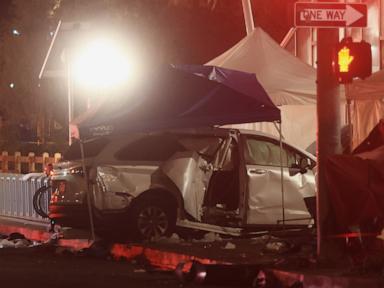
Seven seconds.
That is all it takes for a routine Tuesday errand on a sun-bleached Los Angeles sidewalk to dissolve into sirens, yellow crime scene tape, and three white sheets draped over the concrete.
When official dispatches report that three people are dead in Los Angeles after a driver crashed into pedestrians, the news cycle processes the tragedy like a weather alert. A headline flashes across a screen. Commuters check their traffic apps to see which boulevard is blocked, sigh at the ten-minute delay, and reroute down a parallel street. By Thursday, the skid marks fade into the oil-stained gray of the asphalt, and the city moves on.
But the sidewalk remembers. And if you have ever stood at the edge of a six-lane arterial road in Southern California—waiting for a tiny white walking figure to illuminate while two-ton machines scream past your kneecaps at fifty miles an hour—you know that these crashes are not freak accidents. They are the predictable math of a city built for velocity at the expense of human fragility.
Consider a hypothetical morning on a stretch of asphalt like Venice Boulevard or Western Avenue. Let us invent a composite figure to stand in for the thousands of Angelenos who navigate this concrete gauntlet every day—call him Mateo. Mateo is fifty-four, wears scuffed work boots, and carries a canvas bag with a thermos of coffee and a wrapped sandwich. He does not own a car. Every morning, he walks four blocks to catch the Metro bus, stepping off the curb at the exact same crosswalk where he has stood for eleven years.
To Mateo, the crosswalk is a social contract. The painted white stripes on the ground represent an agreement between the person on foot and the person behind the wheel: I will wait my turn, and you will not kill me.
Two hundred yards away, inside a climate-controlled cabin of steel, glass, and airbags, sits another composite figure—let us call her Elena. She is running twelve minutes late for a shift across town. Her dashboard glows with navigation prompts. Her phone buzzes in the cupholder. She is driving a modern mid-size SUV, a vehicle engineered to absorb tremendous kinetic energy and protect its occupants inside a reinforced safety cage. Because the road ahead is wide, flat, and straight—designed with the generous lane widths of a suburban highway—her brain registers forty-five miles per hour as a crawl.
Then comes a fractional lapse. A glance down at a notification. A sudden swerve to avoid a double-parked delivery van. A patch of gravel near the gutter.
Physics does not care about intent. When a four-thousand-pound vehicle traveling at forty-five miles per hour leaves its lane and mounts a six-inch concrete curb, the kinetic energy released is equivalent to falling from a seven-story building. Against that force, human bone and tissue offer zero resistance. Three people standing near a bus shelter—people who woke up that morning thinking about groceries, rent, or an afternoon doctor's appointment—are erased before they even hear the screech of tires.
The Illusion of the Painted Line
I still remember the first time I truly understood how thin the margin of survival is on a Los Angeles street. Years ago, while walking home from a late shift in Koreatown, a sedan jumped the curb less than fifteen feet behind me, shearing a steel parking meter clean off its base before slamming into a brick storefront. The sound was not the dramatic screech you hear in movies. It was a dull, sickening thud followed by the tinkle of safety glass and the hiss of a punctured radiator. My knees shook so violently I had to sit on a concrete stoop for twenty minutes before I could walk the remaining two blocks.
That moment stripped away an illusion most of us carry every day: the belief that a six-inch curb and two lines of thermoplastic paint constitute a physical barrier.
In reality, urban planners call these painted crosswalks "administrative controls." Think of it like putting a "Caution: Wet Floor" sign next to an open elevator shaft. The sign warns you of the danger, and it assigns legal blame after someone falls, but it does nothing to stop gravity. When Los Angeles officials announce another fatal pedestrian crash, the public conversation almost immediately narrows to individual morality. Was the driver drunk? Were they speeding? Were they texting?
Those questions matter for criminal prosecution, and they matter to grieving families demanding accountability. Yet focusing exclusively on the driver's behavior misses the larger, deadlier truth. Human beings are fallible. Across a county of ten million people making millions of trips a day, someone will always be distracted, exhausted, medical-emergency-stricken, or reckless. A safe system assumes human error will happen and designs the environment so that a mistake does not carry a death sentence.
Los Angeles did the exact opposite for seventy years.
How We Engineered a Killing Floor
To understand why pedestrian fatalities in Los Angeles remain stubbornly, devastatingly high, you have to look at the blueprints drawn in the mid-twentieth century. Following World War II, traffic engineers treated city streets like plumbing. Their sole metric of success was "level of service"—a bureaucratic euphemism for how quickly cars could move from point A to point B without stopping.
Trees were cut down to widen lanes. Sidewalks were shaved narrow to add right-turn slip lanes. Corners were rounded off with sweeping radii so drivers could whip around turns without tapping their brakes. Every visual cue told the human brain to go faster.
Think about how you drive down a narrow, tree-lined residential street with cars parked on both sides. Instinctively, you slow down to twenty miles per hour because your peripheral vision registers friction—tight spaces, potential obstacles, human scale. Now compare that to driving down Olympic Boulevard, Figueroa, or Sepulveda. Four lanes in each direction, wide enough for a commercial airliner, synchronized green lights stretching to the horizon, and utility poles set back from the road. Even when the posted speed limit says thirty-five, the architecture of the street screams fifty-five.
And speed is the single decisive variable between a bruise and a body bag.
Data from traffic safety researchers across the globe confirms a brutal exponential curve. When a pedestrian is struck by a car traveling at twenty miles per hour, the risk of severe injury or death is roughly ten percent. At thirty miles per hour, that risk climbs to forty percent. By the time a vehicle reaches forty miles per hour, the fatality rate exceeds eighty percent. Add the modern American shift toward towering pickup trucks and heavy SUVs—vehicles with high, blunt front grilles that strike an adult in the chest and head rather than the legs—and the survival odds plummet even further.
The Invisible Geography of Grief
There is a cruel socioeconomic map layered directly over the asphalt of Southern California, and anyone who spends time riding the bus or walking these corridors can see it with their own eyes.
Walk through Beverly Hills or the residential pockets of Santa Monica, and you find shaded sidewalks, bulb-out curbs that shorten crossing distances, flashing beacons, and speed humps. Now take a bus down South Figueroa, Vermont Avenue, or Van Nuys Boulevard. Here, the asphalt widens, the shade disappears, and the pedestrian traffic multiplies.
The people waiting at unprotected bus stops along these high-speed corridors are disproportionately low-income workers, seniors, schoolchildren, and immigrants—residents who rely on transit and their own two feet because owning, insuring, and fueling a car in California is financially out of reach. Nationally, Black and Hispanic pedestrians are killed by drivers at significantly higher rates than white pedestrians, a disparity driven not by genetics or culture, but by neighborhood infrastructure. The fastest, widest, least forgiving roads cut straight through working-class communities.
When three people die on a Los Angeles sidewalk, we are rarely looking at an isolated tragedy. We are looking at the predictable outcome of decades of disinvestment in the places where people actually walk.
Officials often point to public awareness campaigns—billboards reminding pedestrians to wear bright clothing at night, or flyers urging drivers to "Watch for Walkers." While well-intentioned, these campaigns quietly shift the burden of survival onto the most vulnerable person in the equation. Telling a seventy-year-old grandmother carrying groceries to "make eye contact with drivers" before crossing a six-lane boulevard is absurd when tinted windshields and glaring sun make eye contact impossible.
The Architecture of Survival
It does not have to be this way, and we know that because other cities—and even scattered pockets of Los Angeles itself—have already proved the alternative works.
In 2015, Los Angeles launched Vision Zero, an ambitious initiative borrowed from Sweden built on a simple, radical premise: no loss of life on city streets is acceptable. The plan identified the "High Injury Network"—just six percent of the city's streets that account for roughly sixty-five percent of all pedestrian deaths and severe injuries. The roadmap was clear. Narrow the lanes. Install concrete pedestrian refuge islands in the middle of wide boulevards. Synchronize traffic signals to give walkers a five-second head start before cars get a green light. Build protected bike lanes that act as a physical buffer between moving traffic and the sidewalk.
Yet nearly a decade later, the death toll barely budged—and in several recent years, pedestrian fatalities actually climbed to multi-decade highs.
Why did the promise stall? Because real street safety requires taking space away from cars, and in Los Angeles, touching a single lane of traffic or a dozen parking spaces ignites political warfare. Whenever engineers propose a "road diet"—converting a dangerous four-lane speedway into two travel lanes, a center turn lane, and protected bike lanes—vocal minorities pack city council meetings. They argue it will ruin businesses, trap emergency vehicles, and turn their commute into gridlock.
Politicians flinch. Projects get watered down from concrete barriers to cheap plastic bollards that SUVs flatten within a week. Meanwhile, the High Injury Network stays wide, fast, and lethal.
Look at what happens when cities refuse to flinch. Hoboken, New Jersey—a dense, bustling city across the river from Manhattan—went seven consecutive years without a single traffic death. How? Not through tougher lectures or louder sirens, but through concrete and geometry. They painted curbs yellow near intersections so parked cars couldn't block sightlines, narrowed lanes to physically force drivers to slow down, and raised crosswalks to sidewalk level so cars had to drive up and over them like speed bumps.
Geometry works twenty-four hours a day. A concrete bollard does not get tired, does not look away from its post, and does not care if a driver is in a rush. When a car loses control on a street protected by steel-reinforced concrete planters and raised curbs, the metal crumples against the barrier, and the family waiting for the bus walks home alive.
What Remains After the Sirens Fade
Whenever news breaks of another multi-fatality crash in Los Angeles, readers naturally ask what happens next. Police tape off the block for six to eight hours while specialized collision investigators measure skid marks, pull data from the vehicle's event data recorder, and canvass nearby businesses for security footage. If impairment, street racing, or gross negligence is uncovered, prosecutors file felony vehicular manslaughter charges.
For the driver, life fractures into court dates, legal fees, and the permanent psychological weight of having ended three lives in a matter of heartbeats.
For the families of the victims, the aftermath is an endless, echoing void. A bouquet of white lilies and a few tall glass prayer candles appear tied to a streetlight pole near the crash site. Friends stop by for a week or two, standing awkwardly on the narrow concrete while eighteen-wheelers rumble past inches from their backs, blowing dust into their eyes. Within a month, the flowers wither in the California heat, the wax melts onto the pavement, and the city sanitation crew sweeps the glass away.
Nothing on the street changes. The lanes remain twelve feet wide. The signal timing stays geared toward moving suburban commuters through the neighborhood as fast as possible. Tomorrow morning, another person carrying a thermos of coffee will step up to that exact same curb, look both ways into the glare of the rising sun, and place their life in the hands of strangers hurtling toward them at fifty miles an hour.
Next time you pass a faded bundle of plastic flowers zip-tied to a utility pole on a Los Angeles boulevard, do not look at it as a memorial to bad luck. Look at the width of the asphalt beside it, and ask yourself who that street was built to protect.