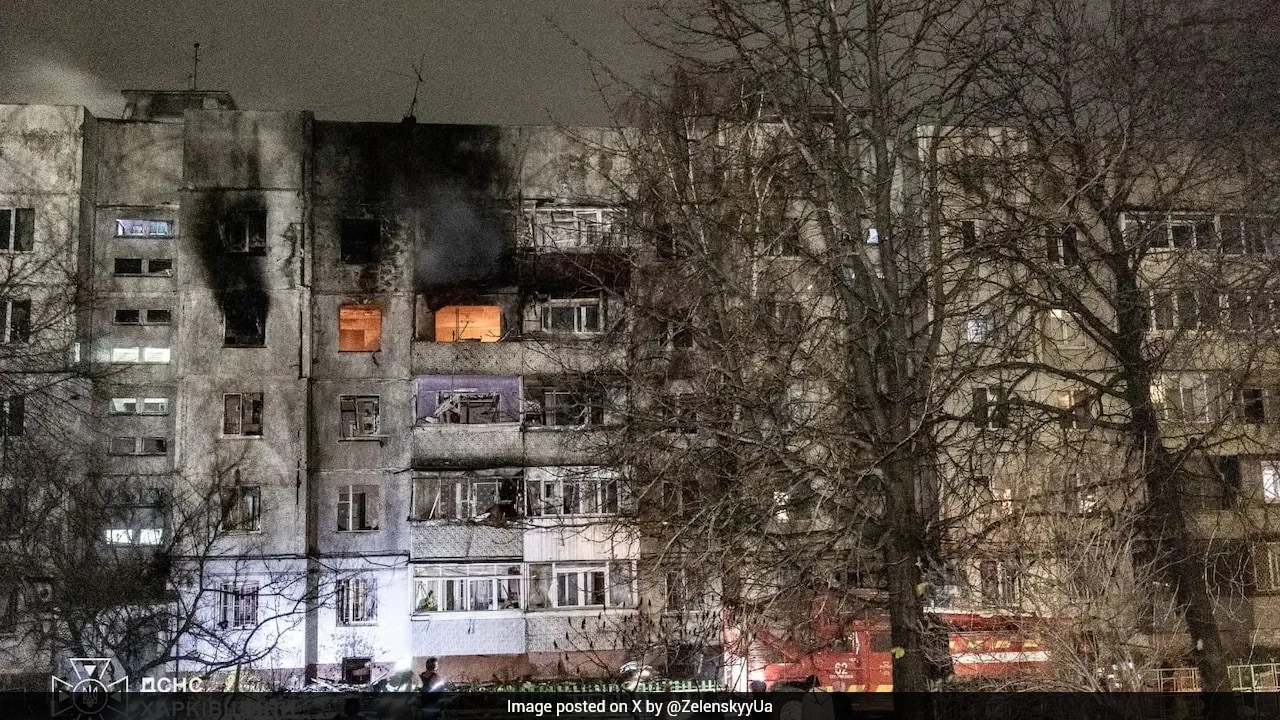
Standard reporting on localized kinetic strikes—such as the Russian bombardment of Ukrainian President Volodymyr Zelensky’s hometown of Kryvyi Rih that killed two people and injured sixty—typically stops at casualty counts and immediate emergency response metrics. That surface-level framing obscures the operational calculus driving the attack. A strike inflicting a thirty-to-one injury-to-fatality ratio on a major industrial and symbolic urban center is not an isolated tactical anomaly; it is a deliberate execution of asymmetric attrition designed to degrade civilian morale, saturate municipal emergency infrastructure, and force the reallocation of scarce air defense assets away from the active front line.
The Structural Logic of Symbolic and Industrial Targeting
To understand why Kryvyi Rih remains a recurring target throughout the conflict, analysts must separate the city’s political symbolism from its material utility. Standard media narratives emphasize the city's status as President Zelensky’s birthplace, framing strikes primarily as psychological messaging. While psychological pressure is a measurable variable in modern warfare, reducing the targeting matrix to symbolism ignores the city’s physical footprint and industrial output.
Kryvyi Rih is an elongated urban corridor stretching roughly 120 kilometers from north to south, making it one of the longest cities in Europe. This extreme linear geometry creates specific vulnerabilities and operational realities for both the attacker and the defender:
- Air Defense Perimeter Dilution: Protecting a compact, circular municipality allows air defense batteries to establish overlapping engagement zones with minimal radar dead spots. Covering a 120-kilometer linear axis requires either significantly more interceptor batteries or leaves industrial and residential sectors exposed to low-altitude cruise missiles and ballistic trajectories.
- Dual-Use Industrial Density: The city serves as the core of Ukraine’s iron ore mining and steel production complex. Even when munitions strike adjacent residential districts or administrative buildings, the proximity to heavy metallurgy and rail logistics creates persistent operational disruption for the broader defense industrial base.
- Psychological Proximity to Leadership: Targeting the executive branch's home municipality forces political leadership to absorb localized domestic pressure while managing theater-wide strategic allocations. The attacker seeks to create a perceived divergence between the security of the capital and the vulnerability of regional industrial hubs.
Deconstructing the Casualty Ratio and Munition Dynamics
The specific casualty profile of the strike—two fatalities alongside sixty injuries—provides critical forensic insight into the weapon systems employed and the structural environment of the impact zone. In urban warfare analysis, the ratio of wounded-in-action (WIA) or injured civilians to killed-in-action (KIA) acts as a proxy for munition yield, fusing mechanics, and warning lead times.
High-explosive fragmentation warheads detonating in dense urban environments typically generate a wide radius of secondary projectiles—shattered glass, spalled concrete, and twisted structural steel. When an air raid alert provides even a three-to-five-minute warning window, civilians move away from exterior windows and into interior corridors or reinforced basements. This behavioral shift dramatically compresses the lethal radius of the blast wave while leaving a large population vulnerable to secondary trauma, acoustic shock, and minor fragmentation injuries.
Conversely, a near-zero warning window—characteristic of short-range ballistic missiles fired from occupied territories in southern Ukraine—catches populations in transit or near glass facades. The resulting sixty injuries represent an immediate, acute strain on local trauma centers, blood banks, and emergency medical transport, far exceeding the logistical burden imposed by fatalities alone.
The Cost Function of Municipal Saturation
Military planners evaluate urban strikes not merely by physical destruction, but by the downstream resource drain imposed on the defender's state apparatus. Every high-casualty event triggers a multi-tiered emergency response cascade that consumes finite state capacity:
- Immediate Triage and Medical Depletion: Processing sixty trauma patients simultaneously requires rapid mobilization of surgical teams, diagnostic imaging, and pharmaceutical reserves. Repeated strikes force regional hospitals to maintain surge capacity permanently, degrading routine healthcare delivery across the entire Dnipropetrovsk Oblast.
- Municipal Repair and Utility Stabilization: Blast waves compromise gas mains, electrical substations, and district heating networks. Diverting heavy engineering equipment and specialized technicians to clear rubble and restore residential glazing slows the repair of critical energy infrastructure elsewhere in the grid.
- Investigative and Administrative Overhead: Documenting war crimes, processing state compensation claims for damaged housing, and managing internal displacement consume administrative bandwidth at the municipal level.
The Air Defense Allocation Dilemma
The central strategic tension exposed by strikes on Kryvyi Rih is the zero-sum geometry of Ukrainian air defense. Ukraine operates a layered, heterogeneous air defense network combining Soviet-era systems with Western-supplied batteries. Because the total inventory of interceptors and launchers is strictly finite, every deployment decision carries an immediate opportunity cost.
If the General Staff positions advanced ballistic-capable systems—such as Patriot or SAMP/T batteries—to shield Kryvyi Rih from short-range ballistic threats, those same systems cannot protect maneuvering brigades on the eastern front, nor can they defend electrical generation facilities in central Ukraine. Russian operational planners exploit this exact trade-off. By maintaining a steady cadence of strikes against secondary urban centers, Moscow forces Kyiv into an unenviable optimization problem: accept intermittent civilian casualties and localized infrastructure damage in the rear, or thin out frontline air cover and expose maneuver forces to glide bombs and reconnaissance drones.
Ballistic Trajectories vs. Interceptor Economics
The physics of intercepting ballistic threats over southern and central Ukraine compounds this resource asymmetry. Unlike subsonic cruise missiles or one-way attack drones, which can be engaged by mobile fire groups using heavy machine guns, autocannons, or short-range surface-to-air missiles, ballistic missiles travel at hypersonic terminal velocities along steep trajectories.
Neutralizing a ballistic threat requires high-end hit-to-kill interceptors. The unit cost of these interceptors often exceeds the manufacturing cost of the incoming ballistic munition, and global production rates for advanced Western interceptors remain constrained by industrial bottlenecks. Expending two high-tier interceptors to defeat a single incoming missile protects immediate lives, yet doing so repeatedly depletes strategic magazines faster than allied supply chains can replenish them.
Asymmetric Information Operations and Narrative Friction
Beyond physical and economic attrition, strikes on Kryvyi Rih serve a distinct informational function aimed at both domestic Ukrainian audiences and external Western backers. Standard news coverage rarely connects these kinetic events to the broader information environment, treating the strike and subsequent diplomatic statements as separate developments.
Domestically, persistent vulnerability in major cities tests social cohesion and trust in local and national governance. While initial waves of bombardment often harden public resolve—a phenomenon documented across historical strategic bombing campaigns from the London Blitz to the War of the Cities—prolonged, multi-year attrition introduces cumulative psychological fatigue. When air raid sirens sound multiple times daily and residential blocks suffer recurring damage, economic activity contracts as businesses struggle to retain staff and insure physical assets.
Internationally, the attacker calculates that repetitive reporting of mid-scale casualty events—two dead, sixty wounded—produces desensitization among foreign publics and policymakers. By calibrating strikes below the threshold that triggers immediate, massive Western policy shifts, while maintaining enough frequency to demonstrate sustained offensive capability, Moscow seeks to normalize the conflict's background violence and erode external political will for sustained military aid.
Operational Limitations of Punitive Urban Bombardment
A rigorous strategic assessment must account for why this campaign fails to achieve decisive operational outcomes despite its tactical lethality. Historical and empirical evidence demonstrates clear ceilings on what long-range strikes against urban centers can accomplish without a corresponding breakthrough on the ground.
- Absence of Political Capitulation: Across modern military history, aerial bombardment of civilian population centers has consistently failed to compel political surrender. Rather than forcing the Ukrainian leadership to accept unfavorable territorial concessions, strikes on the President's hometown reinforce the existential framing of the war and harden diplomatic positions.
- Industrial Adaptation and Decentralization: Heavy industry in Kryvyi Rih has adapted to persistent threat conditions through decentralized power generation, hardened control rooms, and rapid repair protocols. While output fluctuates during acute grid outages, the core industrial capacity remains functional.
- Accelerated Allied Air Defense Integration: High-profile strikes on civilian areas serve as empirical justification for Ukrainian diplomats lobbying for additional air defense systems, expedited interceptor deliveries, and relaxed restrictions on deep-strike capabilities against Russian launch sites.
Strategic Counter-Measures and Force Posture Adjustments
Mitigating the impact of recurring strikes on Kryvyi Rih and similar regional hubs requires shifting from purely reactive point defense to a distributed, multi-domain denial strategy. Relying solely on terminal interception is mathematically unsustainable given current magazine depths and production timelines.
First, military and municipal authorities must prioritize passive civil defense hardening across high-density urban corridors. Constructing modular, reinforced concrete shelters at transit hubs, markets, and residential courtyards directly reduces the injury-to-fatality multiplier by shielding civilians from secondary glass and structural fragmentation during short-warning ballistic attacks.
Second, air defense architecture must incorporate expanded electronic warfare (EW) and decoy networks around major industrial zones. While EW cannot deflect a purely inertial ballistic missile in its terminal phase, spoofing satellite navigation degrades the circular error probable (CEP) of dual-mode guidance systems, shifting impacts away from dense residential blocks and critical utility nodes.
Finally, the only durable solution to short-range ballistic and reconnaissance-strike complexes threatening southern and central Ukraine is upstream suppression. Force allocation must prioritize long-range counter-battery fires, deep-strike unmanned systems, and intelligence, surveillance, and reconnaissance (ISR) assets dedicated to hunting mobile transporter-erector-launchers (TELs) and munitions depots in occupied territory before launch sequences occur. Defeating the archer at the point of origin remains the sole method to break the cost-exchange asymmetry of urban attrition.