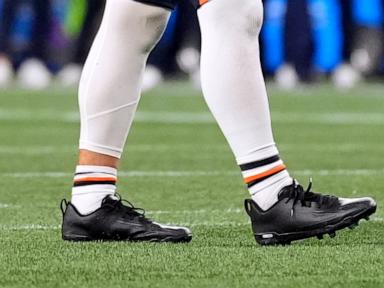
When Chicago Bears quarterback Caleb Williams takes the field wearing cleats from a challenger brand rather than an incumbent athletic conglomerate, the event represents an asymmetric customer acquisition play rather than a standard celebrity endorsement. Incumbent footwear manufacturers rely on high-fixed-cost capital allocation, signing dozens of elite athletes to multi-year, multi-million-dollar exclusivity contracts to lock out shelf space and broadcast visibility. A smaller entrant cannot win a bidding war on those terms. Instead, it must exploit the structural blind spots of the dominant players by targeting high-leverage visibility nodes—specifically, the starting quarterback of a major-market NFL franchise—where the ratio of media impressions to capital outlay reaches its mathematical peak.
Understanding this dynamic requires stripping away the romanticized narrative of the underdog brand and examining the unit economics, NFL uniform compliance constraints, and supply chain mechanics that govern on-field product placement.
The Structural Economics of Challenger Footwear Endorsements
In professional football, footwear operates as a unique asset class within sports marketing. Unlike jerseys, helmets, or sideline apparel—which are locked under exclusive league-wide licensing agreements with single manufacturers—cleats remain an open market for individual player endorsements, provided the footwear adheres to strict league branding and color-way regulations. This regulatory carve-out creates an entry point for challenger brands.
Capital Efficiency and the Quarterback Multiplier
To evaluate the efficiency of placing a product on Caleb Williams, one must analyze the impression distribution of an NFL broadcast. Camera framing during a standard offensive snap isolates the quarterback from the pre-snap cadence through the release of the ball, and frequently during post-play replays. Offensive linemen, linebackers, and defensive backs share frame space; the quarterback commands focal isolation.
For a small footwear company, this creates an extreme divergence between Cost Per Thousand Impressions (CPM) and Customer Acquisition Cost (CAC):
- Broadcast Isolation: Every drop-back, scramble, and sideline cutaway generates high-definition, slow-motion close-ups of the athlete’s lower extremities, particularly when footwork mechanics are analyzed by broadcast commentators.
- Zero-Media-Buy Distribution: Traditional digital advertising requires continuous auction bidding on platforms like Meta or Google, where CAC scales linearly or exponentially with competition. An on-field appearance during a nationally televised Bears game bypasses ad auctions entirely, injecting the brand directly into cultural circulation via sports journalism, social media highlight clips, and local beat reporting.
- Credibility Transfer: Consumers treat athlete footwear differently than lifestyle apparel. A quarterback’s cleats are mission-critical performance equipment. If an elite prospect trusts a small manufacturer with his ankle stability, traction, and lateral deceleration on turf, the market infers technical competence without the brand needing to fund multi-year biomechanical white papers.
Incumbent Blind Spots and Portfolio Bloat
Legacy footwear giants suffer from portfolio bloat. When an incumbent manages hundreds of NFL athletes alongside massive NBA, global football, and Olympic rosters, its marketing bandwidth and product customization pipelines become congested. Top-tier quarterbacks at legacy brands still receive custom lasts (the foot-shaped molds around which shoes are built), yet they remain one asset among dozens competing for flagship campaign budgets.
A challenger brand operates with singular focus. It can offer an athlete direct equity participation, rapid prototyping cycles measured in weeks rather than seasonal quarters, and undisputed flagship status. The economic trade-off for the athlete is clear: forfeit guaranteed upfront cash from a legacy giant in exchange for equity upside, creative control, and custom engineering tailored precisely to their biomechanics.
Operational Mechanics of On-Field Visibility
Securing an athlete's commitment is only the initial phase. Converting on-field visibility into sustainable revenue requires navigating institutional friction and execution bottlenecks that routinely sink undercapitalized apparel startups.
Navigating the NFL Uniform and Equipment Policy
The NFL enforces rigorous equipment standards under its official Uniform and Equipment Rules. A small brand cannot simply hand a player a prototype and expect it to clear pre-game inspection.
- League Approval and Trademark Clearance: Footwear manufacturers must register with the league and pay licensing fees to display visible logos on game day. If a small brand has not cleared the league's commercial licensing threshold, the athlete is required to tape over or obscure the logo—a practice known as "spatting" or blacking out—which destroys visual attribution during broadcasts.
- Color-Way Compliance: Every cleat worn during a game must match the team's designated base color (white, black, or an approved primary team color) with accent colors strictly limited to the franchise's official palette. Custom color-ways require advance submission and approval from the league office to avoid uniform violations and escalating player fines.
- Safety and Cleat-Plate Certification: The league monitors stud length, material composition, and structural integrity to mitigate turf-related lower-extremity injuries. Challenger brands must verify that their outsoles meet performance standards across both natural grass (such as Soldier Field's Kentucky bluegrass) and synthetic slit-film or monofilament turf systems.
The Supply Chain and Direct-to-Consumer Bottleneck
The primary failure mode for challenger brands experiencing sudden viral exposure is inventory stockout combined with premature scaling. When a high-profile quarterback wears an unfamiliar cleat on Sunday afternoon, search volume spikes immediately, peaking within a four-to-six-hour window post-game.
If the company’s digital infrastructure and supply chain are unprepared, the visibility yields zero financial return:
- Conversion Capture: Without an optimized Direct-to-Consumer (DTC) landing page, email capture mechanism, and pre-order functionality live before kickoff, organic search traffic bounces without converting into owned customer data.
- Working Capital Strain: Footwear manufacturing requires heavy upfront capital for injection molds, tooling, and minimum order quantities (MOQs) from factories in Vietnam, China, or Portugal. A small company cannot instantly scale production from 5,000 units to 100,000 units without either taking on dilutive venture capital or risking catastrophic over-inventory if the athlete suffers an injury or switches brands the following season.
- Custom vs. Commercial SKU Divergence: The cleats worn by an NFL quarterback are frequently bespoke iterations featuring carbon-fiber shanks, reinforced uppers, and custom collar heights that are too expensive to retail at standard consumer price points ($130–$180). The brand must engineer a commercial "take-down" model that retains the visual silhouette of the pro-level cleat while utilizing cost-effective materials suitable for mass retail margins.
Strategic Risks and Structural Limitations
Relying on a single marquee athlete introduces severe concentration risk. While legacy brands hedge performance volatility across a diversified roster, a small company ties its brand equity directly to one individual's durability, on-field performance, and public reputation.
Single-Point-of-Failure Exposure
If Caleb Williams experiences a prolonged slump, a high-profile turnover streak, or a season-ending injury, the challenger brand’s primary acquisition engine stalls instantly. Furthermore, if an injury occurs during a non-contact play—such as a turf-toe incident or an ankle sprain—public scrutiny immediately turns toward the footwear. Legacy brands possess the institutional insulation to absorb equipment criticism; a small entrant faces an existential threat to its technical credibility if commentators or fans link an injury to inferior cleat construction.
The Intellectual Property and Retaliation Trap
Once a small footwear company proves that a specific silhouette, lacing system, or traction pattern resonates with consumers, incumbent competitors respond systematically. Legacy brands deploy massive R&D teams to replicate aesthetic trends within two product cycles and utilize their wholesale distribution dominance—controlling shelf space at major sporting goods retailers—to box out the smaller competitor. Without defensible utility patents on midsole geometry or traction plates, a challenger brand's visual distinctiveness erodes rapidly.
The Path From Viral Moment to Defensible Brand
To convert a single quarterback's on-field appearance into durable enterprise value, leadership at the challenger brand must execute a disciplined sequence of operational moves rather than chasing broad retail expansion.
First, lock in zero-party data capture immediately by routing all spike traffic through a dedicated digital waitlist and tiered pre-order system, allowing consumer demand to finance the next manufacturing run rather than straining existing cash reserves. Second, bifurcate the product line immediately: maintain an ultra-premium, low-volume "Pro Issue" tier priced above $250 to anchor brand prestige and capture high-margin enthusiast demand, while simultaneously launching a high-margin youth and high-school team-sales program where volume is predictable and driven by coaches rather than fickle retail trends. Third, reinvest early gross margins into defensible utility patents and biomechanical testing partnerships rather than secondary athlete endorsements, ensuring the company owns a proprietary performance mechanism before the incumbent conglomerates inevitably copy the aesthetic.