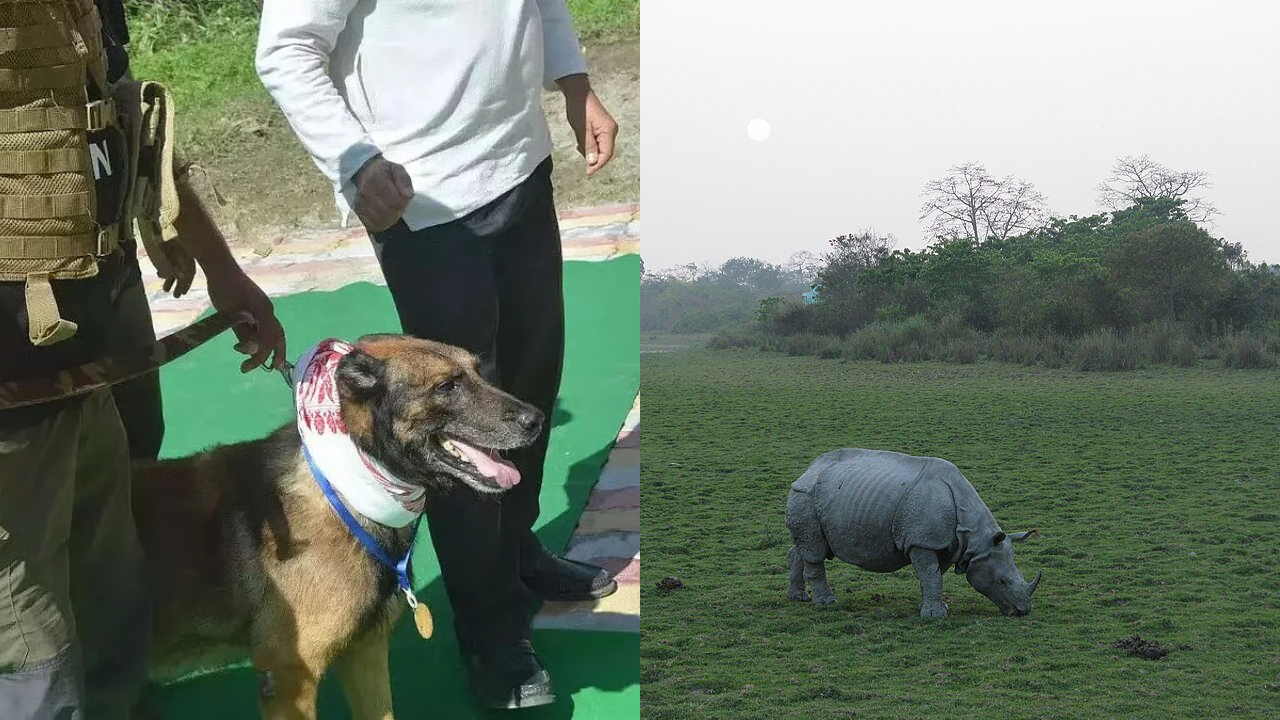
Biological detection assets fundamentally alter the detection probability equation in anti-poaching warfare. In Assam’s Kaziranga National Park, the deployment of a single Belgian Malinois named Zorba resulted in the direct tracking and apprehension of over 60 poachers targeting the Indian one-horned rhinoceros (Rhinoceros unicornis). Rather than viewing this operational record as an isolated human-interest anomaly, conservation strategists must evaluate it as a case study in asymmetric deterrence, olfactory signal processing, and spatial interdiction within high-density alluvial grasslands.
Anti-poaching operations fail when rangers rely exclusively on reactive visual patrol grids across vast, low-visibility terrain. Kaziranga encompasses roughly 1,090 square kilometers of tall elephant grass, dense marshes, and braided river channels. Within this environment, human visual detection ranges frequently drop below five meters. Poaching syndicates exploit this sensory asymmetry by operating during monsoon flooding or nocturnal cycles, extracting rhino horns in under twenty minutes, and vanishing into adjacent human settlements before patrol units can establish a perimeter. Integrating a trained tracking canine collapses the time-to-interdiction window by shifting the primary detection modality from visual sightlines to persistent chemical trails.
The Physics of Olfactory Signal Persistence in Alluvial Terrain
To understand how a canine tracks a suspect across 1.5 kilometers of active floodplains—including following a blood trail left by an injured perpetrator or wounded animal—one must examine the mechanics of scent dispersion and retention. Human and animal bodies continuously shed raft particles: microscopic skin cells, sweat lipids, volatile organic compounds (VOCs), and aerosolized blood particulates.
In standard terrestrial environments, wind shear and thermal updrafts rapidly scatter these rafts, degrading the trail within hours. Kaziranga’s microclimate creates a distinct aerodynamic profile. High ambient humidity and dense canopy cover suppress vertical thermal convection, keeping heavy VOCs and cellular debris suspended near the ground layer or trapped within the moisture film coating the elephant grass.
Canine olfactory anatomy processes these chemical signatures through a separated respiratory pathway. During inhalation, a fold of tissue inside the nostril divides airflow into two streams: one dedicated to respiration, and a secondary dorsal stream directed into the olfactory recess. This recess contains approximately 300 million olfactory receptors—compared to roughly 6 million in humans—coupled with a brain olfactory bulb that is proportionally 40 times larger.
When Zorba tracked a 1.5-kilometer blood trail, the operational mechanism relied on differential concentration mapping. As a target moves through dense vegetation, physical abrasion deposits higher concentrations of cellular material onto grass stalks than onto the soil floor. A trained Malinois samples the air at a frequency of 4 to 7 Hz (sniffs per second), comparing bilateral nostril inputs to determine concentration gradients. By orienting toward the side with higher molecular density, the canine executes a continuous real-time vector calculation, maintaining lock even when visual blood droplets are washed away by rain or obscured by mud.
The Three Pillars of Canine Interdiction Economics
Deploying specialized K9 units within state-run wildlife reserves requires justifying capital expenditure against measurable reductions in poaching mortality. The operational return on investment generated by Zorba’s deployment breaks down into three distinct economic and tactical pillars.
Temporal Compression of the Pursuit Cycle
The primary bottleneck in anti-poaching enforcement is the lag between an acoustic event (gunshot) and physical contact with the perpetrator. Without canine assets, forest guards must execute expanding concentric sweeps from the carcass site. Because human trackers lack the sensory bandwidth to distinguish a specific poacher’s path from legacy wildlife trails, search grids expand exponentially over time, diluting manpower. A tracking canine reduces search geometry from an expanding two-dimensional area to a single linear vector. By locking onto the exit trajectory immediately upon arrival at the kill site, the K9 squad converts an open-ended search into a high-speed pursuit, intercepting syndicates while they are still within the buffer zone and before the horn enters illicit transit networks.Force Multiplication in Low-Visibility Environments
Kaziranga’s tall grassland ecology neutralizes conventional tactical advantages. Night-vision optics and thermal imaging systems suffer severe attenuation when penetrating thick, moisture-laden vegetation and dense foliage. Canines bypass optical barriers entirely. A single handler-dog team effectively clears a flank that would otherwise require a squad of twelve armed guards advancing in a skirmish line. This efficiency frees human personnel to establish static blocking positions along known river crossings and highway chokepoints, transforming reactive patrols into coordinated pincer movements.Asymmetric Psychological Deterrence
Poaching syndicates operate on a risk-reward calculus dictated by local economic conditions and perceived probability of capture. Historically, syndicates viewed Kaziranga’s terrain as a protective shield; once a shooter exited the immediate vicinity of the gunshot, evasion was statistically probable. The introduction of a high-efficiency tracking canine altered the threat matrix for local poaching networks. When over 60 operatives are systematically tracked from remote kill sites directly to safe houses in perimeter villages, the perceived certainty of capture spikes. Deterrence occurs not merely through the physical arrest of individual shooters, but by forcing syndicates to abandon established infiltration routes and increase their operational security costs.
Operational Integration and Deployment Protocols
Introducing a high-drive working dog into a paramilitary conservation force requires strict adherence to structured deployment protocols. A canine cannot function as an autonomous sensor; it operates as part of a tightly coupled human-animal tactical unit.
- Contamination Control at the Point of Origin: When a rhino carcass or gunshot site is discovered, standard forest guards must immediately establish a hard perimeter at least 50 meters from the focal point. Foot traffic from well-meaning rangers destroys the primary scent pool and introduces competing human VOCs, forcing the canine to spend critical minutes discriminating between friendly and target trails.
- Scent Article Acquisition and Vectoring: Upon arrival, the K9 handler guides the dog to a high-probability contact point—such as a discarded shell casing, a blood spatter, or crushed vegetation along the suspected exit line. Once the dog exhibits a behavioral change indicating scent lock (lowered head, accelerated tail movement, increased respiratory rate), the handler transitions from search mode to tracking mode, maintaining tension on a long-line lead to read subtle body-language shifts.
- Armed Over-Watch and Escort: Because a tracking canine operates with its nose to the ground, its situational awareness regarding ambush threats is zero. The handler’s cognitive load is entirely consumed by reading the dog and managing the lead. Therefore, a minimum of two armed forest guards must flank the handler-dog team, scanning elevated terrain and dense brush for armed poachers attempting to lay an ambush along their own back-trail.
- Evidentiary Chain of Custody: Tracking a suspect directly from a carcass to a village residence provides compelling circumstantial evidence, but prosecution under India’s Wildlife Protection Act requires rigorous documentation. Handlers must log GPS tracks of the canine’s route, photograph physical evidence uncovered along the trail, and secure independent witness statements at the point of apprehension to prevent defense attorneys from dismissing the canine’s track as arbitrary.
Structural Limitations of Biological Detection Assets
Relying on biological assets introduces severe operational vulnerabilities that conservation planners must mitigate. There are no silver bullets in counter-poaching, and over-indexing on a single high-performing asset like Zorba creates single-point-of-failure risks.
First, environmental degradation imposes hard ceilings on olfactory performance. While high humidity aids scent retention, extreme monsoon flooding completely submerges terrestrial scent trails. Once water levels rise above the grass line, aquatic currents disperse VOCs downstream, breaking the linear path and rendering ground-tracking impossible until waters recede. Similarly, intense dry-season heatwaves bake soil surfaces, volatilizing organic compounds within minutes and causing severe thermal stress to the animal, limiting operational deployments to brief windows at dawn and dusk.
Second, biological fatigue and handler dependency restrict operational tempo. Unlike mechanical sensors, a Belgian Malinois cannot run continuous 24-hour shifts. High-intensity tracking in thick, razor-sharp elephant grass inflicts physical wear on paw pads, nasal mucosa, and cardiovascular reserves. An elite tracking dog requires strict rest cycles, specialized veterinary nutrition, and daily maintenance training to prevent skill decay. Furthermore, the bond between handler and canine is non-transferable in the short term; if the primary handler is injured, transferred, or rotated out, the unit’s effectiveness drops sharply until a new pairing is calibrated.
Third, syndicate counter-adaptation degrades long-term efficacy. Organized wildlife crime networks learn from operational losses. Once poachers recognize that canines are tracking them via blood trails or terrestrial footprints, they deploy counter-measures. These include wading through deep water channels to break scent continuity, applying pungent masking agents (such as spices, kerosene, or animal dung) to footwear, or utilizing motorized transport immediately upon reaching park boundaries to outrun the pursuit team.
Strategic Allocation of K9 Assets in Protected Areas
The empirical success of Zorba’s career in Assam proves that targeted biological sensors outperform brute-force manpower increases in complex terrain. However, scaling this success across regional conservation networks requires shifting from ad-hoc donations of individual dogs to institutionalized K9 programs.
Wildlife management authorities must stop treating tracking dogs as novelty mascots or temporary pilot projects. Instead, budgets must allocate permanent funding for multi-dog kennels, redundant handler training pipelines, and specialized veterinary infrastructure. By maintaining a rotational roster of at least four to six operational canines per major sector, parks eliminate single-point-of-failure vulnerabilities, ensure continuous 24/7 rapid-response coverage, and sustain the asymmetric detection advantage necessary to bankrupt local poaching syndicates.


