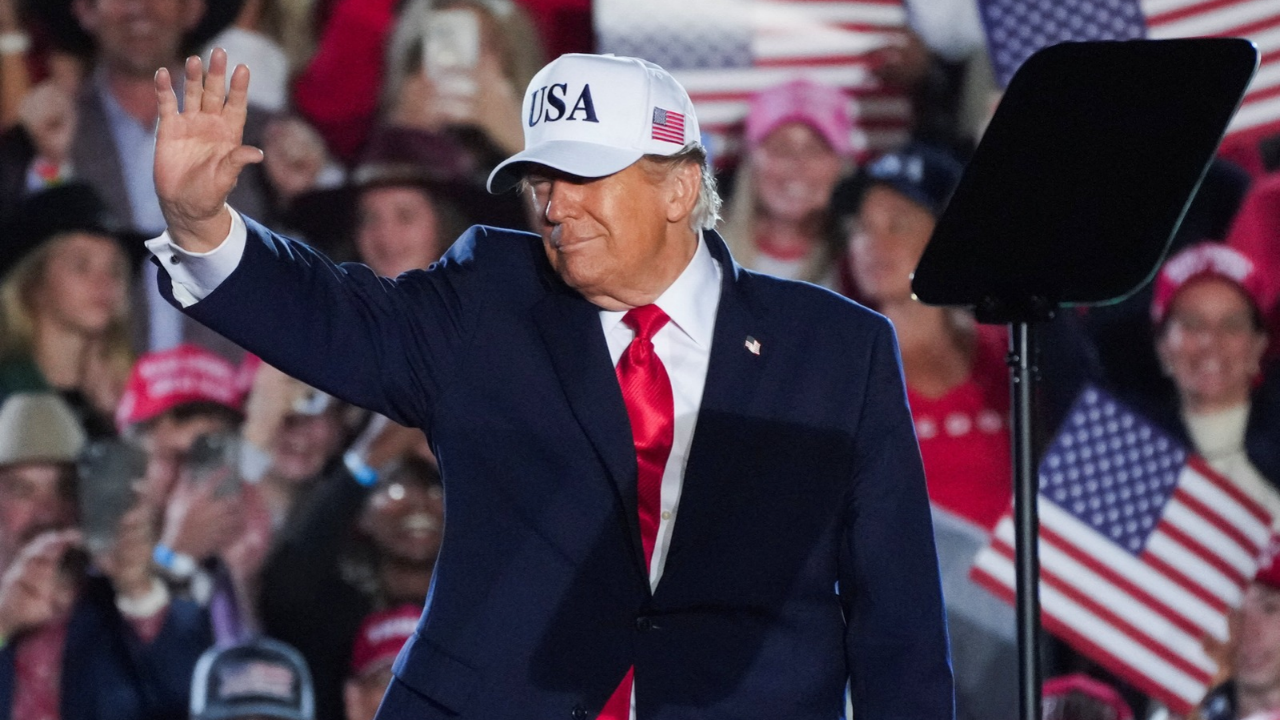
Political rhetoric during midterm cycles operates as an information-compression mechanism designed to lower voter cognitive load through binary categorization. When Donald Trump stood at an Iowa rally and labeled Democratic Michigan Senate candidate Abdul El-Sayed a "jihadist" while praising Republican contender Mike Rogers as "apple pie," he executed a deliberate semiotic arbitrage across state lines. Standard political reporting treats this event as a routine campaign trail provocation, focusing on the surface-level shock value of the insults or the geographic incongruity of attacking a Michigan candidate in Iowa. That reading misses the underlying operational logic. The speech represents a calculated effort to establish an asymmetric framing architecture ahead of the 2026 Michigan Senate contest—one that attempts to lock in primary voter alignments, force the Democratic apparatus onto defensive terrain, and exploit out-of-state media amplification to shape battleground perceptions before local ad spending reaches peak saturation.
The Architecture of Binary Labeling
To understand why a national figure deploys extreme linguistic contrasts for a down-ballot race in a neighboring state, one must examine the mechanics of political heuristics. In low-information environments—or during the early phases of a midterm cycle when voter attention is fragmented—campaigns rely on affective polarization rather than policy comparison. The pairing of "jihadist" and "apple pie" is not random invective; it is a structured exercise in ingroup-outgroup boundary enforcement.
In social identity theory, political messaging achieves maximum efficiency when it simultaneously activates threat perception toward an outgroup and nostalgia-driven safety toward an ingroup. By attaching the label "jihadist" to Abdul El-Sayed, a physician, former Detroit health director, and progressive Democrat of Egyptian-American heritage, the rhetoric bypasses policy debates over healthcare, industrial manufacturing, or Great Lakes infrastructure. Instead, it attempts to trigger an immediate cultural threat heuristic among conservative voters. The term is engineered to collapse complex biographical and ideological attributes into a single, disqualifying threat vector.
Conversely, describing Mike Rogers—a former FBI special agent, seven-term U.S. Representative, and 2024 Senate nominee—as "apple pie" functions as an affective anchor. It signals cultural familiarity, institutional orthodoxy, and unthreatening American traditionalism. The starkness of the binary reduces a multi-dimensional Senate race into a simplistic choice between perceived existential threat and cultural comfort.
This rhetorical pairing operates through three distinct mechanisms:
- Cognitive Shortcut Construction: Voters rarely audit voting records or municipal health administration metrics during the preliminary stages of a midterm cycle. High-contrast labels provide an immediate, low-effort sorting mechanism that aligns candidate perception with pre-existing cultural grievances.
- Asymmetric Burden of Proof: An affirmative cultural label like "apple pie" requires zero evidentiary defense; it operates as an ambient assertion of belonging. A stigmatizing label like "jihadist," however, forces the targeted campaign into a reactive posture. Explaining why a public health official is not an extremist consumes communications bandwidth and inadvertently repeats the smear within the target's own media ecosystem.
- Coalition Consolidation: For Republicans in Michigan, unifying traditional national-security conservatives with populist, anti-establishment voters remains an ongoing structural challenge. Rogers, with his background in federal law enforcement and intelligence committees, occasionally faces skepticism from the populist wing of the party. Framing his opponent in existential cultural terms subordinates intra-party ideological friction to a shared external threat.
Geographic Arbitrage and the Iowa-Michigan Media Corridor
A primary analytical failure in standard coverage of this event is the dismissal of the venue. Why attack a Michigan Senate candidate at a rally in Iowa? In modern nationalized politics, geographic boundaries no longer contain message propagation. Delivering a high-friction attack in Iowa serves as a low-cost testing ground and an earned-media multiplier.
Iowa functions as a national political sounding board where national press corps, livestream networks, and digital clipping operations maintain constant surveillance. When Trump attacks a Michigan candidate in Des Moines or Sioux City, the remark is instantly detached from its physical venue and injected directly into Michigan's digital information streams via social media algorithms and local news aggregation.
This creates a strategic advantage known as geographic arbitrage. If Trump delivers the identical attack inside Michigan—say, in Macomb County or Grand Rapids—it triggers immediate, localized pushback from Michigan's Democratic infrastructure, Arab-American community leaders in Dearborn, and regional editorial boards, potentially alienating swing voters in the Detroit suburbs who favor institutional decorum. By launching the attack from Iowa, the message achieves two divergent outcomes simultaneously:
- National Base Mobilization: It feeds the national conservative media ecosystem with red-meat cultural conflict, reinforcing Trump's dominance over the party's midterm narrative and signaling to donors that the Michigan Senate seat is a top-tier priority.
- Plausible Buffer in the Battleground: Because the remarks occurred outside Michigan's borders during an unscripted rally riff, Mike Rogers' campaign retains a degree of tactical insulation. Rogers does not have to stand on the same stage and immediately endorse or distance himself from the specific slur, allowing him to benefit from the polarization while maintaining a more measured, conventional posture in local Michigan broadcasts.
The media ecosystem reinforces this dynamic. Outrage-driven algorithms prioritize high-conflict phrasing over policy substance. Consequently, national outlets amplify the "jihadist" vs. "apple pie" framing far more aggressively than they would a speech detailing tax policy or automotive supply chain tariffs. The earned media generated by the controversy effectively subsidizes early name-recognition and framing efforts for the 2026 cycle at zero cost to the Republican Senatorial campaign committees.
Historical Precedent and the Evolution of the Smear
The deployment of ethno-religious framing against Abdul El-Sayed is not an isolated rhetorical incident; it represents the continuation of a documented tactical playbook used in Michigan politics since his 2018 gubernatorial bid. During that primary cycle, fringe political operatives and anonymous social media networks circulated false claims linking El-Sayed to the Muslim Brotherhood—allegations thoroughly debunked by mainstream outlets and fact-checkers, yet persistent within partisan information silos.
What distinguishes the 2026 iteration from 2018 is the elevation of the source. In 2018, such attacks remained largely confined to peripheral digital spaces and lower-tier surrogates. When the sitting president or undisputed leader of the Republican Party deploys the term "jihadist" from a national podium, it mainstreams a previously fringe tactic, moving it from the margins of political discourse into the central narrative of a pivotal U.S. Senate race.
This escalation follows a predictable trajectory in modern campaign communications:
- Phase One (Peripheral Seeding): Fringe actors introduce a false or extreme biographical frame during an early campaign cycle, establishing a searchable digital footprint of doubt.
- Phase Two (Dog-Whistle Normalization): Mainstream surrogates allude to the frame indirectly through coded language regarding "radicalism," "anti-American values," or questionable associations.
- Phase Three (Direct Nationalization): The party's primary standard-bearer strips away the subtext, deploying the explicit label on a national stage to cement the association in the minds of low-propensity voters.
For El-Sayed, whose political brand rests on progressive populism, single-payer healthcare advocacy ("Medicare for All"), and technocratic public health competence, this framing introduces a severe structural vulnerability. Progressive campaigns thrive when the electorate evaluates candidates along an economic axis—working-class healthcare access versus corporate pharmaceutical interests. The "jihadist" label violently wrenches the frame away from economics and locks it onto identity and national security.
Demographic Friction in the Michigan Electorate
To evaluate the net electoral impact of this rhetoric, one must map it against Michigan's unique demographic architecture. Michigan is not a monolithic battleground; it is a fragile coalition of distinct voting blocs whose turnout rates and partisan loyalties fluctuate based on national cultural cross-currents.
In the 2024 presidential cycle, Michigan demonstrated heightened volatility among Arab-American and Muslim voters, particularly in Wayne County hubs like Dearborn and Hamtramck. Frustration with the Biden-Harris administration's foreign policy created a historic rupture in a constituency that had reliably backed Democrats for two decades. Trump actively courted segments of this demographic in 2024, capitalizing on shared social conservatism and anti-interventionist sentiment to peel away critical margins.
Calling Abdul El-Sayed a "jihadist" introduces a direct contradiction into that realignment strategy. While the attack is aimed squarely at energizing non-college-educated white voters in rural Michigan and outer-ring suburbs (such as Livingston, Monroe, and Ottawa counties), it risks alienating the exact Arab-American voters who defected from the Democratic Party or stayed home in 2024.
This exposes a fundamental tension in the Republican coalition model for 2026:
- Exurban and Rural Turnout Maximization: In midterm elections, overall turnout drops significantly compared to presidential years. Victory depends heavily on mobilizing high-propensity, ideologically committed base voters. Explicit cultural-threat rhetoric is a proven catalyst for driving turnout among the MAGA base in rural northern Michigan and the Thumb region.
- Suburban Swing Voter Attrition: Conversely, college-educated voters in Oakland, Kent, and Washtenaw counties exhibit high sensitivity to overt ethno-religious rhetoric. In 2018 and 2022, Democratic candidates in Michigan capitalized on Republican rhetorical extremism to sweep statewide offices by running up massive margins in these suburban corridors.
- The Arab-American Re-consolidation Risk: If Trump's attack on a prominent Egyptian-American candidate triggers collective solidarity among Michigan's Middle Eastern and North African (MENA) communities, it could inadvertently repair the Democratic coalition in Wayne County. Voters who withheld support from Democrats over foreign policy grievances in 2024 may view an explicit slur from the top of the GOP ticket as a more immediate domestic threat, driving them back into the Democratic column in 2026.
Strategic Vulnerabilities for Both Campaigns
Neither campaign exits this rhetorical exchange without incurring structural risks. The long-term trajectory of the 2026 Michigan Senate race depends on how effectively each side manages the secondary consequences of this framing.
Mike Rogers: The Credibility Trap
Mike Rogers spent his career cultivating an image as a sober, institutional national security expert—a former FBI agent and chair of the House Intelligence Committee who operates within traditional legislative norms. Being branded "apple pie" by Trump provides immediate primary protection, inoculating Rogers against challenges from further-right populist insurgents who might otherwise attack his establishment credentials.
However, the endorsement carries a steep general election liability. By accepting the "apple pie" mantle juxtaposed against a slur directed at his opponent, Rogers faces a binary communications trap:
- If Rogers explicitly condemns the "jihadist" label, he risks triggering public retaliation from Trump, instantly evaporating his primary protection and fracturing GOP enthusiasm.
- If Rogers remains silent or deflects questions about the remark, Democratic strategists will weaponize that silence in Oakland and Kent County ad buys, portraying him as a complicit enabler of bigotry who abandoned his institutional principles for political survival.
Abdul El-Sayed: The Counter-Framing Dilemma
For El-Sayed, the primary danger lies in allowing the national media narrative to define him before he defines his economic agenda. Progressive candidates often fall into the trap of moral refutation—spending millions of dollars and weeks of earned media cycle time explaining who they are not, rather than articulating what they will do for the median voter.
In midterm elections, voters punished by inflation, healthcare costs, and industrial transition rarely reward candidates who campaign primarily on identity defense. If El-Sayed's response centers on the offensiveness of Trump's language, he validates the cultural battleground Trump selected. Furthermore, leaning too heavily into progressive identity politics risks alienating union households in Macomb and Genesee counties—voters who prioritize manufacturing jobs and kitchen-table economics over cultural grievances.
Limitations of Rhetorical Shock in Midterm Cycles
A rigorous analysis must account for the diminishing marginal returns of shock rhetoric. Since 2015, the American electorate has experienced continuous exposure to hyper-polarized, norm-breaking political language. While extreme labels reliably capture short-term news cycles, their capacity to permanently alter voter behavior in general elections exhibits clear limitations:
- Audience Saturation: High-information partisans on both sides have already priced Trump's rhetorical style into their voting calculus. Calling a Democrat an extremist neither shocks progressive voters nor persuades undecided moderates who have grown desensitized to hyperbole.
- The Local Ground-Game Offset: Unlike presidential elections, where national airwaves dominate voter perception, Senate races are heavily mediated by local television, targeted digital persuasion, and state-level economic indicators. If Michigan's unemployment rate rises or automotive supply chains experience disruption in 2026, pocketbook realities will rapidly override rhetorical framing exported from an Iowa rally.
- Primary vs. General Election Misalignment: Tactics optimized to dominate a primary ecosystem—where the loudest, most polarizing signal wins—frequently backfire in a general election electorate that is broader, older, and more risk-averse.
The Strategic Play for 2026
To neutralize the asymmetric framing established in Iowa, the El-Sayed campaign and Michigan Democratic apparatus must refuse to litigate the slur on Trump's cultural terrain. Instead, they must execute a disciplined Frame-Inversion and Localization Strategy across three operational fronts:
- Pivot Immediately from Identity to Institutional Competence: Do not launch an extended media tour debating the definition of "jihadist" or demanding apologies from Mike Rogers. Issue a single, brisk dismissal framing the attack as a distraction from Washington dysfunction, then immediately anchor every subsequent appearance to El-Sayed's tangible administrative record—specifically his tenure rebuilding Detroit's public health infrastructure and lowering healthcare costs.
- Weaponize the Geographic Outsider Frame: Turn the Iowa venue against Mike Rogers. Deploy targeted digital and broadcast messaging in Michigan portraying Rogers as a Washington insider who relies on out-of-state political theater because he cannot defend his legislative record on healthcare and corporate tax policy to Michigan workers. Contrast El-Sayed's local municipal service with Rogers' post-Congressional career in Washington lobbying and media commentary.
- Execute Micro-Targeted Coalition Repair in Wayne County: Rather than relying on broad, nationalized anti-Trump messaging, deploy localized community organizing in Dearborn, Hamtramck, and suburban Detroit. Frame the election around domestic economic security, healthcare access, and civil rights protections, using the Iowa remarks quietly through trusted local surrogates to remind disaffected Arab-American voters of the tangible stakes of Republican Senate control without making identity grievance the centerpiece of the statewide television campaign.