Maps lie. They flatten the violent curvature of the earth into neat rectangles, smoothing over the jagged edges of history with polite pastel colors. But a map cannot show you the saltwater tears of a people forced onto cargo ships half a century ago. It cannot show you the heavy hum of B-52 bombers rolling down a secret tarmac on an atoll called Diego Garcia, hidden deep in the blue expanse of the Indian Ocean.
Water. Just water for thousands of miles in every direction.
Then, a sudden ring of coral. Palm trees leaning against salt-laden gales. A lagoon so bright it hurts the eyes. This is the Chagos Archipelago. For decades, it has functioned as an invisible knot holding together the security architecture of the Western world. Few people living in London or Washington could point to it on a blank sheet of paper. Yet, every major geopolitical tremor in the Middle East or Asia feels the shockwaves of what happens on these isolated islands.
Now, that invisible knot is fraying.
The United Kingdom recently struck a landmark deal to surrender sovereignty over the Chagos Islands to Mauritius. It was billed in Whitehall as a pragmatic legal settlement, an end to a stubborn colonial embarrassment at the International Court of Justice. But pragmatism in Westminster looks very different when viewed from the grand ballrooms of Mar-a-Lago or the tense situation rooms of the Pentagon.
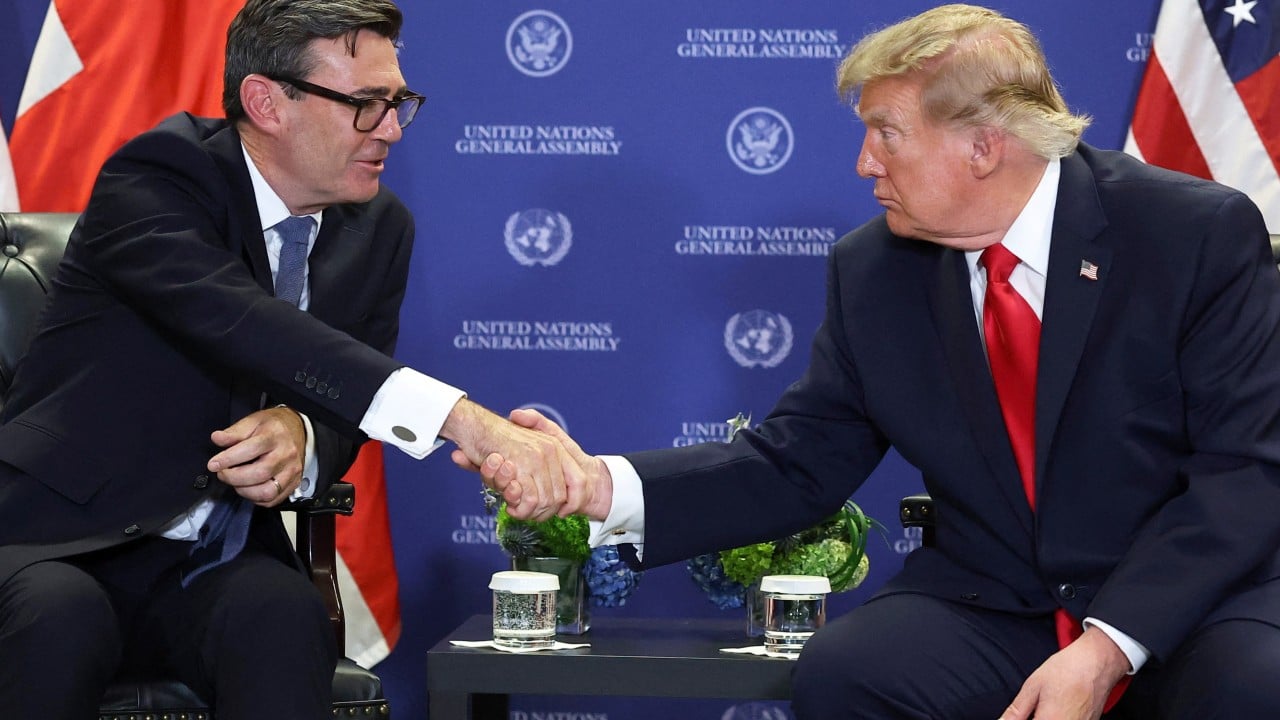
Donald Trump looked at the agreement and scoffed. To him, handing over a strategic foothold in a darkening global climate is not modern diplomacy; it is an unforced surrender. And across the Atlantic, a newly installed British Prime Minister, Burnham, finds himself caught in a tightening vice. The ink on the treaty is scarcely dry, yet the political winds are already shifting violently. Burnham must decide whether to honor a diplomatic exit strategy or bend to the fierce, unyielding pressure of America's returning populist titan, who insists the deal must be undone.
To understand why a cluster of coral reefs thousands of miles from Britain or America is causing such high-stakes friction, you have to step back into the shadows of the Cold War.
Imagine it is 1965. The British government is carving up its vanishing empire. It slices off a tiny necklace of islands from Mauritius, renaming it the British Indian Ocean Territory. Washington wants a base. Moscow is expanding its naval footprint across the globe. The United States leases Diego Garcia, turning the largest island into an unsinkable aircraft carrier.
There was just one catch. People lived there.
Thousands of Chagossians fished the lagoons, harvested coconuts, and raised families in a quiet paradise. They were not consulted. Instead, they were rounded up, loaded onto crowded copra ships, and dumped thousands of miles away in Mauritius and the Seychelles. Their dogs were gassed. Their homes were neglected. For generations, these exiled islanders have fought a bitter legal and emotional war to return to the sand that birthed their ancestors.
For decades, British and American diplomats managed to keep this dark chapter buried beneath layers of strategic necessity. The base stayed. The islanders stayed away. The lawyers argued in air-conditioned courtrooms while the bombers took off into the night sky to fight distant wars.
History has a way of collecting debts.
International courts ruled that Britain’s occupation of the archipelago was illegal. Pressure mounted. The United Nations voted overwhelmingly against London. Facing a moral and legal corner, the previous British administration decided to cut its losses. Hand sovereignty to Mauritius, they reasoned, and lock in a long-term lease for the military base on Diego Garcia. Win-win. Keep the runway, lose the colonial liability.
Except, geopolitics rarely operates in neat bureaucratic boxes.
When Donald Trump weighs in on foreign policy, he does not speak the language of polite diplomatic compromise. He speaks the language of leverage, dominance, and hard security assets. To critics of the Chagos deal in Washington, handing sovereignty of the archipelago to Mauritius opens a dangerous door. Mauritius maintains close, warm diplomatic and economic ties with Beijing. In an era defined by great power competition, inviting a nation friendly to China into the governance structure of a vital Western military outpost strikes American defense hawks as sheer recklessness.
Why give away the keys to the fortress when the walls are already under siege?
This is where Prime Minister Burnham enters the storm.
Burnham did not author the original surrender. He inherited a diplomatic time bomb wrapped in legal ribbon. Stepping into Number 10 Downing Street means confronting the brutal reality of Britain's diminished global standing. On one hand, ignoring international tribunals damages Britain’s claim as a champion of global rules and norms. On the other hand, alienating Washington—especially with an unpredictable administration back in the White House—threatens the bedrock of the special relationship.
Whispers from Whitehall suggest panic. Officials who drafted the treaty under the assumption of smooth continuity are suddenly scrambling. Can the deal be paused? Can it be renegotiated? Can Burnham find a middle path that satisfies the courts without infuriating the Pentagon?
The answer is murky at best.
Let us walk through what happens if Burnham tries to turn the clock back. Reopening negotiations with Mauritius is not a simple phone call. It means inviting public humiliation, sparking fresh legal challenges, and antagonizing regional African allies who cheered the initial decolonization victory. Mauritius has spent decades fighting for this recognition; they will not quietly fold their hand because a new British prime minister feels the heat from across the Atlantic.
Conversely, pushing forward with the deal despite fierce American opposition carries an equally terrifying price tag. Intelligence-sharing agreements, military cooperation, and defense procurement could all find themselves caught in the crosshairs of an administration known for punishing perceived allies just as harshly as adversaries.
For the average citizen sitting in a London cafe or an Ohio diner, this might sound like dry political theater. Distant islands. Old treaties. Military jargon.
It is much more than that.
It is about what happens when the fragile agreements holding the post-war international order together begin to crack under the pressure of a new, multipolar reality. Every nation is testing its limits. Every alliance is being strained. When superpowers clash over a scrap of coral in the Indian Ocean, the ripples touch global shipping lanes, intelligence networks, and the fundamental trust between sovereign states.
And beneath the grand theater of statecraft lie the real human casualties of this entire saga.
The Chagossians.
Imagine being a child of the diaspora, born in a cramped apartment in Port Louis, watching politicians in London and Washington argue over whether your ancestral home belongs to Mauritius, Britain, or the United States. To the diplomats, you are a demographic variable. To the strategists, you are an inconvenience. To yourself, you are a ghost haunting a paradise you are legally barred from touching.
When Trump criticizes the deal, does he speak for the exiled islanders? Not necessarily. His focus is the runway on Diego Garcia, not the fishermen who once walked its beaches. When British officials sign over sovereignty, are they doing it out of deep penance for colonial sins, or simply to dodge a losing legal battle at the Hague? The truth, as usual, is coated in self-interest.
Yet, the critique leveled by Washington strikes a chord because the world has grown infinitely more dangerous since the treaty was hatched. In a time when authoritarian powers are rewriting borders through force and economic coercion, giving up an inch of strategic ground feels to many like the beginning of an unravelling.
Burnham stands at the epicenter of this contradiction. He is a modern leader tethered to an imperial past, trying to navigate a turbulent present where every single choice carries a heavy cost.
Consider the silence of the ocean at night around Diego Garcia. Far from the news studios, far from the shouting matches in Parliament, the waves crash quietly against the barrier reef. The runway lights blink in the dark, guiding bombers through the humid air. The crabs scuttle across the abandoned foundations of houses that were once filled with laughter before the ships came.
The islands remain what they have always been: a prize, a shield, and a wound.
As the pressure mounts from Washington and the domestic machinery of government begins to stutter, Burnham’s window for decisive action narrows. To blink is to invite disaster from across the Atlantic. To charge ahead is to fracture a vital military alliance.
History does not forgive leaders who mistake hope for strategy. The Chagos deal was born out of an attempt to wish away an inconvenient past by handing over the keys and hoping no one noticed the locks had been changed. But Trump noticed. And now, the bill has come due.
The ocean winds continue to howl across the archipelago, indifferent to prime ministers, presidents, and parliaments. The coral grows slowly in the warm water, layer by calcium layer, building structures that outlast empires. Whatever Burnham decides in the sterile, wood-paneled rooms of Downing Street, the ghost of the empire will linger over those blue waters, waiting to see who claims the final word on the edge of the world.