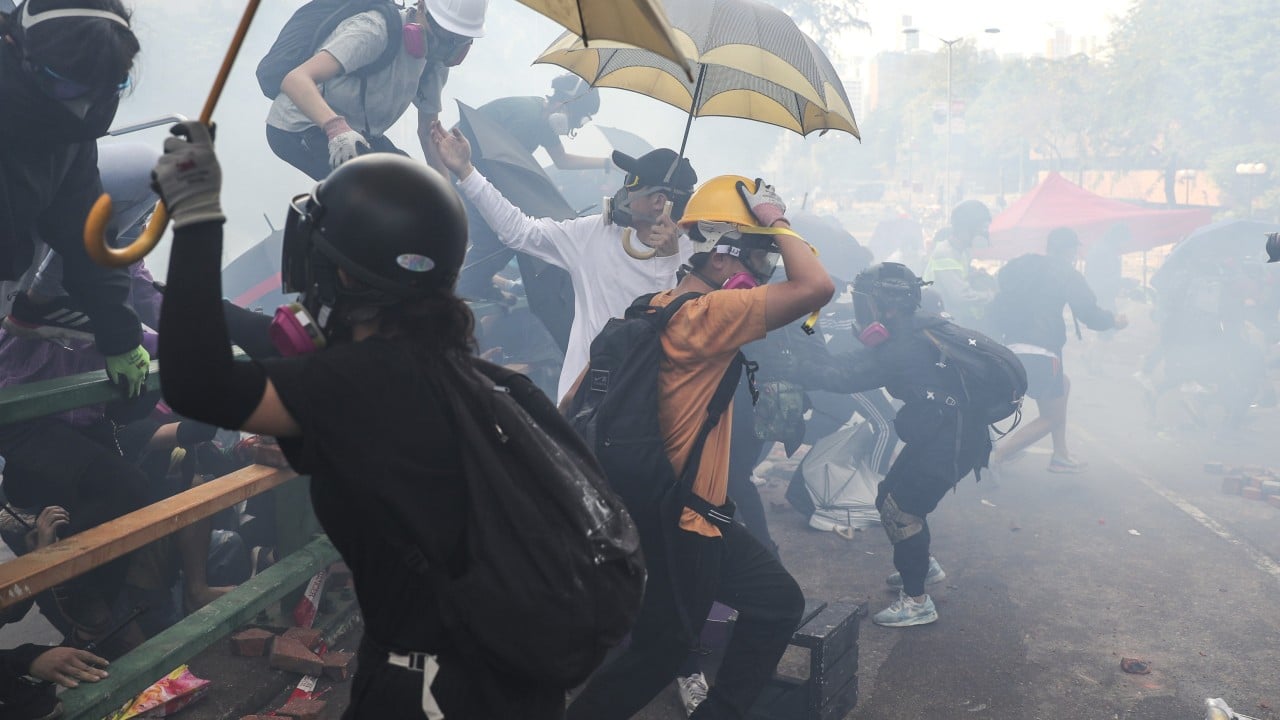
The operational life cycle of large-scale civil unrest concludes not on the streets, but within the structural constraints of the judicial system. On June 8, 2026, the District Court of Hong Kong finalized the sentencing of four male defendants involved in the November 2019 confrontations at and around the Hong Kong Polytechnic University (PolyU). This adjudication serves as a baseline case study for analyzing the math of judicial delay, the quantitative mechanics of sentence reduction functions, and the enforcement trajectory of long-tail public order prosecutions.
By deconstructing this specific decision, we can isolate the deterministic variables that judges apply to transform a statutory maximum or structural starting point into an operational prison term. The case demonstrates that the time elapsed between an offense and its final legal disposition operates as a distinct variable within the judicial calculus, functioning alongside traditional mitigation inputs like a timely guilty plea.
The Mathematical Framework of Sentence Computations
Judicial sentencing within common law frameworks operates through a structured formula where a base penalty is established based on gravity and culpability, then subjected to systematic reduction factors. In this specific adjudication, the court evaluated a joint charge of rioting under the Public Order Ordinance.
The mechanics of the transformation from the initial starting sentence to the final operational sentence can be formalized through a sequential reduction model. Let $S_0$ represent the initial starting point determined by the gravity of the offense. The court established an initial baseline of:
$$S_0 \in [54, 57] \text{ months}$$
To calculate the final sentence ($S_f$), the court applies two distinct reduction variables: the plea mitigation discount ($D_p$) and the exceptional systemic delay discount ($D_d$). The operational formula functions as follows:
$$S_f = S_0 - D_p - D_d$$
The application of these variables yielded a total reduction range where the cumulative discount ($D_p + D_d$) fell between 17 and 25 months.
The Plea Mitigation Discount Function
A timely guilty plea typically guarantees a standard one-third (33.3%) reduction from the starting baseline within Hong Kong's jurisdiction. This discount serves a dual programmatic purpose: it optimizes state resources by avoiding protracted trials and indicates an explicit admission of legal culpability. For a 54-month starting point, the standard plea mitigation factor removes 18 months from the baseline, establishing an intermediate quantum of 36 months before secondary environmental factors are assessed.
The Systematic Delay Discount Matrix
The distinct operational feature of this June 2026 ruling is the formalized accounting for a 6.5-year temporal gap between the offense (November 2019) and the disposition (June 2026). In standard criminal processing, an extended backlog functions as a mitigating factor due to the prolonged psychological burden of pending litigation. The court quantified this delay as a discrete downward adjustment, translating into a net deduction. This variable explains how a starting point of nearly five years scaled down to an operational sentence of approximately three years and one month (37 months) for the highest-penalized individual in this group.
The Co-Dependency Matrix of Compounding Sentences
A critical structural bottleneck arises when a defendant faces sentencing for a public order offense while simultaneously serving time or awaiting disposition for an unrelated criminal conviction. The case of 33-year-old former tutor Chan Yuen-ming illustrates the mechanics of the non-concurrent sentencing doctrine.
Chan was handed a 37-month term for his role in the PolyU riot. However, his total operational incarceration period was calculated at 21 years and seven months. This spike is dictated by the interaction between two distinct legal categories:
- Primary Sentence (Unrelated): An 18.5-year (222 months) sentence for a prior, distinct drug trafficking conviction.
- Secondary Sentence (Public Order): A 3.7-year (37 months) sentence for the 2019 rioting charge.
The structural relationship between these two liabilities is governed by a strict concurrency versus consecutive choice matrix.
| Sentencing Architecture | Structural Application | Mathematical Effect |
|---|---|---|
| Concurrent Sentencing | Applied when offenses share an identical transaction or behavioral nexus. | $\max(\text{Sentence}_A, \text{Sentence}_B)$ |
| Consecutive Sentencing | Applied when offenses are legally distinct, occur at different times, and target separate state interests. | $\text{Sentence}_A + \text{Sentence}_B$ |
Because drug trafficking and rioting share no transactional nexus, the court executed a fully consecutive order. The 37-month riot sentence was appended directly to the termination date of the 222-month narcotics sentence. This demonstrates that historical public order liabilities retain an independent penal valuation that cannot be absorbed into existing, longer sentences.
Psychological Verification and the Evidentiary Bar
The defensive strategy in long-tail prosecutions frequently pivots to the psychological toll of protracted legal limbo. In this adjudication, the defense sought an additional downward departure by citing a diagnosis of Post-Traumatic Stress Disorder (PTSD). The defense argued that the remand environment triggered memories of an intermediate event: Chan's alleged 2022 detention and torture inside an extra-jurisdictional scam compound in Myanmar.
The court's rejection of this argument highlights the strict evidentiary thresholds required to override standard sentencing minimums. The judicial assessment prioritized empirical state evaluations over subjective defensive claims:
- The Psychological Assessment Paradigm: The court relied on an official government clinical psychologist's report rather than unilateral medical assertions.
- The Adaptation Metric: The state's evaluation concluded that the defendant displayed "no significant psychological distress" at the time of examination and exhibited successful adaptation behavioral metrics within the correctional facility.
- The Culpability Allocation Rule: Judge Edmond Lee Chun-man established a clear causal link regarding the extended timeline, noting that the defendant bore behavioral responsibility for the circumstances leading to the secondary drug trafficking conviction in 2020, which independently complicated his legal profile.
This establishes a clear precedent: historical trauma or subsequent intermediate victimization does not automatically reduce criminal liability for a prior offense if the state’s clinical metrics indicate current psychological stabilization.
Macro Enforcement Trends and Strategic Implications
The June 2026 sentences are not isolated events; they are part of a systematic campaign to clear a massive backlog of cases stemming from the 2019 civil unrest, which saw over 10,200 total arrests. The historical data from the broader Yau Ma Tei and PolyU localized sweeps provides the necessary context for understanding these numbers:
- The Arrest Denominator: 213 individuals were arrested in the immediate Yau Ma Tei perimeter during the November 18, 2019 "rescue protests" designed to break the university siege.
- The Prosecution Partition: The state divided these 213 co-defendants into 17 distinct trial groups to prevent judicial congestion and manage the massive volume of digital and physical evidence.
- The Conviction Baseline: Within this specific cohort, more than 112 individuals have achieved final conviction status.
- The Penal Bandwidth: Operational prison sentences for past trials have consistently fell between 29 months and 64 months, depending on specific weapon possession charges or direct evidence of violent acts.
The 2026 sentences fall square within the lower-to-middle tier of this historical distribution. This positioning reflects the systemic application of discounts for guilty pleas, balanced against the state's clear policy of pursuing public order violations regardless of how much time has passed.
The strategic takeaway for legal analysts and risk compliance officers is clear: the passage of time does not dilute the state's prosecution strategy or lead to implicit amnesty. Instead, it alters the mathematical structure of the final sentence, offering predictable discounts for delayed processing while preserving the core consecutive penal framework for multi-offense profiles.