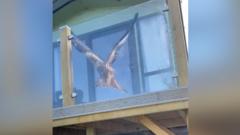
The intersection of high-density human temporary settlements—specifically caravan sites and holiday parks—and the hunting grounds of large raptors creates a recurring failure point in local biodiversity management. When a large bird of prey, such as an owl or buzzard, requires "rescue" within these environments, it is rarely a random event. Instead, it is the predictable outcome of habitat fragmentation and trophic level interference. Rescuing these animals requires more than localized empathy; it demands an understanding of the physiological stressors and environmental bottlenecks that forced the predator into a high-risk human zone in the first place.
The Triad of Raptor Displacement
The presence of an apex predator in distress at a caravan site is typically driven by three distinct variables. These factors dictate the bird’s physical condition and the subsequent success rate of any intervention.
- Nutritional Deficit and Hunting Inefficiency: Large raptors require significant caloric intake to maintain the high metabolic cost of flight and thermoregulation. Urban and semi-urban sprawl reduces the density of primary prey species (small mammals and amphibians). This forces the predator to expand its hunting radius, often entering human-dense zones where artificial lighting and noise pollution disrupt their sensory hunting mechanisms.
- Structural Entrapment: Caravan sites are characterized by high-frequency vertical and horizontal obstacles—power lines, glass panels, and awnings. Large wingspans, while optimized for open-field soaring or woodland maneuvering, become a liability in tight, artificial corridors. Impact trauma or exhaustion from navigating these "structural mazes" often precedes the need for rescue.
- Anticlockwise Biological Stress: A bird found on the ground is often in a state of metabolic shutdown. Raptors prioritize energy conservation; once they hit a specific threshold of exhaustion or dehydration, they cease flight to prevent irreversible muscle atrophy.
Biomechanical Mechanics of Raptor Injury
Understanding the severity of a grounded bird requires a systematic assessment of its kinetic chain. Unlike smaller birds, the sheer mass of a large raptor ($1.0$ kg to $4.5$ kg depending on the species) means that even low-altitude falls generate significant force.
The Kinetic Chain Failure
If a raptor is found unable to fly, the diagnostic focus must shift to the coracoid bones. These bones act as the primary structural struts of the avian shoulder. A hairline fracture here is invisible to the untrained eye but renders the bird flightless. The second most common failure point is the patagium, the skin membrane along the leading edge of the wing. Damage to this tissue compromises the lift-drag ratio, making sustained flight impossible.
- Primary assessment: Check for wing symmetry. An asymmetrical droop indicates skeletal or neurological trauma.
- Secondary assessment: Evaluate the "righting reflex." If the bird cannot maintain an upright posture, the issue is likely systemic—poisoning, severe dehydration, or head trauma.
The Hidden Variable: Secondary Poisoning
One of the most frequent, though invisible, reasons large birds of prey are found incapacitated in holiday parks is Rodenticide Accumulation. Caravan sites often employ heavy baiting programs to manage pest populations. Raptors that consume these weakened rodents undergo a process of bioaccumulation.
The physiological impact is a slow-motion collapse. Anticoagulant rodenticides inhibit the bird’s ability to recycle Vitamin K, leading to internal hemorrhaging. A bird in this state may appear "tame" or "dazed" because its brain is experiencing minor, persistent bleeds. What onlookers perceive as a "moment of rescue" is often the final stage of a chronic toxicological event.
Operational Rescue Protocols: Minimizing Capture Myopathy
The most significant risk during a rescue operation is not the bird’s talons, but a physiological condition known as Capture Myopathy. This is a hyper-metabolic state where extreme stress causes the bird’s muscles to break down at a cellular level, releasing myoglobin into the bloodstream and causing kidney failure.
To mitigate this, the rescue process must follow a strict Reduction of Input framework:
- Visual Occlusion: The immediate application of a dark, breathable cover (a towel or specialized hood) overrides the bird's visual processing centers, effectively "resetting" the nervous system into a dormant state.
- Temperature Stabilization: A grounded bird cannot effectively thermoregulate. It must be moved to a climate-controlled environment (approximately 20°C to 22°C) to prevent shock.
- Constraint vs. Containment: Avoid manual handling. The goal is containment in a solid-walled, ventilated box. Cages with bars are contraindicated as they cause feather breakage, which can delay the bird's return to the wild by months as it waits for a molt cycle.
Reintegration Logistics and Territory Fidelity
The "moment of rescue" is a singular point in a much longer timeline of ecological recovery. The ultimate metric of success is not the survival of the bird in a sanctuary, but its successful reintegration into its original territory.
Raptors are highly territorial. If a bird is removed from its site for more than 14 days, its territory is likely to be subsumed by a neighboring rival. This creates a "bottleneck of return." If the bird is released back into a now-occupied territory, it faces immediate physical combat while still in a post-recovery state.
The Release Decision Matrix
- Wing Load Testing: Before release, the bird must demonstrate a minimum lift capability equivalent to its body weight plus 20% to ensure it can hunt effectively.
- Weather Windowing: Release must occur during a 48-hour window of high pressure and low wind to allow for the re-establishment of territorial boundaries without the added stress of adverse weather.
- Site Assessment: If the site of rescue remains a high-risk zone (e.g., active construction or heavy rodenticide use), a "soft release" at a secondary location within the same 5km buffer is necessary to maintain genetic continuity in the local population.
Structural Mitigation for Caravan Site Management
The recurring nature of these incidents suggests that site managers must move beyond reactive rescue and toward environmental hardening.
- UV-Reflective Glass Coatings: Installing bird-safe films on large glass panels reduces the frequency of high-speed collisions.
- Integrated Pest Management (IPM): Transitioning from anticoagulant baits to mechanical traps reduces the risk of secondary poisoning to local apex predators.
- Vegetative Buffers: Planting native scrub at the perimeters of the site provides a "buffer zone" that allows raptors to hunt along the edge without being forced into the high-traffic central corridors of the park.
Strategic management of apex predators is not a matter of sentiment; it is a matter of maintaining the ecological checks and balances that prevent pest surges. Every "rescue" represents a failure in the local infrastructure. Correcting these systemic flaws is the only way to ensure that the "moment of rescue" does not become a recurring necessity.
Site operators should prioritize a transition to raptor-compatible lighting (low-blue-light LEDs) to minimize the disorientation of nocturnal hunters. This reduces the probability of ground-level displacement and ensures that the local raptor population remains an active asset in rodent control rather than a liability requiring emergency intervention.