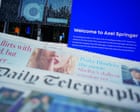
The auction for The Telegraph was never just about a newspaper. It was a proxy war for the soul of British conservatism and a brutal lesson in the shifting mechanics of global media capital. For months, Lord Rothermere, the billionaire proprietor of the Daily Mail, sat as the presumptive heir to the broadsheet. His path seemed clear after the British government effectively blocked the UAE-backed RedBird IMI bid on grounds of foreign state interference. But the collapse of the Gulf-funded dream did not hand the keys to the Mail Metro Media group. Instead, it opened a door for Friedkin, then snapped shut as a more formidable, cold-blooded contender emerged from Berlin. Axel Springer, the German titan behind Bild and Politico, has turned a predictable British succession into a geopolitical chess match.
Rothermere’s failure to clinch the deal early is a symptom of a deeper malaise in traditional UK media ownership. The assumption that the "local" billionaire would always be the lender of last resort for a distressed national asset has been proven false. High interest rates, the sheer scale of the debt attached to the Barclay family’s previous tenure, and the aggressive regulatory scrutiny applied to any merger involving the Daily Mail created a vacuum. Axel Springer didn’t just walk into that vacuum; they mapped it.
The Myth of the Natural Successor
For decades, the British press operated under a gentlemanly understanding of territory. Lord Rothermere’s interest in The Telegraph was seen by many in Westminster as a consolidation of the right-wing press that would ensure "stability." That stability, however, looks a lot like a monopoly to the Competition and Markets Authority (CMA). The moment the RedBird IMI deal faltered, the regulatory spotlight shifted directly onto the Daily Mail’s market share.
Critics argued that a combined Mail-Telegraph entity would control too much of the advertising revenue and political narrative in the UK. This regulatory friction acted as a tax on Rothermere’s ambitions. While he was busy navigating the corridors of power to prove his suitability, German capital was quietly evaluating the spreadsheets. Axel Springer’s interest isn't sentimental. They don't care about the prestige of owning a "Tory Bible" for the sake of a seat at the dinner table. They see a data-rich environment and a subscriber base that can be plugged into their global digital-first infrastructure.
Berlin's Digital Playbook vs Fleet Street's Nostalgia
The fundamental disconnect between the bidders lies in their vision for the future of news. To the traditional British owner, The Telegraph is a brand to be protected and curated. To Mathias Döpfner, the CEO of Axel Springer, it is an asset to be digitized, optimized, and potentially stripped of its legacy overhead.
Springer’s track record with Politico and Business Insider shows a ruthless focus on high-margin digital growth. They are not looking to keep a sprawling printing press operation running as a hobby. They want the 1.1 million subscribers and the influence that comes with a premium paywall. Their entry into the fray shattered the illusion that Rothermere was the only "safe" pair of hands. In fact, Springer’s distance from the UK’s internal political squabbles makes them, ironically, a more palatable owner for a government wary of a domestic media kingmaker.
The Debt Trap and the Barclay Legacy
We cannot understand the current chaos without looking at the wreckage left by the Barclay family. The £1.2 billion debt owed to Lloyds Banking Group was the original sin that put the paper on the block. RedBird IMI’s attempt to clear that debt with Emirati money was a clever financial maneuver that hit a brick wall of national security concerns.
When that deal was legislated out of existence, it left a massive financial hole. Rothermere’s bid was reportedly hampered by the need to find partners who wouldn't trigger the same "foreign influence" alarms while also satisfying the Barclays' lingering interests. Springer, fueled by private equity giant KKR, doesn't have the same liquidity constraints. They have the "dry powder" to outspend a domestic proprietor who is already feeling the squeeze of declining print revenues across his existing portfolio.
Why the Market Misread the German Intent
Industry analysts often mistake Axel Springer’s aggressive expansion for mere vanity. It isn't. The German group is currently undergoing a massive internal divorce, splitting its classifieds business from its media assets. This restructuring is designed to make the media wing more agile and attractive for further acquisitions.
The pursuit of The Telegraph is a strategic hedge. As the US market becomes increasingly saturated and litigious, the UK offers a high-value, English-language audience with a tradition of paying for news. The "German twist" in this tale isn't just about a new bidder; it's about the end of the era where British newspapers were the private playground of the British aristocracy.
The Regulatory Paradox
The British government finds itself in a bind of its own making. By blocking the UAE bid, they signaled that they would protect the press from foreign state control. However, they cannot easily block a private European corporation without appearing protectionist or breaking trade norms.
- Market Concentration: A Rothermere win creates a domestic giant that the CMA will likely dismantle.
- Sovereignty: A Springer win moves the editorial heartbeat of a British institution to Berlin.
- Viability: If neither can close the deal, the paper risks a slow decline under interim management.
This isn't a choice between good and bad; it's a choice between different types of disruption. The Daily Mail’s struggle to secure the deal highlights a growing reality: being the "patriotic" choice doesn't pay the bills in a globalized credit market.
The Overlooked Cost of Delay
Every week the sale remains in limbo, the value of the asset erodes. Talent is poaching. Advertisers are jittery. The editorial staff, caught between the specter of a German takeover and a Mail merger, are operating in a vacuum of leadership. The Barclays’ attempt to retain some sliver of control through various legal maneuvers only adds to the complexity.
The real reason the Rothermere dream is shattering isn't just because a German rival appeared. It’s because the financial model for a "national" newspaper has fundamentally broken. The cost of entry is now so high, and the regulatory hurdles so steep, that only those with global scale—like Springer—can justify the ticket price.
The Cultural Collision
There is a visceral resistance within the Telegraph newsroom to the idea of German ownership. It’s not just about the history; it’s about the style of journalism. Springer’s Bild is a populist powerhouse, while their more serious outlets are characterized by a very specific, often pro-corporate, editorial line.
British journalists fear a "Politico-fication" of the paper—a shift toward data-driven, punchy, inside-baseball reporting that ignores the broadsheet’s role as a cultural anchor for the British middle class. But sentiment doesn't vote in a boardroom. The creditors want their money back. If Springer offers a cleaner, faster exit for the debt holders, the cultural objections will be relegated to the letters page.
The Irony of "Free Markets"
It is a stinging irony for the Telegraph, a paper that has championed the free market for over a century, to find itself a victim of that very system. For years, its columnists argued for the deregulation of British industry and the opening of the UK to global capital. Now, that same global capital is arriving to take the keys, and the domestic owners find themselves outmuscled.
Rothermere’s plan relied on a sense of inevitability. He believed that once the "foreign" threat was neutralized, the path would be cleared for the "rightful" owner. He underestimated the appetite of the German machine. Springer is not looking for a trophy; they are looking for a platform. They have watched the decline of British print and concluded that the brand is worth more than the business. They can afford to overpay because they are not buying a newspaper—they are buying a gateway to the UK’s high-net-worth digital audience.
Structural Realities vs Editorial Hopes
We often focus on the names—Rothermere, Döpfner, Barclay—but the real drivers are the lenders. Lloyds and other financial institutions have no loyalty to the British establishment. They have a fiduciary duty to recoup losses. The complexity of the RedBird IMI exit, which involves a convoluted process of transferring debt into equity and then selling that equity, favors a buyer with a simple, transparent balance sheet.
Springer’s partnership with KKR provides that transparency. Rothermere, with his complex web of private holdings and offshore structures, faces a more grueling due diligence process. The "German twist" was actually a financial inevitability that the British media elite simply refused to see coming.
The struggle for The Telegraph has revealed a harsh truth about the state of the UK media. Influence is no longer a localized commodity. It is traded on the same global exchanges as tech stocks and energy futures. The dream of a British-owned, British-led conservative press is colliding with the reality of who actually has the cash to sustain it.
The next few months will decide if The Telegraph remains a British institution or becomes a subsidiary of a German multinational. Regardless of the winner, the era of the Fleet Street baron is over. The spreadsheets have won.
The paper’s future now rests on whether it can adapt to a digital model that its prospective owners understand far better than its current custodians. If Springer takes the helm, the change will be swift, data-driven, and entirely indifferent to the traditional sensibilities of the British establishment. This is the new reality of the news business: pay for your own seat or someone else will buy it from under you.