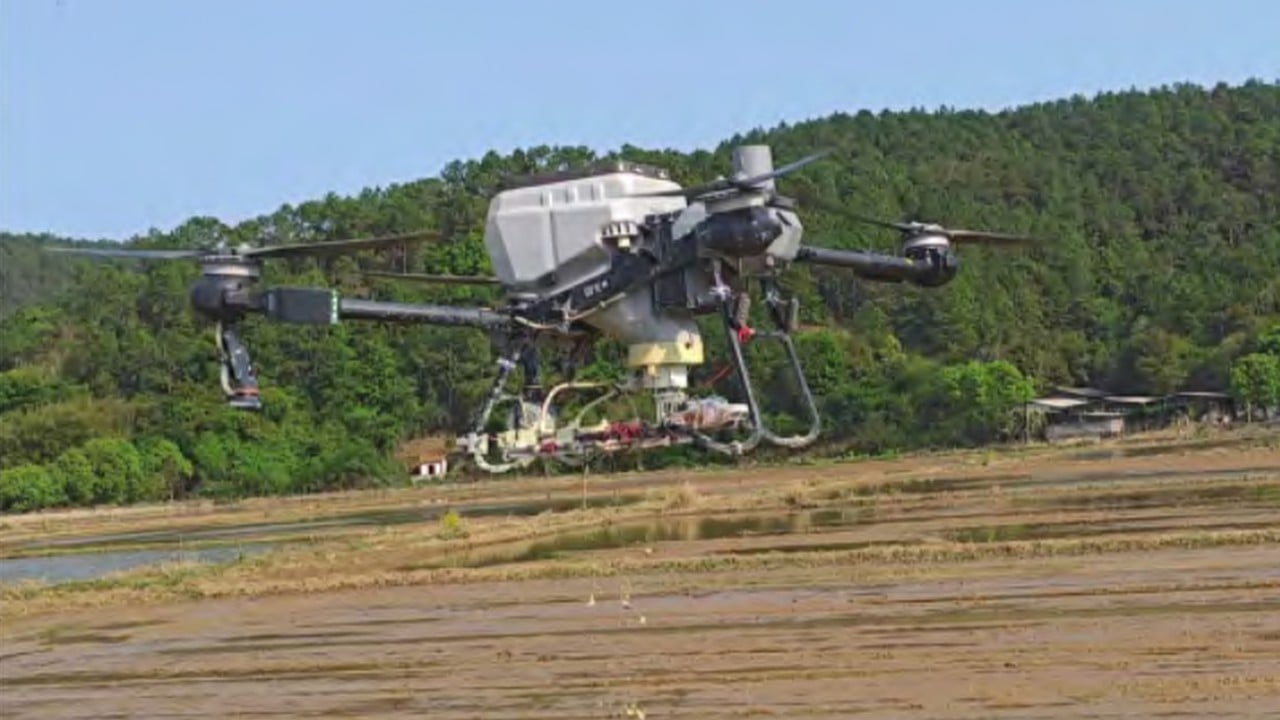
Conventional direct-seeded rice farming fails when soil conditions prevent mechanical traction, yet traditional aerial broadcasting suffers from severe germination losses due to surface exposure and avian predation. The development of drone-mounted pneumatic seed injection systems—often sensationalized in general media as "seed guns"—solves a specific mechanical bottleneck in precision agriculture: achieving uniform soil penetration without ground contact. By decoupling seed placement from chassis weight, high-velocity aerial injection transforms unmanned aerial vehicles (UAVs) from passive broadcasters into active soil-penetrating planters.
To understand the operational value of this mechanism, one must evaluate it against the physical constraints of paddy cultivation, the ballistics of biological payloads, and the unit economics of agricultural robotics. Recently making waves in this space: Why Nuclear Weapons Treaties Won't Save Us From AI.
The Soil-Contact Bottleneck in Paddy Cultivation
Rice cultivation operates across three primary planting methodologies, each governed by distinct labor, water, and mechanical constraints:
- Manual Transplanting: Seedlings are raised in a nursery and hand-planted into puddled, flooded soil. This method maximizes weed suppression and stand uniformity but requires massive labor inputs, creating acute vulnerability to rural demographic shifts and rising wage floors.
- Mechanized Transplanting: Tracked or wheeled transplanters automate seedling placement. However, heavy machinery compacts wet clay soils, requires precise water-level management prior to entry, and struggles in fragmented, terraced, or irregularly shaped plots common across East and Southeast Asia.
- Direct Seeding (Dry and Wet): Seeds are sown directly into the field, eliminating nursery management and transplanting shock. Ground-based seed drills achieve proper burial depth but remain restricted by soil trafficability; mud-clogged coulters and bogged tractors halt operations during peak monsoon windows.
Conventional agricultural drones attempted to bypass ground-contact limitations through centrifugal broadcasting—spinning discs that fling seeds across a swath width. While broadcasting solves the trafficability problem, it introduces a severe agronomic penalty. Seeds resting on the soil surface suffer from desiccation, poor root anchorage (leading to late-season lodging), uneven emergence, and high mortality from birds and rodents. Additional insights regarding the matter are covered by Wired.
Pneumatic drone-mounted injection addresses this exact failure mode. Instead of relying on gravity and surface friction, the system uses compressed air or mechanical spring-loaded actuators to accelerate coated or pre-germinated seeds downward, using kinetic energy to penetrate the top layer of soft, puddled mud.
The Physics of Ballistic Seed Delivery
Engineering a viable aerial seed injector requires balancing terminal velocity, structural integrity of the embryo, and aerodynamic stability over a variable altitude. Unlike standard aerial spraying, where droplet drift is managed through nozzle pressure and surfactant viscosity, ballistic planting operates as a discrete projectile problem.
Kinetic Energy vs. Embryo Viability
Every seed possesses a critical impact threshold. If the kinetic energy ($E_k = \frac{1}{2}mv^2$) at impact exceeds the structural tolerance of the seed coat and endosperm, the internal embryo fractures, resulting in zero germination. Conversely, if kinetic energy falls below the shear strength of the mud surface, the seed bounces or rests on top, reverting the system to an expensive broadcast spreader.
To widen the operational window between soil penetration and biological damage, engineers manipulate two variables:
- Pelletization (Mass Modification): Raw rice seeds have low mass and high drag, causing them to decelerate rapidly after leaving the barrel. Coating seeds in a clay, fertilizer, and binder matrix increases projectile mass, stabilizes aerodynamic flight, and shields the embryo from shock loading upon impact.
- Muzzle Velocity Modulation: Pneumatic systems adjust chamber pressure dynamically based on real-time soil resistance feedback or pre-mapped soil moisture data. Softer, saturated soils require lower exit velocities than partially drained clay loams.
Altitude Coupling and Dispersion Mechanics
A multi-rotor UAV does not operate as a static benchrest; it is a vibrating platform navigating turbulent downwash. Rotor wash creates high-velocity air currents directly beneath the airframe, which can deflect low-mass projectiles off-target.
Effective drone-mounted injectors mitigate this through barrel extension and firing synchronization. Extending the launch tube closer to the ground reduces the time of flight, minimizing crosswind drift and rotor-wash interference. However, flying at ultra-low altitudes (under 1.5 meters) increases collision risk on uneven terrain and narrows the effective swath width per pass. Consequently, the system must fire in rapid, multi-barrel bursts synchronized with ground speed via real-time kinematic (RTK) GPS, ensuring exact spatial distribution (hill-to-hill spacing) rather than random scatter.
Operational Architecture of an Aerial Injection System
Moving from a laboratory prototype to a field-ready agricultural tool requires integrating four subsystems into a unified payload constrained by battery energy density.
- The Hopper and Singulation Mechanism: Bulk seed must be separated into single units or calibrated micro-clusters without jamming. Mechanical fluted rollers or vacuum-assisted discs feed seeds into the firing chamber. Moist, pre-germinated seeds—often preferred for faster establishment—tend to clump, requiring agitators and non-stick coatings within the feed path.
- The Pneumatic Reservoir and Valve Array: Carrying heavy steel compressed-air tanks destroys flight endurance. Operational systems utilize lightweight carbon-fiber composite tanks or onboard miniature compressors powered by the drone's primary lithium-polymer battery bus. High-speed solenoid valves release precise bursts of air, with cycle rates dictated by forward flight velocity.
- RTK-GNSS and Terrain-Following Radar: Uniform plant density dictates yield. Without centimeter-level positioning, overlapping passes cause overcrowding and fungal pressure, while gaps invite weed proliferation. Millimeter-wave radar maintains constant height above the mud surface regardless of topographic dips, keeping impact velocity consistent.
- The Flight Controller Integration: Firing a projectile generates recoil. While the recoil of a single seed pellet is negligible, rapid-fire multi-barrel volleys create continuous upward thrust vectors. The flight controller must treat firing events as known disturbances, adjusting rotor RPMs instantaneously to maintain pitch and roll stability.
Unit Economics and the Cost Function of Aerial Planting
Technological novelty does not guarantee agricultural adoption; farmers adopt machinery only when it lowers the total cost per ton of harvested grain or mitigates catastrophic seasonal risk. Evaluating drone-based ballistic planting requires examining its cost function relative to ground mechanization.
Payload-to-Battery Trade-offs
The primary economic bottleneck of heavy-lift agricultural drones is energy density. A commercial agricultural UAV typically carries a payload between 30 and 50 kilograms, achieving flight times of 10 to 15 minutes per battery cycle.
Seeding rates for direct-seeded rice generally range from 30 to 60 kilograms per hectare, depending on tillering capacity and germination rates. If seed pelletization doubles or triples the weight of the payload to achieve ballistic stability, a single drone sortie can cover less than half a hectare before requiring a battery swap and hopper refill. High operational throughput therefore demands a ground-support ecosystem: mobile battery charging trailers, rapid-swap hopper cartridges, and a two-person crew operating multiple airframes in relay.
Capital Expenditure vs. Labor Displacement
In regions with high labor scarcity, the capital expenditure of a heavy-lift drone fleet is amortized quickly against manual transplanting wages. However, where wheeled or tracked mechanical transplanters already operate efficiently on large, consolidated, flat fields, aerial ballistic injection struggles to compete on pure operating cost per hectare. Ground machines carry massive seed loads, operate continuously for hours on diesel fuel, and achieve near-100% placement accuracy.
The economic sweet spot for drone injection lies in marginal and high-friction environments:
- Fragmented Terraces: Hilly regions where moving heavy machinery between plots requires manual disassembly or narrow-track transport.
- Waterlogged Floodplains: Delta regions where early monsoon rains prevent tractors from entering the field during the optimal planting window, where a two-week delay directly reduces photosynthetic grain-filling periods and final yield.
- Ratoon and Relay Cropping: Systems where a second crop is planted into a standing primary crop before harvest, where ground wheels would crush existing biomass.
Systemic Limitations and Agronomic Risks
Presenting pneumatic drone planting as a universal replacement for ground machinery ignores severe biological and mechanical failure modes.
Soil Crusting and Burial Depth Variance: If soil moisture is inconsistent across a single paddy—dry patches mixed with standing water—a fixed pneumatic pressure setting will produce erratic results. Seeds fired into dry clay will shatter or sit exposed; seeds fired into deep water will sink too far into anaerobic mud layers, exhausting their endosperm reserves before the coleoptile reaches oxygen and sunlight.
Weed Management Escalation: Transplanting gives rice seedlings a three-to-four-week head start over germinating weeds, and flooded paddy conditions naturally suppress terrestrial weed species. Direct-seeded rice—whether drilled or ballistically injected—emerges simultaneously with competitive grasses like Echinochloa crus-galli (barnyard grass). Adopting aerial injection requires an immediate, parallel upgrade in pre-emergence herbicide chemistry and precise water management protocols; otherwise, weed competition will erase any yield gains from uniform seed placement.
Maintenance Complexity in Abrasive Environments: Agricultural environments are hostile to precision pneumatics. Dust from clay seed coatings, high ambient humidity, and corrosive fertilizer residues degrade solenoid seals and jam singulation rollers. Field-level reliability requires modular, tool-free component replacement, as downtime during a narrow planting window costs far more than the hardware itself.
Strategic Deployment Playbook
For agribusinesses, equipment manufacturers, and agricultural cooperatives evaluating ballistic aerial seeding, deployment should follow a disciplined sequence rather than broad-acre substitution:
- Target High-Friction Acreage First: Deploy aerial injection exclusively on non-trafficable soils, fragmented terraces, and flood-prone deltas where ground machinery experiences high bogging rates or severe logistical transport delays. Do not compete head-to-head against high-horsepower ground drills on large, consolidated, well-drained acreage.
- Standardize Seed Pelletization Locally: Establish regional pelletizing facilities that coat locally adapted rice varieties with standardized clay-binder formulations. Selling the drone hardware without controlling projectile mass and diameter guarantees inconsistent field germination and customer churn.
- Bundle Herbicide and Water Protocols: Market the technology as an integrated agronomic package rather than a standalone hardware tool. Pair every aerial seeding service contract with a matched pre-emergence herbicide spray pass (executed by the same drone fleet 48 to 72 hours post-seeding) to lock in stand establishment before weed emergence.
- Optimize Ground Logistics for Relay Operations: Engineer the ground support unit around a 3:1 battery-to-drone ratio and pre-loaded, quick-release seed hoppers to keep airframe utilization above 75% during daylight operating windows, driving down the fixed-cost amortization per hectare.