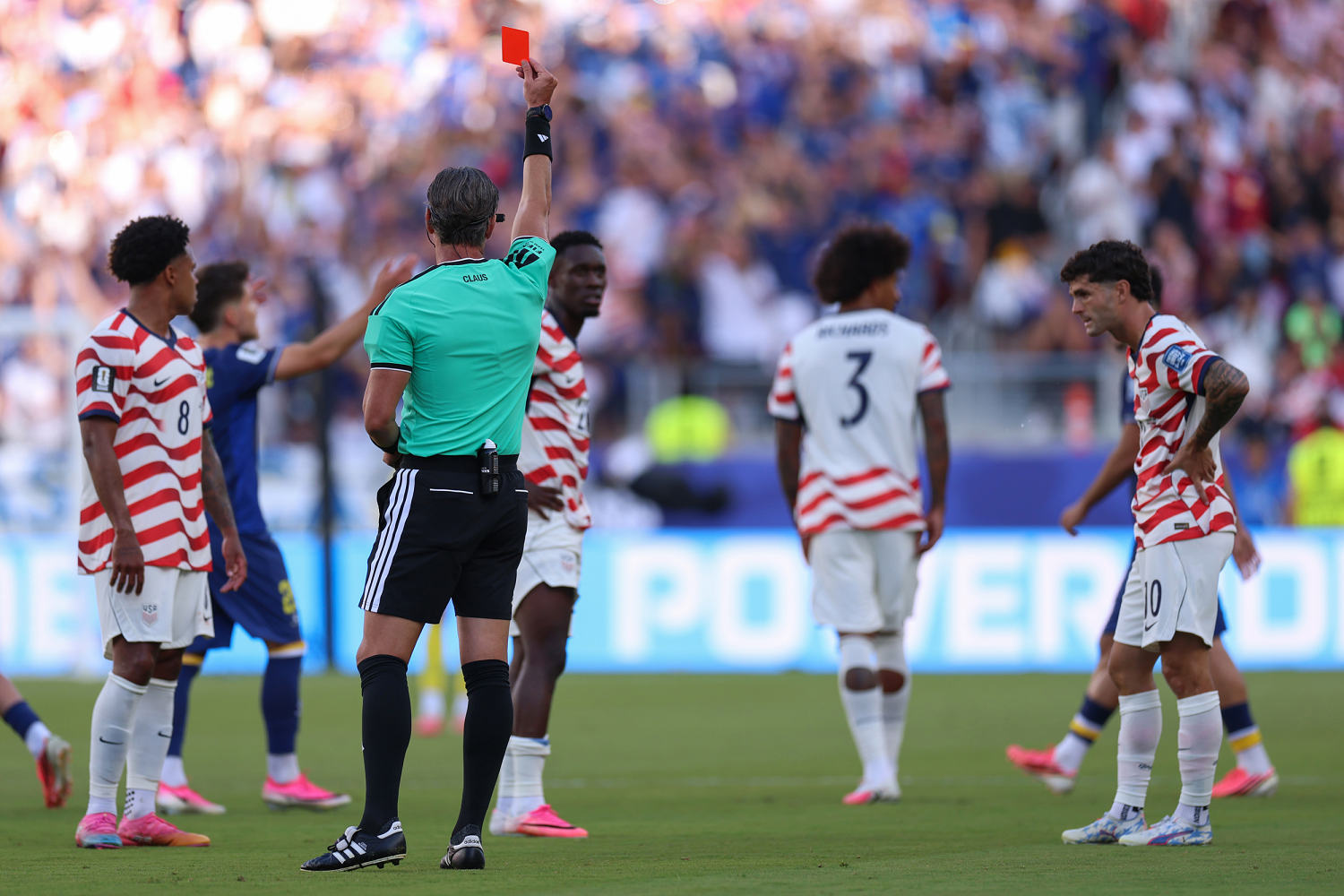
The advancement of the United States Men’s National Team (USMNT) to the knockout stages of international competition presents a paradox of structural survival masked by systemic vulnerability. While tournament progression remains the primary metric of success, the mechanical cost of achieving that progression under optimization stress introduces severe friction for subsequent matches. Specifically, the red card issued to striker Folarin Balogun does not merely represent a temporary disciplinary lapse; it alters the team's tactical equilibrium, forces structural reconfigurations, and degrades the squad's efficiency metrics ahead of high-leverage knockout fixtures.
Evaluating the true impact of this disruption requires shifting away from superficial narrative analysis toward a rigorous breakdown of tactical systems, squad depth constraints, and the mathematical reality of playing short-handed in international football. For a deeper dive into this area, we recommend: this related article.
The Mechanics of In-Game Structural Degradation
When a high-pressing, possession-oriented side loses its focal point in the attacking third due to a dismissal, the tactical degradation is immediate and measurable. The immediate response is an involuntary structural retreat. A team that typically operates with a high defensive line and dense counter-pressing triggers must transition into a low-block or mid-block architecture to preserve vertical compactness.
The structural shift involves a distinct series of tactical compromises: To get more context on this issue, extensive reporting can also be found on Bleacher Report.
- Loss of the Primary Pressing Trigger: Modern attacking systems rely on the center-forward to dictate the direction of the opponent’s buildup. By cutting off passing lanes to one side of the pitch, the striker forces the opposition into pre-determined pressing traps. Without this initial point of friction, opponents circulate the ball cleanly into the midfield pivot, shifting the defensive burden entirely onto the second line of pressing.
- Contraction of Vertical Spaces: To compensate for the numerical disadvantage, the defensive and midfield lines must contract. This reduces the distance between the back four and the midfield line to less than fifteen meters, effectively conceding territorial control in the middle third of the pitch to prevent central penetration.
- The Isolation of Wide Attackers: In a compromised shape, the remaining wingers are forced to drop deep to provide defensive coverage against overlapping fullbacks. This converts a proactive 4-3-3 or 4-2-3-1 structure into a reactive 4-4-1 or 5-3-1, isolating the remaining lone attacker and removing any immediate outlet for vertical counter-attacks.
The statistical consequence of this retreat is reflected in the Passes Per Defensive Action (PPDA) metric. A lower PPDA indicates a high-intensity press, whereas a sharp increase in PPDA indicates a passive defensive posture. When a key attacking asset is dismissed, the team's PPDA typically inflates by 40% to 60%, signaling a total abandonment of high-territory defensive actions. This structural passivity invites sustained pressure, increasing the probability of conceding high-value chances via volume rather than systemic failure.
Quantifying the Attacking Deficit Without Balogun
Folarin Balogun provides specific tactical attributes that cannot be replicated by a simple personnel substitution. To quantify what the USMNT loses during his suspension, we must examine the specific mechanics of his profile: line-breaking movement, box presence, and transition velocity.
Balogun’s primary value lies in his capacity to stretch opposing defensive blocks vertically. His tendency to make blind-side runs behind central defenders forces the opposition backline to drop deeper, which opens up the critical "Zone 14" space between the opponent’s midfield and defensive lines. This space is where creative midfielders operate. Without a constant threat running in behind, opposing center-backs can step up aggressively, compressing the midfield space and suffocating the creative output of players like Christian Pulisic or Weston McKennie.
The drop-off in attacking output can be modeled through historical Expected Goals (xG) data and shot creation metrics.
Standard Attacking Phase with Balogun:
[Midfield Possession] ---> [Balogun Deep Run] ---> [Defensive Line Retreats] ---> [Space Opens in Zone 14] ---> [High xG Shot Opportunity]

Compromised Attacking Phase without Balogun:
[Midfield Possession] ---> [No Deep Threat] ---> [Defensive Line Steps Up] ---> [Midfield Compressed] ---> [Low-Value Wide Cross or Turnover]
Analysis of historical matches where the USMNT operated without an elite, mobile number nine demonstrates a distinct pattern. The team experiences a significant reduction in central box entries, forcing a heavy reliance on wide crosses from deep positions. Crosses from deep areas carry a historically low conversion probability, often registering less than 0.03 xG per attempt. Balogun’s absence shifts the shot profile from high-probability central involvements within the eighteen-yard box to low-probability opportunities generated under heavy defensive duress.
The Substitution Bottleneck and Squad Depth Limits
Replacing a starting caliber international striker requires navigating a severe depth bottleneck. In tournament soccer, squad selection is a zero-sum calculation. The drop-off from the primary option to the secondary and tertiary profiles introduces tactical friction that forces the coaching staff to modify the entire attacking blueprint.
Consider the functional profiles of the available replacement options:
The Target Man Profile
Utilizing a traditional physical target man shifts the attacking mechanics from dynamic transitions to direct aerial buildup. While this profile offers a reliable outlet to escape pressure via long vertical distributions, it fundamentally changes the tempo of the attack. A target man lacks the recovery speed to exploit high defensive lines on the counter-attack, meaning the team must commit more bodies forward to support the second ball. This increases vulnerability to counter-transitions.
The False Nine Profile
Deploying a creative winger or attacking midfielder as a false nine enhances possession retention in the middle third but completely eliminates a physical presence inside the penalty box. This tactical choice often results in sterile possession, where the team circulates the ball cleanly around the periphery of the defensive block without penetrating the penalty area. The absence of a fixed focal point allows opposing center-backs to defend horizontally rather than vertically, simplifying their defensive assignments.
The operational limitation here is not merely individual talent; it is structural compatibility. The entire tactical framework built during the preparation phase is optimized for a specific profile. Introducing a mismatched profile into the starting eleven breaks down established passing sequences and spatial automated behaviors, leading to increased unforced errors and lower execution speeds during critical transitions.
Tournament Fatigue and Cumulative Physical Toll
The downstream effects of a red card extend far beyond tactical configurations; they impose a severe physical tax that compounds over the course of a tournament. Playing down a man for an extended duration forces the remaining nine outfield players to cover significantly more ground to protect space.
Data from GPS tracking systems in elite soccer indicates that an average outfield player covers between 10 to 12 kilometers per ninety-minute match. When a team drops to ten men, the collective distance required to cover defensive spaces increases by roughly 8% to 11% per player. More importantly, the volume of high-intensity sprints (defined as movements exceeding 25.2 kilometers per hour) escalates rapidly for the central midfielders and fullbacks, who must cover wide spaces to assist the shifted defensive blocks.
This acceleration of physical depletion creates a compounding deficit:
- Elevated Lactate Accumulation: The lack of controlled possession forces prolonged periods of anaerobic exertion, increasing muscular fatigue and recovery timelines.
- Delayed Cognitive Processing: Physical exhaustion directly correlates with a degradation in decision-making speeds. In knockout football, a fraction-of-a-second delay in tracking a runner or closing down a shooting lane results in conceded goals.
- Suboptimal Rotation Cycles: Because the players expended excessive energy surviving the group-stage finale, the coaching staff cannot utilize standard rotation patterns. They are forced to choose between starting fatigued first-choice assets or fresh but tactically inferior reserve players in a do-or-die knockout match.
This physical tax directly compromises the team’s closing capacity in the subsequent match. Teams that endure a prolonged short-handed performance in the final group stage game consistently show a statistical decline in high-intensity running metrics during the second half of their next knockout fixture.
Strategic Matrix for Knockout Survival
To mitigate the tactical and structural deficits caused by Balogun's suspension, the coaching staff must deploy a highly calculated strategic framework. Relying on emotional motivation or unstructured resilience is a failing strategy against elite knockout opposition. The solution must be structural, disciplined, and tailored to minimize the specific vulnerabilities identified.
The following operational framework outlines the necessary tactical adjustments required to optimize the squad's survival probability in the upcoming knockout fixture:
- Implement a Mid-Block PPDA Cap: Rather than attempting an energy-intensive high press or collapsing into an unsustainable low block, the team should institute a disciplined mid-block structure. The pressing trigger should be strictly capped at the halfway line, preserving physical reserves and maintaining vertical compactness while denying the opponent easy entry into the final third.
- Asymmetrical Fullback Deployment: To balance the loss of central attacking threat, one fullback must be given license to act as an inverted midfielder during possession phases, creating a numerical overload in the center of the pitch. Concurrently, the opposite fullback must remain deep to form a permanent three-man rest-defense structure, preventing exposure to rapid counter-attacks.
- Transition Focus on Direct Set-Piece Generation: With open-play xG metrics compromised by the loss of the primary striker, the strategic value of set-pieces increases exponentially. The attacking strategy must prioritize drawing fouls in the final third and maximizing high-value corner routines, utilizing physical central defenders to offset the lack of open-play goal-scoring efficiency.
The ultimate limitation of this strategy is its low margin for error. A defensive system operating under these constraints can be undone by a single missed assignment or an individual technical error. The structural adjustments described do not guarantee a fluid, high-scoring performance; rather, they are designed to suppress the opponent's efficiency, manage the game-state effectively, and engineer a narrow pathway through the tie via defensive rigidity and set-piece optimization. The success of the knockout campaign depends entirely on the flawless execution of this defensive blueprint.


