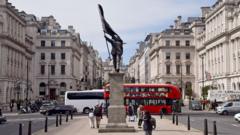
The sudden appearance of a statue bearing Banksy’s signature in London has ignited the usual firestorm of social media speculation and amateur sleuthing. Within hours of its discovery, crowds gathered, phone cameras clicked, and the valuation machine began to hum. But for those who have tracked the Bristol-born artist’s career from the early days of stencil-and-run tactics to the high-stakes spectacle of the Sotheby’s shredder, this latest "discovery" feels less like a gift to the public and more like a calculated exploit of a crumbling verification system.
The core of the issue is not whether the work looks like a Banksy. It is whether the signature—the literal mark of the man—is being used as a smoke screen for a sophisticated market manipulation. Banksy does not sign his street work with a formal, etched signature in the way a traditional sculptor might. He uses Pest Control. If the piece hasn't been authenticated by his official body, it isn't a Banksy. It is just a piece of metal or stone taking up sidewalk space. Meanwhile, you can read other events here: The Death of the Jolt and the Rise of the Aesthetic Commodity.
The Mechanics of a Modern Art Hoax
Street art is inherently illegal. That is its power. When a piece appears overnight with a tidy signature and a lack of local council interference, the red flags should be deafening. The "why" behind these pop-up installations is rarely about social commentary anymore. Instead, it is about real estate and the secondary market.
Adding a Banksy signature to a physical object in a public space instantly increases the "eyes on" value of that specific location. We have entered an era where property developers and business owners are incentivized to turn a blind eye to—or even commission—imitation works. They know that even a disputed Banksy can drive foot traffic, increase the valuation of a building, and serve as a focal point for a neighborhood's gentrification. To understand the full picture, we recommend the detailed analysis by Vanity Fair.
The process is simple. An anonymous artist creates a piece in a high-traffic area. They mimic the stylistic tics of the world’s most famous vandal. They leave behind a signature that looks just authentic enough to trigger a viral news cycle. By the time Pest Control issues a "non-authentic" verdict weeks later, the physical space has already been monetized. The news outlets have already run the headlines. The myth has done its job.
The Problem with the Signature
Historically, Banksy used his signature sparingly. His brand was built on a specific aesthetic, a dark humor, and a refusal to play by the gallery rules. When he moved into three-dimensional work, such as the pieces seen in Dismaland or the Walled Off Hotel, the authentication was built into the provenance of the event or the location itself.
A standalone statue appearing on a London street with a prominent signature is a reversal of his entire methodology. It is a loud, desperate grab for attention that contradicts the stealth-focused operations he has perfected over thirty years. True Banksy works are usually discovered by the public, not announced by the presence of a name tag.
The Valuation Trap
The art market thrives on scarcity and certainty. Banksy provides the scarcity, but he intentionally denies the certainty. This creates a vacuum that "found" statues and murals rush to fill.
Consider the logistical nightmare of a public statue. Moving several hundred pounds of material into a central London location requires equipment, timing, and likely several accomplices. In a city with more CCTV cameras per square inch than almost anywhere on earth, the idea of an "anonymous" installation is becoming a fairy tale.
If this work was not caught on camera during its placement, it suggests one of two things. Either the installers had access to the security feeds, or they had the permission of the property owner. Neither scenario aligns with the "outsider" persona that Banksy has cultivated. If you have permission, you aren't a street artist; you're a contractor.
Why the Public Still Falls for It
We want to believe in the mystery. There is a specific thrill in thinking you have stumbled upon a million-pound secret while walking to get coffee. This emotional investment is exactly what the counterfeiters exploit. They aren't just faking a statue; they are faking an experience.
The media plays its part by prioritizing speed over accuracy. A headline stating "New Banksy Appears" gets ten times the clicks of one titled "Unverified Statue Mimics Famous Artist." By the time the correction is buried on page sixteen, the false narrative has already solidified in the public consciousness.
The Pest Control Gatekeeper
Pest Control remains the only entity that can turn a piece of street junk into a global asset. Their refusal to authenticate "street" pieces that were intended to remain in situ is a deliberate attempt to thwart the very market that this new statue is trying to court.
When a statue appears with a signature, it is a direct challenge to this authority. It attempts to bypass the official channels by building such a massive groundswell of public opinion that the authentication becomes a formality. But Pest Control has shown time and again that they are willing to let "popular" works rot in the "Undeclared" pile if they suspect the work was created for commercial gain rather than artistic expression.
This standoff is where the real drama lies. On one side, you have the anonymous creators and the speculators hoping for a payday. On the other, you have a small team of people dedicated to protecting the integrity of a brand that was never supposed to be a brand in the first place.
The Aesthetic of Imitation
The statue in question relies heavily on the "Banksy trope" list. It likely features a juxtaposition of innocence and violence, or perhaps a critique of capitalism that feels just a bit too polished.
Genuine Banksy work usually contains a "sting"—a specific detail that makes the viewer uncomfortable or forces a realization. Imitations, however, tend to focus on the "look." They use the same color palettes and the same stencil-adjacent textures because those are the elements that are easiest to replicate. They provide the comfort of the familiar without the bite of the original.
Authenticity in the 21st century is not about the object; it is about the intent.
If the intent of the London statue was to spark a conversation about public space, it failed. If the intent was to drive up the value of the surrounding square footage, it is a resounding success. We are witnessing the shift from street art as a weapon of the disenfranchised to street art as a tool for the developer.
The Risk of the "Signed" Sculpture
The danger of this trend is the dilution of the genre. When every city has a "Banksy-esque" sculpture, the impact of the actual artist’s work is lessened. It becomes background noise, part of the urban "creative" aesthetic that includes overpriced avocado toast and coworking spaces with neon signs.
The signature is the final nail in the coffin. It is an admission that the art cannot stand on its own. It needs the celebrity name to justify its existence. For an artist who has spent his life mocking the elitism of the art world, having his name used as a cheap marketing tag is the ultimate irony.
Investors and fans alike need to look past the bronze and the signatures. They need to ask who benefits from the statue being there. If the answer involves a real estate firm, a PR agency, or a "street art" gallery with a suspiciously high stock of prints, the piece is a commodity, not a contribution to the culture.
The London statue will likely be removed, or boxed in by a layer of plexiglass, within the week. It will be debated on morning talk shows and analyzed by "experts" who haven't stepped foot in a spray-paint shop in their lives. But the reality is that the real Banksy probably isn't in London at all. He is likely somewhere else, working on something that doesn't have his name on it, waiting for us to stop looking at the signature and start looking at the world.
Stop looking for the name in the corner. If the work is good, the name doesn't matter. If the work is bad, the name is just a lie told in metal.