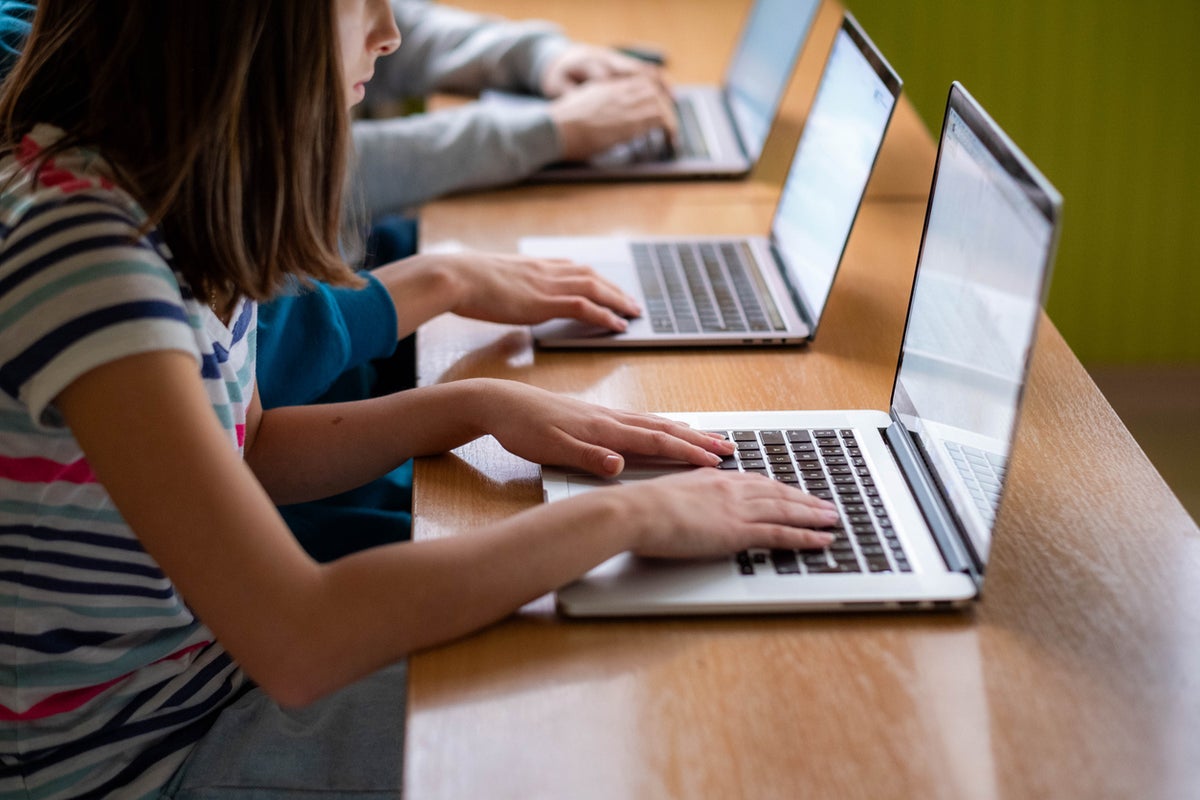
Panic makes terrible policy. Six states just passed laws restricting classroom screen time because politicians want panicked parents to feel seen, ignoring how actual learning works. The lazy consensus says laptops are rotting young minds, turning classrooms into digital daycares, and handing our kids over to tech monopolies. Strip away the hand-wringing and you find a much simpler, uglier truth: schools are not failing because of glowing rectangles. They are failing because we refuse to fix how adults teach.
I have spent the last decade watching districts blow millions on shiny hardware without a shred of pedagogical strategy, only to panic and try to ban it all five years later. That is not reform. That is administrative whiplash.
Let us get terms straight. "Screen time" is a lazy metric invented by people who cannot distinguish between a kid playing mindless video games on a phone and a student building an interactive simulation of cell mitosis or collaborating on a live Google Sheet. Lumping a TikTok scroll in with active code compilation is intellectual fraud. When a state legislature passes a blanket ban on classroom laptops, they are treating a 15-year-old high schooler preparing for a digital economy the exact same way they treat a toddler staring at an iPad during dinner. It is absurd.
The Nostalgia Trap
The entire anti-screen movement rests on a romanticized myth of the 1990s classroom. We picture engaged students hanging on every word of a charismatic teacher while quietly taking meticulous notes in spiral-bound notebooks.
That never existed on a mass scale.
In reality, the average classroom before laptops featured widespread daydreaming, note-passing, textbook-doodling, and profound, crushing boredom. The hardware did not kill attention spans. Attention spans were already fragile because passive lecture formats go against everything cognitive science tells us about how the human brain processes information.
Blaming the laptop for student disengagement is like blaming the kitchen stove for a bad meal. The tool is neutral. The execution is garbage. When a lesson is built around active problem-solving, real-time peer critique, and dynamic data analysis, devices become invisible extensions of the mind. When a lesson consists of a teacher reading bullet points off a projector, a laptop becomes a slot machine for distraction.
Removing the laptop does not fix a boring teacher. It just forces the kid to stare blankly into space or carve initials into their wooden desk instead.
What the Panic Peddlers Get Wrong
Look closely at the arguments coming out of these state legislatures and you will find a fundamental misunderstanding of the modern workforce. Lawmakers love to claim they are protecting kids from distraction. What they are actually doing is insulating them from reality.
Every modern workplace runs on asynchronous communication, multi-screen data synthesis, cloud collaboration, and digital fluency. If you spend twelve years shielding a student from digital workflows under the guise of "mindfulness" or "analog purity," you are dropping them off at the edge of a cliff the day they turn eighteen.
Imagine a scenario where a university engineering professor tells incoming freshmen that laptops are banned because they hinder deep thought. Those students would transfer out by noon. Higher education abandoned the paper-only model decades ago. The professional world abandoned it even earlier. Pretending that middle or high school is a sanctuary where paper magically performs better than pixels is a profound disservice to the kids.
I admit the downsides of my own stance. Unregulated device access creates a constant tax on executive function. Multitasking is a cognitive myth; students juggling Discord chats and a history essay are operating at a fraction of their capacity. The digital environment is engineered for addiction, and expecting an adolescent prefrontal cortex to resist push notifications without scaffolding is foolish.
But the answer to cognitive friction is not throwing the hardware in a dumpster. The answer is teaching digital hygiene, enforcing structural boundaries, and designing environments where distraction carries an actual cost. Banning the tools because kids don't know how to use them yet is like banning cars because teenagers tend to speed.
The Real Crisis Is Not the Screen
The obsession with screen time is a convenient smoke screen for school boards and politicians who refuse to tackle structural failures. It is much easier to pass a bill banning devices than it is to reduce class sizes, invest in intensive teacher professional development, or update curricula that were designed for the Eisenhower administration.
When a teacher has thirty-five students in a room, differentiation is impossible without technology. Adaptive software can help meet a struggling reader where they are while an advanced student pushes ahead. Take that away in the name of analog purity, and the teacher is forced to teach to the literal center of the room, leaving everyone else behind.
We are trading equity for nostalgia. Wealthy private schools will continue to use cutting-edge tools to prepare their students for elite universities, while public schools bound by screen bans will teach kids how to use a dictionary and a TI-84 calculator. That is not protection. That is a class trap.
Stop trying to regulate the physical objects on the desk and start evaluating the cognitive demand of the tasks we assign. If the work requires a brain, the screen is just glass. If the work requires a pulse, no amount of paper will save it.


-annual-meeting.jpeg?width=1200&auto=webp&trim=0%2C0%2C0%2C0)