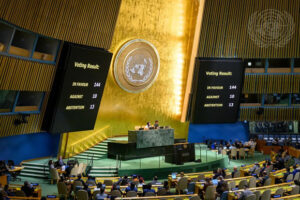
Everyone is losing their minds over Volker Türk getting another four years as the United Nations High Commissioner for Human Rights.
Washington screams about backroom deals. Paris postures about moral leadership. Moscow tries to shrink the clock. The pundit class treats the 144 to 10 General Assembly blowout as a referendum on global justice.
It is all smoke.
The entire obsession with who holds the gavel at the Office of the United Nations High Commissioner for Human Rights is a masterclass in missing the point. The lazy consensus in international relations says that a tougher, louder, or more ideologically aligned chief can whip the global human rights apparatus into shape. That belief assumes the machinery actually works if you just turn the crank hard enough.
It does not.
Focusing on the personality at the top hides the structural rot underneath. The architecture of international oversight is built to protect sovereign impunity, not to stop atrocities. Arguing over Türk is like debating the interior decorating choices of a house built entirely on quicksand.
The Myth Of Administrative Salvation
Let us clear away the diplomatic throat-clearing. Critics point to Türk's record, his institutional pedigree inside the UN bureaucracy, and the quiet, fast-tracked nomination by outgoing Secretary-General António Guterres as procedural foul play. They are not wrong about the mechanics. It was rushed. It bypassed open deliberation.
Yet, pretending that a different bureaucrat would change the structural output of the General Assembly is institutional gaslighting.
Imagine a scenario where a hypothetical human rights chief arrives with a mandate to aggressively sanction every rogue state on earth without fear or favor. Within forty-eight hours, the funding dries up, visa committees lock down, and host-country agreements vanish. The UN is an association of states, many of which treat domestic dissent as a competitive sport. Giving an official a four-year contract extension does not grant them an army, an enforcement division, or a magical immunity to geopolitics.
The office relies on naming and shaming. Shaming only works if the target cares about its reputation. When autocracies stop caring about polite letters from Geneva, the entire institutional model flatlines. No amount of rhetorical fire from the High Commissioner alters that math.
Weaponized Hypocrisy In The General Assembly
The floor fight revealed something far more revealing than Türk's administrative competence. It exposed the transactional nature of global diplomacy.
When the United States denounces the process as cronyism, and France accuses Washington of losing its moral compass, they are not fighting for human rights. They are fighting for narrative control. Western democracies want a human rights office that exclusively targets their geopolitical rivals while ignoring structural compromises closer to home. Authoritarian blocs want an office that treats basic liberties as a matter of "cultural relativism."
Both sides miss the operational reality. The UN human rights machinery operates on consensus compromise and lowest-common-denominator resolutions.
When 144 nations voted to lock in continuity, they were not endorsing a visionary human rights crusade. They were voting for stability. They wanted an predictable administrator who knows how to keep the lights on in Geneva without triggering an immediate fiscal crisis. Expecting revolutionary justice from a body designed to prevent world wars through polite deadlock is organizational illiteracy.
Stop Watching Geneva
If you want to track where human rights actually live or die, stop looking at the General Assembly podium.
Real accountability happens away from the diplomatic cocktail circuits in Vienna and New York. It happens through localized digital forensics, independent open-source intelligence clearinghouses, targeted transnational sanctions, and domestic legal maneuvers like universal jurisdiction exercised by individual national courts.
When local activists track supply chains to forced labor camps, they do not wait for a press release from the High Commissioner. When investigative outfits map detention facilities using satellite data, they bypass the diplomatic gridlock entirely.
The global bureaucracy is built for theatre. Treat it as such. Watching the high-stakes political theater over who runs a toothless office is a waste of intellectual capital. The system is performing exactly as designed: talking loudly, moving slowly, and changing nothing.
Stop looking for saviors in glass towers.
US And France clash at UN over human rights vote
This video provides additional context on the diplomatic fallout and public clash between Western allies following the contentious United Nations vote.


