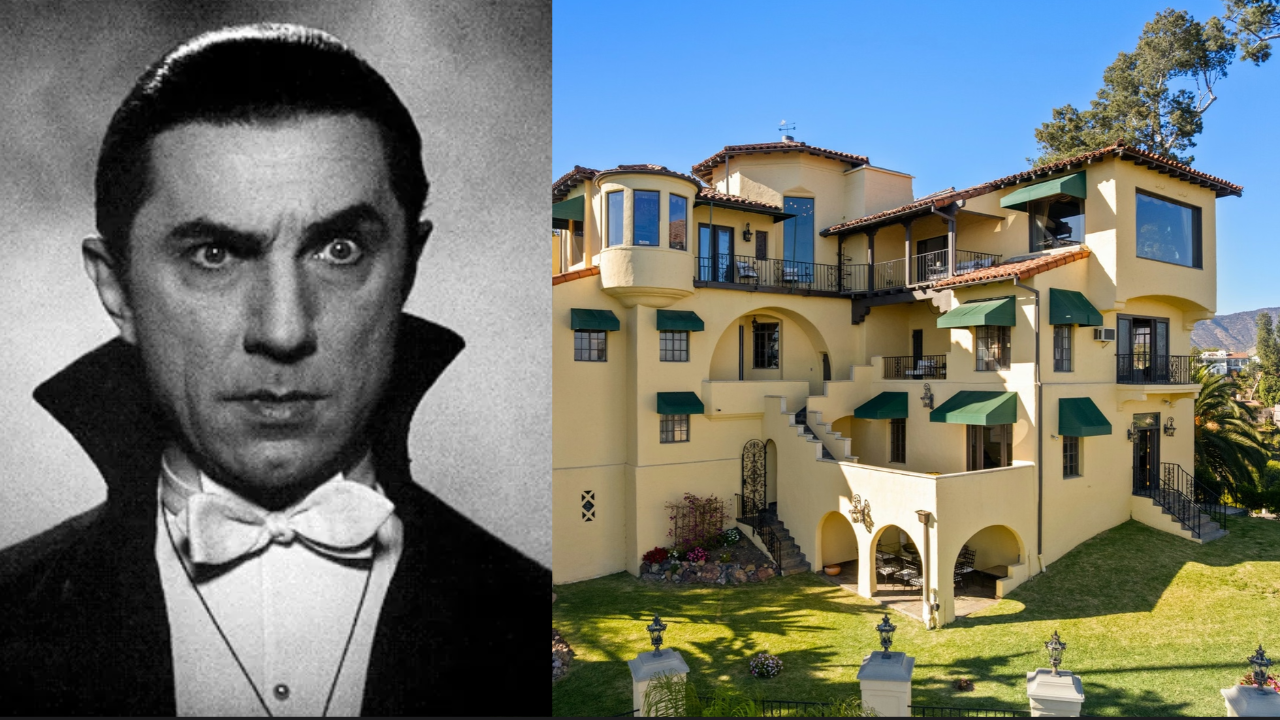
Bela Lugosi never slept in a daytime coffin at that Outpost Estates mansion, and whoever just paid $6.75 million for the Hollywood Hills property bought a remarkably expensive piece of fiction.
Every real estate outlet in Los Angeles ran the same breathless headline this week. They leaned hard into the gothic novelty, recycling ninety-year-old studio press releases about the Dracula star lounging in velvet-lined caskets to justify an eye-watering price tag in a sluggish luxury market. It makes for great clickbait. It also completely obscures what actually happened in this transaction, how celebrity provenance really works in Southern California real estate, and why attaching a dead actor’s gimmick to a residential deed is usually a financial liability disguised as prestige.
The Myth of the "Dracula" House
Let’s clear up the Hollywood folklore before looking at the balance sheet.
During the early 1930s, Universal Pictures ran one of the most aggressive publicity machines in entertainment history. Studio publicists fabricated eccentric habits for their contract players to feed fan magazines like Photoplay and Modern Screen. Boris Karloff was painted as a quiet British intellectual; Bela Lugosi was marketed as a nocturnal aristocrat who couldn't shake his Transylvanian roots. Stories circulated that Lugosi kept a coffin in his home on Outpost Drive, sleeping inside it during daylight hours to stay in character.
Biographers—most notably Arthur Lennig in The Immortal Count and Gary Don Rhodes in Lugosi—thoroughly debunked this decades ago. Lugosi was a working stage actor from Hungary who liked cigars, Hungarian goulash, and Union organizing (he was an early, vocal founder of the Screen Actors Guild). He moved frequently, struggled with crippling sciatica, and eventually went bankrupt due to tax issues and morphine addiction. He didn't sleep in a pine box. He slept in a bed, often with a heating pad on his back.
Furthermore, Lugosi only lived in the 1929 Spanish-style residence on Outpost Drive for a brief window in the early 1930s during the height of his Dracula fame. By the end of the decade, he had moved on to cheaper rentals in North Hollywood and Burbank.
Yet, nearly a century later, real estate copywriters are still acting as unpaid interns for Carl Laemmle’s 1931 publicity department. Why? Because without the vampire gimmick, a 3,200-square-foot, four-bedroom house in Outpost Estates—even one with canyon views and preserved 1920s tilework—is just another nice mid-tier luxury listing competing against dozens of newer builds with infinity pools and smart-home glass walls.
How Celebrity Provenance Actually Distorts Property Values
If you have ever sat across the table from high-net-worth buyers in Beverly Hills, Bel Air, or the Sunset Strip, you quickly learn a truth that real estate press releases refuse to print: celebrity provenance rarely adds durable equity.
In fine art or classic automobiles, provenance is everything. A 1962 Ferrari 250 GTO raced by Stirling Moss commands tens of millions more than an identical chassis driven by a privateer because the object itself is preserved in a museum-grade vacuum.
Real estate is the exact opposite. Houses are depreciating physical structures sitting on appreciating dirt. They require constant capital expenditure—new roofs, seismic retrofitting, updated electrical panels, plumbing repipes, and modern kitchens.
When a property carries heavy celebrity lore, three things happen to the economics of the deal:
- The Buyer Pool Shrinks Immediately. Most affluent buyers moving to Los Angeles want privacy, security, and turnkey modern amenities. They do not want tour vans idling outside their front gate on a Saturday afternoon, nor do they want gawkers peering over their hedges hoping to catch a glimpse of where Count Dracula allegedly took naps. By marketing a house heavily on its spooky pop-culture past, listing agents actively alienate 80% of standard luxury buyers.
- Renovation Becomes a Minefield. If you buy a generic 1929 Spanish Revival in the Hills for $6 million, you can gut the interior, blow out the back wall for indoor-outdoor flow, and flip it for $9 million eighteen months later. If you buy "Bela Lugosi’s House," every architect, preservationist, and local blogger scrutinizes your permits. Strip out the original wrought-iron banisters or dark wood beams to brighten the floor plan, and you destroy the exact narrative hook the previous seller used to justify the price. You are trapped paying maintenance on a quasi-museum.
- The "Vanity Premium" Evaporates at Resale. A die-hard horror collector or eccentric tech founder might pay a 15% emotional premium to own a piece of cinema history. When that buyer inevitably divorces, downsizes, or relocates five years later, the odds of finding a second ultra-wealthy horror superfan at the exact moment they need liquidity are slim. The property reverts to its baseline comparable sales ("comps") per square foot.
I have watched investors in the Hollywood Hills burn millions chasing "iconic" addresses—from mid-century homes once leased by Rat Pack members to Laurel Canyon bungalows where 1970s rock stars recorded demos. Nine times out of ten, the sellers who make real money in these neighborhoods are the ones who quietly buy the ugliest house on the best street, strip away the nostalgic clutter, and sell square footage, views, and privacy.
Breaking Down the $6.75 Million Math in Outpost Estates
To understand whether $6.75 million was a shrewd acquisition or an emotional overpay, you have to strip away the garlic and wooden stakes and look at the dirt.
Outpost Estates sits in a prime pocket just north of Hollywood Boulevard, tucked between Runyon Canyon and the Hollywood Bowl. Developed in the 1920s by Charles E. Toberman—the same developer behind the Roosevelt Hotel and the Chinese Theatre—it was designed as a secluded enclave for studio executives and silent-film stars. Unlike the narrow, hairpin-turn streets of Nichols Canyon or Beachwood Canyon, Outpost offers relatively wide roads, underground utilities, and quick access to both the Westside and the studios in Burbank.
Let’s look at the hard numbers on this specific property:
- Sale Price: $6,750,000
- Living Area: Roughly 3,200 square feet
- Price Per Square Foot: ~$2,109
In late 2026, $2,100 per square foot in Outpost Estates is top-of-market territory for a vintage home without massive acreage or panoramic ocean-to-downtown views. Standard renovated 1920s Spanish homes of similar size in that pocket typically trade between $1,500 and $1,850 per square foot, depending on lot usability and pool placement.
Adding to the friction is Los Angeles’s Measure ULA—the so-called "mansion tax" enacted in 2023. Any residential property selling above $5 million in the city of Los Angeles is hit with a 4% transfer tax on the entire sale price, escalating to 5.5% above $10 million. On a $6.75 million sale, the seller just handed $270,000 straight to the city before paying a dime in broker commissions, staging costs, or capital gains.
Why did this house clear $6.75 million despite the ULA headwind and a high price per square foot?
Not because of Bela Lugosi. It cleared that number because authentic, un-ruined 1920s Spanish architecture in the Hollywood Hills has become genuinely scarce.
Over the past fifteen years, developers systematically bulldozed classic Toberman-era homes in Outpost Estates, replacing them with stark white stucco boxes featuring flat roofs, glass railings, and zero soul. Those modern spec homes flooded the market, creating a glut of interchangeable inventory that now sits on the MLS for hundreds of days. Meanwhile, buyers fatigued by sterile, hotel-lobby minimalism have bid up the remaining original estates that still possess hand-painted Malibu tiles, arched doorways, and mature landscaping.
The Lugosi connection gave the listing free global PR—dozens of unpaid articles across entertainment, lifestyle, and news sites—which drove foot traffic through the front door. That media blitz solved the hardest problem in luxury real estate: getting qualified eyeballs on the listing without spending $100,000 on print ads. Once buyers walked through the gate, however, the architecture and the Outpost location closed the deal, not the ghost of Count Dracula.
Answering the Questions Buyers Actually Need to Ask
When a high-profile celebrity home hits the news cycle, casual observers and aspiring luxury buyers tend to fixate on the wrong metrics. Let’s dismantle the most common misconceptions surrounding historic Hollywood sales.
Does a famous former owner automatically increase a home's appraisal value?
No. Licensed residential appraisers are strictly bound by Uniform Standards of Professional Appraisal Practice (USPAP) guidelines. They determine value using recent, proximate comparable sales based on gross living area, lot size, condition, view quality, and bedroom/bathroom count. There is no line item on a Fannie Mae 1004 appraisal form for "Starred in 1931 Horror Classic." If a buyer agrees to pay $1 million above comps for celebrity aura, they have to bring that extra $1 million in hard cash to the closing table, because no jumbo mortgage lender will underwrite nostalgia.
Are historic Hollywood homes protected from demolition?
Rarely, unless they hold a formal Historic-Cultural Monument (HCM) designation from the City of Los Angeles or fall under a Historic Preservation Overlay Zone (HPOZ). Outpost Estates is not an HPOZ. While an HCM status can grant substantial property tax reductions under California’s Mills Act, it also hands the city’s Office of Historic Resources veto power over exterior modifications. Most savvy buyers avoid properties encumbered by strict landmark restrictions unless the Mills Act tax savings outweigh the bureaucratic headaches.
Is buying a "story house" a good investment strategy?
Only if you are buying the dirt at a discount and treating the story as a free marketing bonus, never as an asset you pay extra to acquire. The moment you factor "bragging rights" into your acquisition cost, your downside protection vanishes.
The Playbook for Buying Character Real Estate Without Getting Burned
If you are shopping in historic enclaves—whether it’s Outpost Estates in Los Angeles, the West Village in New York, or Coral Gables in Miami—the worst mistake you can make is falling in love with the brochure. Sellers hire publicists and boutique agencies specifically to manufacture romance around ninety-year-old plumbing.
Use this counter-intuitive framework to separate real architectural value from overpriced hype:
1. Strip the Name Off the Listing Sheet
Before running numbers, delete every mention of former owners, architects’ minor apprentices, and Hollywood anecdotes from your notes. Look strictly at the parcel map, the square footage, the orientation of the lot (south- and west-facing backyards command massive premiums for natural light), and the surrounding sales within a half-mile radius over the past 180 days. If the math doesn't work as an anonymous house, walk away.
2. Budget 15% of the Purchase Price for Invisible Infrastructure
A 1929 Spanish Revival with original tilework looks stunning on Instagram, right up until you scope the main sewer line and find terracotta pipes crushed by seventy-year-old ficus roots. Vintage Hollywood homes routinely hide knob-and-tube wiring, unreinforced masonry chimneys, galvanized steel water lines, and hillside retaining walls that predate modern seismic codes. Never waive your physical inspection contingency for a famous address, and get a structural engineer—not just a general home inspector—under the floorboards.
3. Weaponize the Stigma
While sellers try to use celebrity lore to push prices up, sharp buyers use the exact same history to drive prices down. Remind the listing agent that the property’s public profile compromises privacy, attracts trespassers, and limits future resale liquidity. Use the house’s fame as leverage to demand credits for security upgrades, perimeter gating, and soundproofing.
4. Know the Difference Between Pedigree and Gimmick
True architectural pedigree—a documented residence designed by Richard Neutra, John Lautner, Paul R. Williams, or Wallace Neff—holds value across decades because the design itself is an irreplaceable work of art recognized globally. A standard builder-grade house where a famous person briefly rented a bedroom in 1932 is just a gimmick. Pay for the architect; never pay for the tenant.
The Real Takeaway From Outpost Drive
To be fair, there is one undeniable upside to owning a property with deep pop-culture roots: cultural immortality. In a city obsessed with tearing itself down and rebuilding every twenty years, owning a piece of tangible 1920s Hollywood carries a psychological reward that spreadsheets cannot measure. If you have $6.75 million in disposable liquidity and want to host dinner parties in the room where Bela Lugosi once held court, nobody can stop you from writing that check.
Just don't confuse a fun cocktail-party anecdote with a sound real estate thesis.
The publicity machine that turned a Hungarian stage actor into an immortal vampire is still running at full speed nearly a hundred years later, and it just helped close another multi-million-dollar escrow in the Hollywood Hills. The smart money in Los Angeles knows the difference between the magic on the screen and the reality on the deed—and they never pay retail for a ghost story.