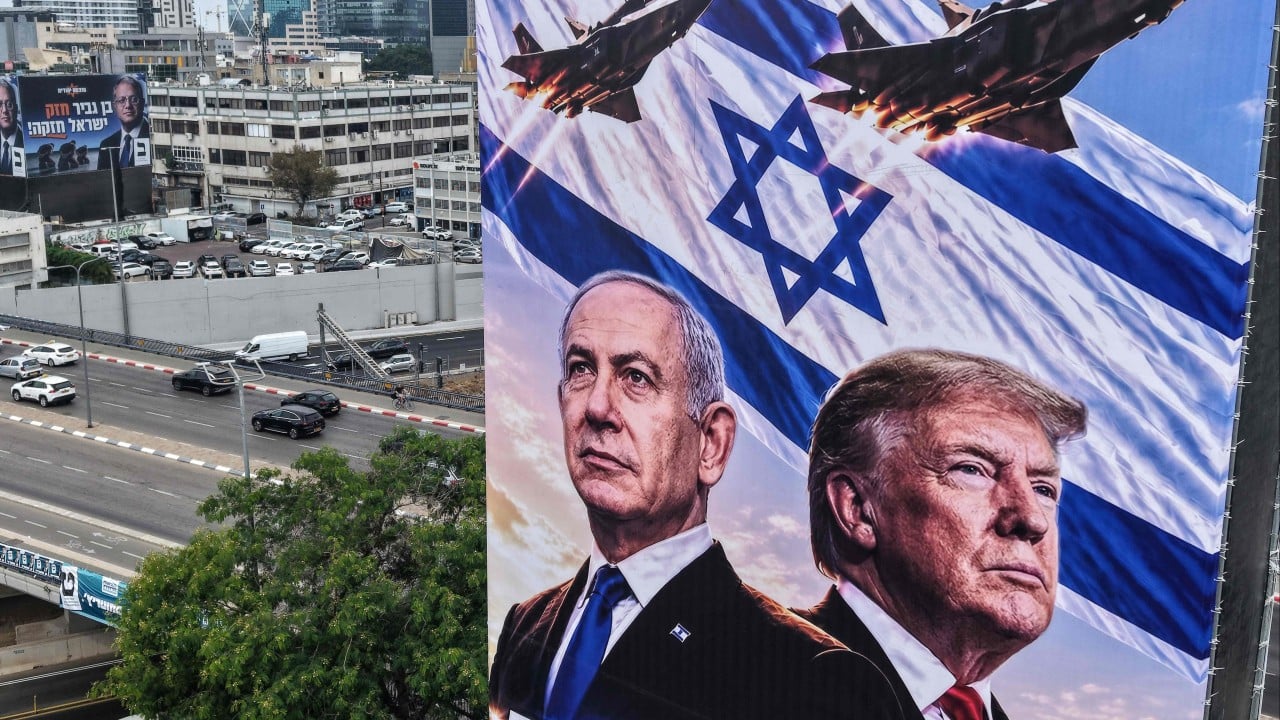
Israeli Prime Minister Benjamin Netanyahu is pressing President Donald Trump to authorize joint military strikes against Iran immediately following the United States midterm elections. By targeting this exact post-election window, Jerusalem aims to bypass the domestic political friction of an American campaign season while exploiting a brief period before Tehran can fully harden its nuclear facilities and reconstitute its regional proxy network. For Netanyahu, the calculation rests on a brutal reality of Washington politics: an American president freed from immediate voter accountability is far more likely to greenlight a high-risk Middle Eastern war than one trying to protect vulnerable congressional seats from the fallout of spiking global oil prices.
Understanding this push requires looking past the daily noise of diplomatic cables and into the mechanics of two overlapping clocks. One clock measures the physical enrichment of uranium deep beneath Iranian mountains. The other measures the political survival of two leaders whose domestic fortunes remain tightly bound to their perceived strength abroad.
The Post-Election Window of Opportunity
American presidents hate starting wars before November. Every seasoned operative in Washington knows that rising gas prices at the pump will sink a ruling party faster than almost any domestic scandal. When voters head to the polls, foreign entanglements that threaten economic stability become toxic liabilities.
Netanyahu knows Washington better than almost any foreign leader alive. Having dealt with American administrations since the Reagan era, he understands that asking the White House for a major military commitment during a heated midterm cycle is a non-starter. Even a president with an aggressive posture toward Tehran cannot afford a Strait of Hormuz blockade in October.
Once the ballots are cast, however, the political math changes overnight. The lame-duck period between the November midterms and the swearing-in of a new Congress in January offers a rare insulation from immediate electoral punishment. A president no longer has to worry about how an air campaign in the Persian Gulf will play in swing districts across Pennsylvania or Michigan.
For Jerusalem, this post-midterm window represents the sweet spot. It arrives late enough to avoid tanking Republican prospects in November, yet early enough to act before a potentially more fractured or isolationist Congress takes office in the new year.
The Nuclear Threshold and Deeply Buried Targets
Military timelines do not wait for political convenience. Over the past several years, Iran has steadily compressed its breakout time—the period required to produce enough weapons-grade fissile material for a single nuclear device. While enrichment levels have hovered near the 60 percent threshold, the technical leap from 60 percent to the 90 percent required for a bomb is remarkably short.
More troubling for Israeli defense planners is where this work happens.
Facilities like the Fordow Fuel Enrichment Plant, dug deep into a mountain near Qom, and the newer tunnel complexes near Natanz are specifically engineered to survive conventional Israeli airstrikes. Israel possesses an extraordinary air force and unmatched intelligence penetration inside Iran, demonstrated repeatedly through sabotage operations and targeted assassinations. Yet when it comes to penetrating hundreds of feet of reinforced rock and concrete, Jerusalem hits a hard physical wall.
Only the United States possesses the GBU-57 Massive Ordnance Penetrator, a 30,000-pound bunker-busting bomb, alongside the B-2 Spirit stealth bombers required to deliver it. Without American heavy bombers, an Israeli strike on Iran’s nuclear infrastructure would likely delay the program by a few months rather than set it back by years. Netanyahu is not merely asking Trump for diplomatic cover or mid-air refueling tankers; he is lobbying for direct American kinetic participation to finish a job Israel cannot complete alone.
Exploiting a Weakened Axis of Resistance
Timing a strike requires assessing the enemy's capacity to hit back. For decades, Tehran’s primary deterrent against a direct attack on its nuclear sites was not its own conventional military, which suffers from aging hardware and decades of sanctions, but its Axis of Resistance. Hezbollah in Lebanon, Hamas in Gaza, and various militias across Iraq, Syria, and Yemen formed a ring of fire designed to rain tens of thousands of rockets onto Israeli cities the moment an Israeli jet crossed into Iranian airspace.
That deterrent has been severely degraded.
Sustained Israeli military campaigns have battered Hamas into a fraction of its former fighting force and decimated Hezbollah’s senior leadership, command structure, and heavy rocket stockpiles. Meanwhile, direct exchanges of fire between Israel and Iran have exposed critical gaps in Iranian air defenses, particularly the vulnerability of its Russian-made S-300 batteries to modern stealth aircraft and standoff munitions.
From the perspective of the Israeli security cabinet, Iran has rarely been more exposed. Its forward defensive shield in the Levant is broken, and its domestic air defense network has been mapped and degraded. Waiting another year or two gives Tehran time to rebuild Hezbollah, acquire more advanced air defense systems from Moscow, and push its centrifuges even deeper underground. In military strategy, you do not wait for a wounded adversary to recover.
The Friction Inside Trump’s Inner Circle
Netanyahu’s lobbying campaign faces a major obstacle inside the White House itself. Donald Trump’s foreign policy instincts have always pulled in two competing directions, creating a permanent tug-of-war among his top advisors.
On one side sit the traditional Iran hawks. These officials view the Islamic Republic as the central source of instability in the Middle East and argue that the United States will never have a better chance to permanently dismantle its nuclear ambitions. They share Netanyahu’s belief that maximum pressure must eventually be backed by overwhelming military force if Tehran refuses to capitulate completely.
On the other side sits the America First restraint faction. These advisors, backed by influential voices in conservative media and key figures within Trump’s political base, view another Middle Eastern war as a catastrophic betrayal of the movement's core promises. Their arguments are blunt and pragmatic:
- Economic shockwaves: Even a brief conflict in the Persian Gulf would disrupt global shipping lanes, sending crude oil prices soaring and reigniting inflation across the American economy.
- Troop vulnerability: Tens of thousands of American service members stationed across Iraq, Syria, Kuwait, Bahrain, and Qatar would instantly become targets for Iranian ballistic missiles and drone swarms.
- Strategic distraction: Tying down American aircraft carriers, air defense interceptors, and precision munitions in the Middle East depletes stockpiles desperately needed to deter China in the Indo-Pacific.
Trump himself has historically favored unpredictability over rigid doctrine. He authorized the 2020 strike that killed Qasem Soleimani, proving he is willing to take lethal, high-stakes action against Iranian leadership. Yet he has also repeatedly expressed disdain for protracted foreign interventions and nation-building, preferring quick, decisive shows of force or high-profile diplomatic deals over open-ended wars. Netanyahu’s challenge is convincing Trump that a post-midterm strike would resemble the swift, contained operation against Soleimani rather than the quagmire of the 2003 invasion of Iraq.
What an Attack Would Actually Look Like
If Netanyahu succeeds in persuading Washington, the resulting military operation would not be a symbolic pinprick. A half-hearted strike would give Iran every incentive to race for a nuclear weapon while leaving its capacity to do so intact.
To achieve real strategic value, a joint US-Israeli campaign would need to unfold in distinct, relentless phases over several days or weeks.
First would come the total suppression of enemy air defenses. Stealth aircraft, electronic warfare planes, and cruise missiles would target every remaining radar installation, surface-to-air missile battery, and command-and-control node across western and central Iran. Establishing absolute air supremacy is non-negotiable before heavy bombers can operate safely over hardened sites.
Second would be the systematic destruction of the nuclear fuel cycle. B-2 bombers would drop multiple Massive Ordnance Penetrators on the ventilation shafts and access tunnels of Fordow and Natanz, aiming to collapse the underground caverns. Simultaneously, strike fighters would level above-ground centrifuge assembly workshops, uranium conversion facilities at Isfahan, and heavy water reactors.
Third, and perhaps most critical, would be neutralizing Iran’s retaliatory capability. A campaign of this scale would almost certainly include strikes on ballistic missile production plants, drone factories, and naval bases along the Persian Gulf to prevent the Islamic Revolutionary Guard Corps from closing the Strait of Hormuz or overwhelming regional bases with saturation attacks.
The Unspoken Risks of the Day After
Military planners excel at designing the opening hours of an air campaign, yet they consistently struggle to control what happens on day four. The central flaw in the argument for a post-midterm strike lies in the assumption that Iran’s leadership would simply absorb the blow and accept defeat.
Bombs can destroy centrifuges, collapse tunnels, and kill nuclear scientists. They cannot erase scientific knowledge.
If the United States and Israel bomb Iran’s nuclear sites, the surviving leadership in Tehran would face an existential choice. Moderates who argued for diplomatic engagement with the West would be completely discredited. Hardliners within the Revolutionary Guard would immediately point to the rubble as ultimate proof that only an operational nuclear deterrent can guarantee the regime's survival.
Iran could withdraw from the Nuclear Non-Proliferation Treaty, expel all remaining international inspectors, and move its surviving enriched uranium stockpiles to small, covert facilities impossible to detect from the air. Instead of ending the Iranian nuclear program, a military strike could drive it entirely dark, transforming a monitored threshold state into a covert nuclear weaponization effort.
Furthermore, the global economic fallout would not care about the US midterm calendar. Roughly twenty percent of the world's petroleum passes through the Strait of Hormuz. Even if the US Navy successfully clears Iranian mines and sinks fast-attack craft within a few weeks, commercial shipping insurance rates would skyrocket immediately. Tankers would halt transit, global supply chains would seize up, and the resulting energy shock would ripple through European and Asian markets long before American voters forgot about it.
Jerusalem’s Domestic Calculations
To fully grasp why Netanyahu is pushing so aggressively for this timeline, one must also examine his own political survival in Israel. Having presided over the catastrophic security failures of October 7, Netanyahu’s legacy remains deeply fractured at home. Critics across the Israeli political spectrum accuse him of prolonging regional conflicts to delay domestic inquiries, stave off early elections, and keep his fragile right-wing coalition intact.
Defeating Iran’s nuclear ambitions alongside an American president offers Netanyahu a chance to rewrite his historical narrative entirely. It allows him to pivot away from the failures of Gaza and present himself as the indispensable leader who eliminated the greatest existential threat to the Jewish state since its founding.
This convergence of personal political survival and genuine national security anxiety makes Netanyahu relentless. He has spent decades warning the world about the Iranian nuclear clock, often brandishing diagrams at the United Nations and clashing openly with Democratic presidents over diplomatic agreements. With Trump in the White House and the midterms approaching, Netanyahu sees the final alignment of stars he has waited for his entire career.
Whether Washington takes the bait depends entirely on how Donald Trump weighs two competing legacies: being the president who finally broke the back of the Iranian regime, or the president who dragged the United States into another devastating Middle Eastern war just as his second term hit its halfway mark.


