A celebration of freedom turned into absolute chaos on a Saturday night in the heart of Germany.
Hundreds of thousands had gathered near Berlin's Tiergarten park for Christopher Street Day, one of Europe's largest LGBTQ+ Pride celebrations. Then a white minivan plowed into the crowd. The driver didn't just stop at vehicular carnage; he jumped out with a bladed weapon—believed to be a machete—and slashed through terrified pedestrians. Also making waves lately: Diplomatic Signaling in South Asian Bilateral Architecture.
One woman lost her life. Twenty-nine others sustained injuries, with several fighting for survival in hospitals.
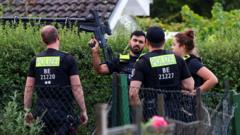
The manhunt ended roughly twenty hours later in an allotment garden complex in the western suburb of Spandau. Elite police units tracked down 21-year-old Abdul Ballout, a German citizen of Lebanese descent. According to authorities, Ballout charged at officers with a weapon. Police opened fire, killing him at the scene. More insights on this are covered by Al Jazeera.
The Anatomy of an Extremist Threat
Interior Minister Alexander Dobrindt didn't mince words when addressing reporters. Investigators immediately classified the atrocity as an Islamist terror attack.
Why? Because the suspect was hardly an unknown entity to law enforcement. Ballout was born in Germany in 2005 and possessed a documented history of radicalization. Court and prosecutorial records show he traveled to Lebanon in 2025 with the explicit intent of reaching Syria to join the Islamic State.
He made contact with militant networks overseas, leading to a three-month prison sentence by a Lebanese military court. Upon returning to Germany late last year, federal police arrested him at the airport. Yet, despite his known affiliations with extremist factions and a previous conviction for preparing a serious act of state-endangering violence, he remained free enough to execute a mass-casualty plot.
Security sources confirmed he had only recently spent time in juvenile detention before walking back onto the streets. This glaring detail has reignited fierce public anger across Germany regarding how the judicial system handles radicalized individuals.
The Political and Social Aftermath
Chancellor Friedrich Merz called the massacre an assault on German society's core values. Memorials quickly materialized at the Brandenburg Gate, where grieving residents laid flowers, lit candles, and clutched rainbow flags in defiance.
Yet, beneath the grief lies a tense political reality. This tragedy arrives just weeks before critical regional elections, injecting fuel into ongoing debates over immigration, border security, and domestic surveillance. Critics are demanding answers about why monitoring protocols failed to stop a radicalized citizen from hiring a van and turning it into a weapon of mass murder.
Berlin's mayor, Kai Wegner, emphasized that the festival's actual perimeter held strong thanks to heavy police barricades, forcing the attacker onto an adjacent side path. Even so, the sheer vulnerability of public spaces remains an open wound.
The investigation has shifted entirely to federal prosecutors. They are currently piecing together whether Ballout acted completely alone or had accomplices who helped facilitate the rampage. As forensics teams comb through seized mobile phones and raided properties, Berlin is left grappling with a grim truth. Tolerance and open societies remain prime targets for those intent on destroying them.


