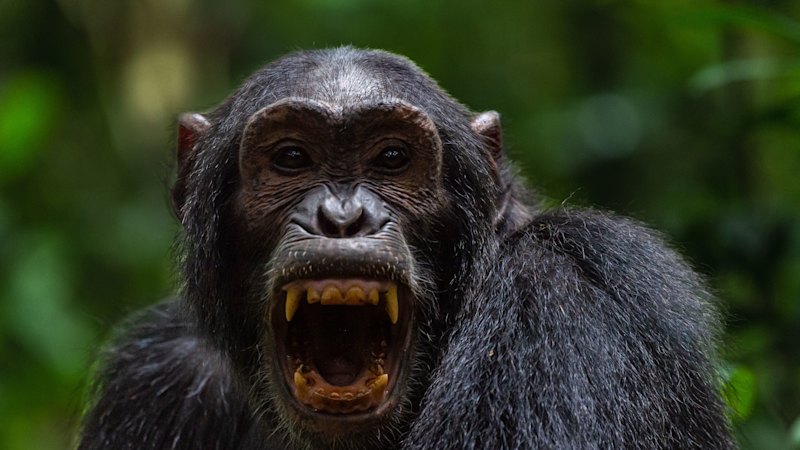
Lethal aggression within chimpanzee (Pan troglodytes) communities is not a breakdown of social order but a calculated, resource-driven optimization strategy. While popular media frames these events as "killing sprees" or "senseless violence," such descriptions fail to account for the evolutionary cost-benefit analysis governing primate behavior. Intra-group killing—specifically the targeting of former allies—functions as a high-stakes mechanism for territory consolidation and reproductive dominance when the internal competition for finite resources exceeds the benefits of social cooperation.
Understanding these violent shifts requires a departure from anthropomorphic shock and an adoption of a biological audit. The emergence of lethal conflict is dictated by three operational variables: demographic imbalances, caloric scarcity, and the shifting utility of coalitionary bonds.
The Imbalance of Power Hypothesis
The primary driver of lethal aggression in chimpanzees is the Power Asymmetry Metric. Lethal strikes rarely occur during balanced skirmishes. Instead, they are the result of "low-cost" opportunities where a coalition of attackers outnumbers a single target by a ratio of at least 3-to-1. This numerical advantage minimizes the risk of injury to the aggressors, effectively reducing the "price" of the kill to nearly zero.
The Mathematics of the Coalition
In a typical community split, the logic of the group shifts from mutual defense to internal pruning. If a community grows too large for its home range, the friction of competition for food and mates increases. When the cost of sharing these resources with a "friend" outweighs the security that friend provides against external rivals, the social contract dissolves.
- Risk Mitigation: Attackers focus on isolated individuals. By targeting a former ally when they are vulnerable, the aggressors secure a permanent reduction in resource competition without sustaining the metabolic debt of a prolonged fight.
- Resource Reallocation: The removal of a high-ranking male immediately frees up access to receptive females and high-quality foraging sites within the existing territory.
The Caloric Threshold and Territorial Stress
Chimpanzee violence tracks closely with environmental productivity. When high-energy fruit sources are scarce, the tolerance for "redundant" males within the group collapses. We can categorize this through the Caloric Stress Framework, which posits that social cohesion is a luxury afforded by surplus energy.
Metabolic Drivers of Aggression
The metabolic cost of maintaining a large, cooperative social structure is immense. Each individual requires a specific daily caloric intake to maintain homeostasis. When the territory’s carrying capacity is breached, the group faces a choice: disperse or downsize. Dispersal is often impossible due to the presence of hostile neighboring communities. Consequently, downsizing via lethal force becomes the only viable path to ensure the survival of the remaining core coalition.
The transition from "friend" to "target" is often triggered by a shift in the Reciprocity Ratio. If an individual is consuming more resources than they are contributing in terms of territorial defense or social grooming, they become a liability. In periods of extreme scarcity, this liability is liquidated.
The Social Capital Pivot: Why Allies Turn
The most striking aspect of these events—the betrayal of long-term bond partners—is explained by the Transience of Social Capital. Unlike human social structures, which are often reinforced by abstract moral codes, chimpanzee alliances are purely functional and highly volatile.
The Utility Decay of Bonds
Coalitions are formed to achieve specific ends: overthrowing a dominant alpha or defending a border. Once that objective is achieved, or when the external threat diminishes, the utility of the bond begins to decay.
- The Sunk Cost Fallacy: Chimpanzees do not suffer from the sunk cost fallacy. They do not maintain a bond simply because it has existed for years. If the current landscape dictates that a partner is now a competitor for a limited mating opportunity, the past history of the relationship is disregarded in favor of immediate reproductive gain.
- The Power Vacuum Effect: Following the death of a high-ranking individual, the social hierarchy becomes fluid. Former allies often turn on each other to preemptively eliminate the next most likely contender for the vacant position. This is not a "spree"; it is a sequential elimination of competition.
Distinguishing Fact from Hypothesis in Primate Warfare
To maintain analytical rigor, we must separate the observable mechanics of these killings from the speculative drivers often cited in non-peer-reviewed reporting.
Known Mechanics:
- Targeting of the Genitalia and Throat: Attacks are specifically designed to incapacitate and ensure death, indicating a clear intent to kill rather than merely discipline or drive away.
- Coalitionary Stability: The aggressors almost always remain as a cohesive unit after the killing, suggesting the act strengthens the bonds among the survivors through shared resource gain.
Educated Hypotheses:
- Human Encroachment: There is significant debate regarding whether human-induced habitat fragmentation increases the frequency of these killings. While it is true that smaller territories lead to higher stress, lethal aggression has been documented in pristine environments, suggesting it is an inherent part of the Pan behavioral repertoire.
- Xenophobia vs. Intra-Group Purging: While inter-group warfare (attacking "strangers") is more common, the mechanics of intra-group purging are nearly identical, suggesting the biological "off-switch" for empathy is triggered by the same resource-scarcity signals regardless of the target's identity.
The Strategic Logic of Infanticide during Social Upheaval
When a community turns on its own, the violence frequently extends to the offspring of the targeted males. This is not collateral damage; it is a reproductive reset. By eliminating the progeny of a rival, the new dominant coalition ensures that the females will return to estrus sooner and that the future group will be comprised of their own genetic lineage.
The "horror" felt by human observers stems from a projection of our own social norms onto a species that operates on a much tighter survival margin. In the wild, there is no social safety net. Every kilocalorie must be fought for, and every competitor eliminated if the environment demands it.
The Operational Reality of Primate Strategy
The shift from cooperation to lethal competition is a predictable response to environmental and demographic pressures. It is an optimized biological response to a localized Malthusian trap. When we observe chimpanzees "turning" on their friends, we are witnessing a cold recalibration of the social group to match the realities of the physical environment.
For researchers and conservationists, the focus must shift from the "shocker" of the violence to the monitoring of territory-to-population ratios. The most effective way to predict a social collapse within a primate community is not to monitor "personalities" but to track the decline in high-quality food availability and the rise in male-to-female ratios.
The data suggests that the "peace" of the forest is a temporary state of equilibrium, maintained only as long as the cost of cooperation remains lower than the cost of conflict. When that balance tips, the most efficient survival strategy is the immediate and total elimination of the closest competitor. Any strategy for primate management that does not account for this inherent cost-benefit logic will fail to anticipate the next systemic collapse within these communities.