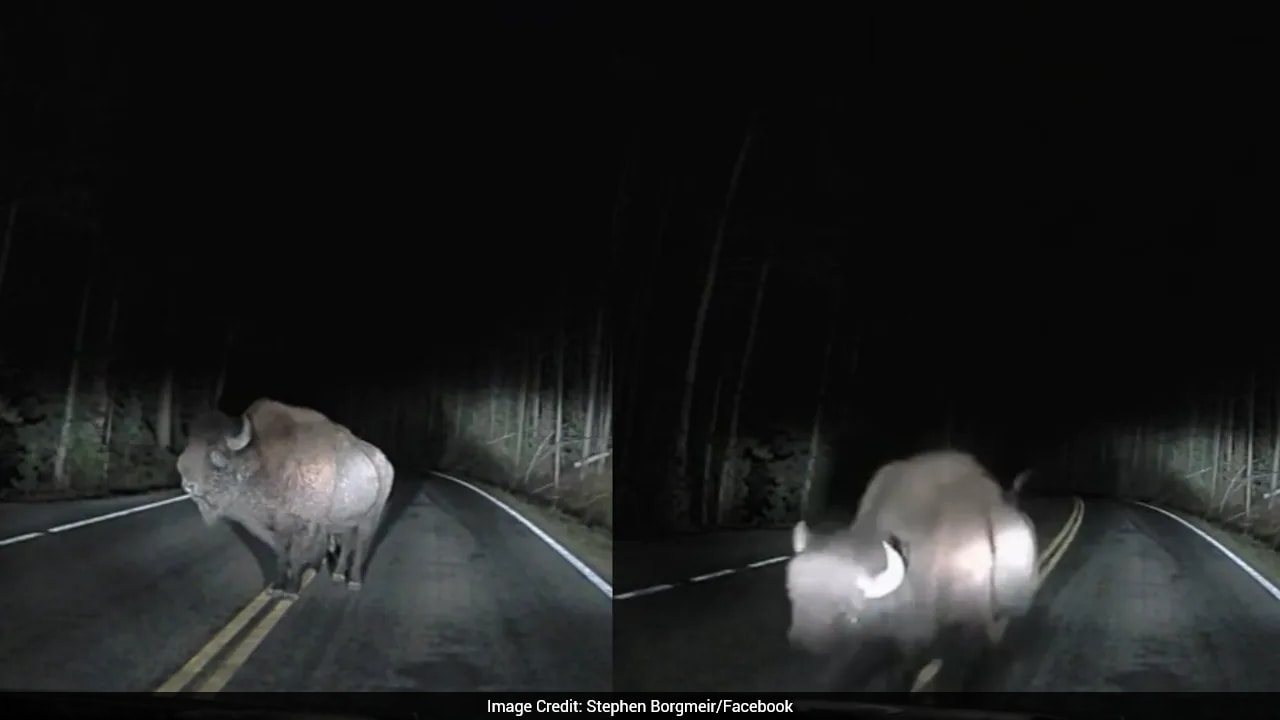
Dashcam footage of an American bison charging a truck inside a national park exposes a recurring failure of spatial judgment rather than random animal malice. Conventional viral reporting treats these incidents as isolated spectacles of brute strength, overlooking the predictable behavioral thresholds, kinetic realities, and human decision errors that produce near-misses and collisions. This analysis maps the mechanics behind bison-vehicle charges, separates observable wildlife biology from situational speculation, and outlines practical risk controls for park visitors and operations teams.
Deconstructing Viral Incident Coverage
Standard media coverage of a close encounter between a bison and a motor vehicle follows a narrow narrative arc. A headline emphasizes drama, a brief clip shows a large ungulate accelerating toward a stationary or slow-moving vehicle, and a few lines of commentary note that bison are unpredictable and visitors should keep their distance. That framing entertains viewers while obscuring how the encounter actually escalated.
Three structural gaps weaken typical incident reporting:
- Cause-and-effect compression: Viral clips isolate the final charge and omit the preceding minutes during which a driver stopped too close, boxed the animal in, or misread early warning postures.
- Metric distortion: Coverage often highlights top running speed or maximum body mass without connecting those figures to reaction time, stopping distance, or energy transfer at close quarters.
- Authority abdication: Articles frequently mention safety rules in passing without explaining the underlying ethological and physical reasons those rules exist.
A rigorous breakdown treats a charge not as a bolt from the blue, but as the output of an interaction system linking wildlife physiology, vehicle dynamics, road geometry, and human risk perception. Because the source reference provides no full text or verified incident telemetry, the analysis below distinguishes established biological and physical principles (known facts) from plausible scene dynamics inferred from typical park encounters (educated hypotheses).
Known Facts Versus Educated Hypotheses
Separating confirmed science from situational reconstruction keeps safety analysis honest when video context is incomplete. Without verified metadata such as exact park location, GPS coordinates, timestamp, vehicle speed, or official ranger reports, any specific claim about the truck driver's exact intent remains an educated hypothesis.
What is firmly established in wildlife biology and traffic physics is clear. American bison (Bison bison) are the largest terrestrial mammals in North America, with mature bulls frequently weighing well over 1,500 pounds and adult cows often exceeding 900 to 1,000 pounds. Despite their heavy forequarters, bison can sprint at roughly 30 to 35 mph over short distances, pivot rapidly, and leap obstacles that casual observers assume would stop them. Vehicles, by contrast, carry substantial kinetic energy even at low speeds and restrict driver peripheral visibility compared to standing on open ground.
When analyzing a dashcam clip where an animal charges a truck, analysts can reasonably hypothesize several contributing factors: the truck may have lingered inside the animal's perceived flight or defense zone, another vehicle or pedestrian may have created visual pressure on the opposite flank, or the bison may have been reacting to rutting stress, calf protection, or perceived confinement near a roadway edge. Treating those possibilities as hypotheses rather than proven facts prevents armchair blame while pointing directly to observable behaviors that drivers can recognize before escalation occurs.
The Agonistic Escalation Loop
Bison rarely initiate a charge without prior behavioral signaling, though human observers frequently miss or misinterpret early cues. In behavioral ecology, agonistic interactions unfold across observable stages rather than a single switch from calm to attack.
Posture and Vocalization Signals
Before lunging, a stressed or defensive bison typically displays tension through body alignment and movement. Observers often see the head lowered near or below shoulder level, the tail raised or flicking stiffly, ears pinned or rotating vigilantly, or the animal turning broadside or facing squarely toward the perceived threat. Low grunts, huffs, or snorts can accompany agitation, though inside a closed truck cab with windows up and air conditioning or audio running, acoustic cues are often muffled or missed entirely.
Proximity Thresholds and Flight Zones
Every wild animal operates with dynamic spatial margins often described in wildlife management through flight and defense zones. When a vehicle enters a margin that the animal perceives as intrusive—or blocks an escape route along a two-lane park road—the bison's options narrow to retreating, holding ground, or displacing the threat. A stationary truck idling beside a herd is not neutral furniture to a large herbivore; its size, engine vibration, reflective glass, and sudden gear shifts can register as an active presence.
Why Vehicles Trigger Charges
Drivers often assume a steel cab makes a close approach harmless. From the bison's perspective, a truck is a large, noisy object occupying space along a travel corridor. During the late-summer rut, bull bison experience heightened androgen levels, elevated restlessness, and heightened reactivity toward rival males and unfamiliar objects. Cows with calves exhibit strong protective responses when calves are separated or cornered near traffic. Even outside the rut, heat stress, insect harassment, or accumulated traffic congestion can lower a bison's tolerance threshold.
The Collision Physics Model
Understanding why a close encounter turns dangerous requires looking past headlines to the mechanics of mass, velocity, and stopping distance. Two variables dominate the outcome of a bison-vehicle conflict: closing speed and impact geometry.
When a bison charges a stationary or creeping truck, the relative closing speed equals the animal's rush speed—potentially 25 to 35 mph over a short burst. At that pace, a 1,500-pound animal carries massive momentum into a single point of contact, such as a front bumper, grille, fender, or door panel. Sheet metal and plastic fascias deform easily, while high-clearance pickup trucks or SUVs can strike or take impacts at angles that buckle frames, shatter windshields, or push heavy mass into passenger compartments.
A second physical trap involves driver reaction time. Seeing an animal lower its head or accelerate takes a fraction of a second to register, followed by foot movement from brake or accelerator and vehicle response time. If a driver is already stopped too close—often tempted by photo opportunities or stuck behind a traffic bottleneck—there is little or no runway to back out cleanly without hitting another car, driving onto soft shoulder terrain, or clipping a nearby animal.
Human Decision Errors Behind Close Encounters
Most park wildlife incidents are not caused by a single catastrophic mistake; they accumulate through a sequence of small human errors.
- Normalization of deviance: Watching dozens of cars stop inches from wildlife without immediate harm convinces drivers that proximity is safe until probability catches up with exposure.
- Misreading animal body language: Mistaking a calm grazing pause or slow walk for tame indifference leads visitors to step out of vehicles or edge closer for better camera angles.
- Bottleneck blindness: Focusing on the animal in front of the hood causes drivers to ignore cars stacking up behind them or pedestrians stepping onto the pavement on the opposite side.
- Overreliance on vehicle mass: Assuming a full-size truck is impervious to a charge leads drivers to hold position rather than yielding space early.
The operational trade-off for drivers is straightforward. Yielding extra distance early costs a few seconds of delay and occasionally a missed photograph; holding position to capture closer footage trades margin of safety for an unpriced tail-risk event.
Risk Controls for Visitors and Park Operations
Reducing bison-vehicle charges requires coordinated actions across both individual drivers and park management systems. No single measure eliminates risk entirely—enforcement is constrained by vast park acreage, wildlife moves freely across unfenced terrain, and crowd surges can overwhelm roadside patrols during peak travel hours.
Tactical Steps for Drivers
- Maintain generous buffer distance: Keep well back from bison on or near roadways—park safety guidance routinely sets minimum buffers such as 25 yards from large wildlife like bison and 100 yards from bears and wolves, with even wider margins sensible when animals are moving or agitated.
- Watch the full herd, not just one animal: A lone bull or cow walking near the road often has herd mates or a calf nearby that alters the animal's path without warning.
- Keep escape space open: Leave room ahead of your bumper so you are not trapped bumper-to-bumper if an animal steps onto the pavement or charges toward the lane.
- Stay inside and avoid escalating noise: Remain inside the enclosed vehicle, avoid opening doors or windows to provoke or approach the animal, and refrain from revving engines or honking unless needed to prevent an imminent collision where movement is safe.
- Drive smoothly through wildlife corridors: Slow down gradually in known grazing valleys and river bottoms, scan road shoulders ahead of blind curves, and never stop abruptly in a travel lane without signaling and pulling clear if safe.
Operational Priorities for Park Management
Park rangers, traffic planners, and visitor safety teams face distinct operational constraints:
- Dynamic traffic flow management: Using mobile messaging boards, pullout staging, and roving patrols during peak congestion helps prevent "bison jams" from turning roads into corrals.
- Targeted signage and sightline management: Placing clear wildlife-crossing and buffer reminders ahead of high-incident stretches—and managing roadside brush where sight distances are short—gives drivers earlier decision windows.
- High-contrast behavioral education: Replacing abstract rule lists with visual cues showing warning postures and stopping distances improves recall among first-time visitors unfamiliar with large wild ungulates.
Every control has practical limits. Signs cannot force attention when a driver is distracted, patrols cannot stand on every mile of road simultaneously, and wild animals do not follow human traffic lanes. Treating visitor safety as a continuous margin-management problem rather than a checklist of slogans is the most reliable way to keep close encounters from becoming collisions.
Strategic Recommendation for Park Safety and Media Teams
Park safety communicators and wildlife risk managers should shift public messaging from fear-based shock clips to early-stage behavioral triggers and buffer discipline. Viral footage grabs attention for a day, yet lasting injury prevention depends on teaching visitors what a bison looks like before a charge begins—lowered head, stiff tail, restricted escape path, or herd tension—and pairing that recognition with immediate distance and open space ahead of the vehicle.
If you'd like to sign in to a Google Account, it can help you save your chat history and return to conversations like this one later.