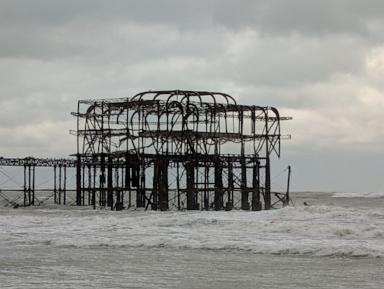
A storm hits. Iron twists. A headline screams about Atlantic fury.
Lazy. Predictable. Wrong.
Every time a section of a famous Brighton pier gives way during rough weather, coverage follows the exact same script. Out comes the phrase "Atlantic storms." Out come the sad photos of foaming surf and weeping locals. Out comes the comforting myth that a historic coastal structure simply lost a fair fight against nature.
I have spent years working around coastal structures, marine engineering assessments, and municipal infrastructure budgets. I have seen cities and private trusts burn millions on cosmetic patches, sentimental appeals, and reactive repairs while ignoring the slow mechanical rot underneath. Weather pulls the trigger. Neglect loads the chamber.
Calling a pier collapse a storm story lets everyone off the hook. It turns a failure of asset management, marine metallurgy, and political will into a tragedy of the elements.
The Lazy Consensus Around Storm Collapses
Read the standard storm coverage and you will see three tired claims repeated as gospel.
First, that a severe Atlantic weather system overwhelmed a sturdy structure. Second, that Victorian or mid-century coastal engineering was built to last forever if only people cared enough. Third, that preservation comes down to heroic fundraising and good intentions.
All three claims fall apart under basic structural inspection.
Start with geography and oceanography. Brighton sits along the English Channel on the south coast of England, sheltered to a large degree from direct open-ocean swell compared with exposed western headlands, yet still exposed to fetch-driven wind waves, spring tides, and low-pressure systems funneling up the Channel. When low pressure deepens and onshore winds align with high tide, wave steepness and orbital water velocities jump. Breaking waves exert slamming pressures far higher than calm hydrostatic load.
Blaming "the storm" treats a recurring environmental load as a freak ambush. Coastal structures face waves, salt spray, wet-dry cycling, and tidal shifts every single day of their service life. If a structure cannot survive a seasonal or decadal storm event, the core question is not why the wind blew. The question is what degraded between the last serious maintenance cycle and the day the iron gave out.
Second, coastal structures do not fail in a single dramatic snap without warning. They lose capacity through corrosion, fatigue, scour, and brittle fracture long before a gale arrives. Cast iron and wrought iron—hallmarks of classic Victorian pier architecture—behave very differently from modern structural steel. Cast iron has high compressive strength but poor tensile ductility and can suffer graphitic corrosion in seawater, leaving behind a weakened, porous residue that looks intact from a distance while carrying a fraction of its original load.
Third, sentimentality is not a structural engineering material. A famous name, heritage status, or nostalgic postcard value does not resist cyclic wave loading. Steel does not care how beloved a promenade is. Seawater does not care about history.
What Actually Happens Before the Iron Drops
To understand why part of a famous Brighton pier collapses when rough weather sweeps in, stop looking at the wave crest and start looking at the load path.
A pier is a framed skeleton standing in one of the most aggressive chemical and mechanical environments on earth. Loads enter through the deck—pedestrians, wind, equipment, and wave uplift—and travel down through beams, bracing, and piles into the seabed. Every bolted or riveted joint, every brace connection, and every submerged pile section has to carry its share without losing stability.
When maintenance lapses, the load path breaks down in stages:
- Section loss from corrosion: Saltwater, splash-zone wetting and drying, and trapped moisture eat away cross-sectional thickness. Thinner members mean higher stress under the same load and lower resistance to local buckling.
- Seized or failing connections: Rust jacking, sheared bolts, and degraded rivets stop diagonal bracing from triangulating frames properly. Without effective bracing, lateral wave forces push frames out of plane.
- Scour around foundations: Moving water strips sediment away from pile bases, increasing the unsupported length of a pile. A longer unsupported column buckles under far less load than a well-embedded one.
- Cyclic fatigue: Thousands upon thousands of wave impacts flex joints repeatedly. Microscopic cracks grow slowly until a peak wave load pushes stress past fracture resistance.
Imagine a scenario where a coastal truss pier has gone years with only superficial painting above the waterline while submerged and splash-zone members lose a third of their effective wall thickness. On a calm day, gravity loads still sit comfortably inside the remaining capacity. Then a strong low-pressure system drives steep waves against a high tide. Lateral drag and slamming forces spike. Already-thin struts buckle or snap. Adjacent members take on redistributed loads they were never sized to handle. Progressive failure takes over, and a section drops into the surf.
To the casual observer, the storm destroyed the pier. To anyone reading the structural mechanics, the storm merely audited decades of deferred maintenance.
Why Coastal Heritage Becomes a Financial Trap
Here is the uncomfortable truth that heritage boosters hate hearing: owning or keeping a derelict or half-ruined coastal pier is often a negative-equity trap disguised as a civic treasure.
In marine civil engineering—work closely tied to standards and research from organizations such as the Institution of Civil Engineers (ICE) and the Construction Industry Research and Information Association (CIRIA)—everyone knows the harsh arithmetic of coastal assets. Marine steel and iron require relentless inspection, access scaffolding over tidal water, abrasive blasting, specialized coatings, and underwater or tidal work windows dictated by weather and tides.
Costs escalate nonlinearly as a structure deteriorates. Replacing a corroded brace early is an intervention. Rebuilding collapsed bays after storm damage, clearing debris from a dynamic seabed, and stabilizing adjacent spans that lost lateral support is an emergency rescue at top dollar.
I have seen owners and civic groups pour money into piecemeal fixes—patching a visible handrail or repainting an upper pavilion—while leaving structural joints and submerged bracing untouched. That approach feels productive because people can see fresh paint. Structurally, it is theater. Paint over rusted, section-lost iron just hides the rot until the next big blow strips the facade off and exposes the hollow skeleton underneath.
Even my own contrarian push for strict structural triage carries real downsides. Treating heritage structures purely through cold engineering and financial math can alienate communities that rely on them for identity, tourism, and local pride. Over-demolishing or writing off marginal structures too quickly can erase irreplaceable architectural character if a viable, funded restoration model actually exists. Ignoring public attachment is bad politics and bad stewardship. Yet pretending a crumbling frame is safe because people love it is worse—it invites public hazard and wastes scarce funds on dead ends.
The Questions People Keep Asking Wrong
When news breaks that part of a pier collapsed during storms, search feeds fill up with the same predictable questions. Most of them point people straight toward bad conclusions.
"How could a storm tear apart a historic pier?"
It usually does not tear apart intact, well-maintained iron in one clean blow. It exploits weaknesses that were already there. A structure weakened by corrosion, missing bracing, or foundation scour lacks the reserve strength needed when wave heights and wind loads spike together. Calling it a freak act of weather ignores the slow erosion of safety margin that made failure possible.
"Why don't authorities just reinforce the whole pier before winter storms?"
Because "just reinforce the whole pier" costs staggering money, requires specialized marine contractors, faces narrow tide and weather windows, and often collides with ownership disputes, insurance limits, and competing municipal priorities. Full-scale marine rehabilitation is capital-intensive and slow. When budgets are tight and responsibilities are fragmented, structures get managed by crisis rather than by proactive engineering.
"Are older coastal piers built worse than modern ones?"
Not necessarily worse—just built for different conditions, materials, and expectations. Historic structures often show remarkable craftsmanship for their era, yet they were not engineered around modern climate projections, rising sea levels, or multi-decade maintenance backlogs. A structure designed a century or more ago is not a perpetual-motion machine. Without continuous reinvestment, age and seawater win every time.
"Can a partially collapsed pier still be saved?"
Sometimes, yes—if the remaining structure still has sound primary framing, stable foundations, and realistic funding for engineered stabilization and ongoing upkeep. Sometimes, no—if progressive collapse has compromised core load paths and the cost of safe restoration dwarfs any realistic return or civic budget. Turning a ruin into a safe, usable asset takes hard engineering triage, not wishful thinking.
What Actually Works When Storms Hit Coastal Infrastructure
If you care about coastal structures, municipal budgets, or real infrastructure resilience, stop reciting storm clichés and start applying hard-nosed discipline.
- Audit the hidden load path first. Focus inspections on splash zones, submerged members, bolted/riveted connections, and seabed scour—not just pretty upper decks. If you do not know the remaining section thickness and joint integrity, you do not know the real capacity of the asset.
- Stop funding cosmetic lipstick on structural rot. Never treat surface paint or minor top-side repairs as a substitute for structural steelwork and foundation stabilization. Fix primary load paths before spending a dime on aesthetics.
- Price in full lifecycle marine costs before committing. Before any restoration pledge or public bailout, calculate true marine construction costs, exclusion zones, ongoing annual maintenance, and worst-case storm repair reserves. If the ongoing maintenance math does not work on paper, it will fail in reality.
- Separate emotional value from structural safety. Protect public safety with strict exclusion zones and honest structural assessments. Do not let nostalgia bully engineers or officials into keeping unstable spans open or pretending doomed sections are sound.
- Plan for the next storm before the current one clears. Treat severe coastal weather as a scheduled stress test of your asset management system. Every collapse or near-miss should trigger an honest post-mortem on inspection gaps, deferred work orders, and funding bottlenecks—not another round of blaming the Atlantic.
The sea does not sneak up on a coastal pier. It shows up every single day, testing every weld, every bolt, every millimeter of corroded iron, until whatever was weak finally gives way.