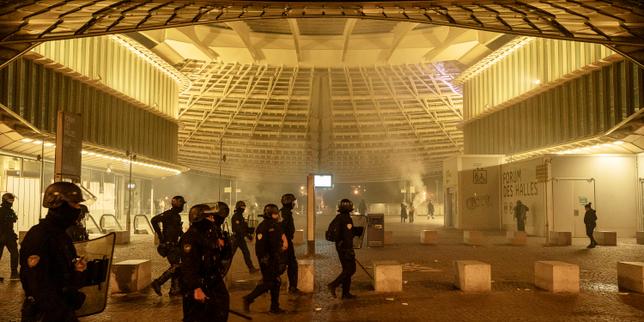
Match. Street fire. Slogan. Instant blame.
That is the lazy consensus whenever unrest erupts in France and foreign leaders—including Israeli officials watching the footage on their screens—link French street violence straight to Islam and pro-Palestinian solidarity. It makes a tidy story. It fits neatly on a broadcast chyron. It is also analytically sloppy.
When violent unrest hit French cities in autumn 2026 amid protests over cost-of-living pressures and hardline security crackdowns, observers in Israel and elsewhere quickly framed the turmoil as an imported religious war or a spillover from Middle Eastern conflict. Having spent years tracking political risk, urban security narratives, and crisis messaging across Western capitals, I have seen governments and commentators make this exact mistake repeatedly. I have watched analysts burn serious credibility by treating every flag in a crowd as the root cause of a riot rather than the banner pinned onto an existing domestic powder keg.
Let us separate two distinct realities that lazy commentary mashes into one: imported grievances versus homegrown structural friction. Confusing the two does not clarify anything. It distorts intelligence, inflames diplomatic friction, and blinds policymakers to what actually sets French streets ablaze.
The Lazy Consensus Everyone Keeps Recycling
Standard coverage of French unrest usually follows a predictable script. Images of clashes or damaged property circulate abroad. Politicians in Jerusalem point to extremism or pro-Palestinian mobilization as the driving force behind the disorder. Critics on the opposite side counter with sweeping claims about state repression or prejudice. Both sides treat a complex urban crisis as a single-variable equation.
That framing fails on basic logic. France has experienced recurring waves of mass unrest long before the latest Middle East flare-ups—from the 2018 yellow vest protests over fuel taxes to multi-day urban riots over policing and economic marginalization. When a society already carries high youth unemployment, strained municipal budgets, housing bottlenecks, and deep distrust between certain neighborhoods and security forces, international crises act as accelerants on dry timber. An accelerant speeds up a fire. It is not the timber, and it is not the spark.
Look at polling from French research institutions like IFOP across recent years. Public attitudes in France toward the Israeli-Palestinian conflict are layered, often ambivalent, and frequently paired with concern over both antisemitism and anti-Muslim hostility at home. Reducing millions of French Muslims—or every demonstrator waving a Palestinian flag—to a single ideological or violent script is lazy analysis disguised as toughness.
Precision Beats Noise
To analyze this accurately, we have to use clean definitions instead of political shorthand:
- Political solidarity vs. violent criminality: Marching, chanting, or flying a flag in support of Palestinians is political expression. Arson, looting, and attacks on police or bystanders are criminal acts. Conflating the two erases law enforcement accountability and smears peaceful citizens.
- Geopolitical projection vs. domestic grievance: Foreign leaders frequently interpret domestic events in other countries through their own security lens. For Israeli decision-makers shaped by existential threats and regional conflict, street disorder in Paris can look like a mirror of their own battles. That projection is understandable psychologically, yet unreliable as a diagnosis of French domestic politics.
- Causation vs. correlation: Two events happening in the same month—or even appearing in the same news clip—do not share a single cause. A rioter carrying a grievance over rent, policing, or inflation may grab a prominent geopolitical symbol because it commands maximum media attention.
What Serious Scholars Actually Show
Serious researchers who study political violence and contentious politics—such as political scientist Sidney Tarrow on protest cycles and social movements, or sociologist Olivier Roy on radicalization and identity politics in Europe—have spent decades dismantling one-dimensional explanations of unrest.
Their work points to a blunt truth: movements and riots attach themselves to symbols that already carry emotional charge. When local frustration meets a global flashpoint, activists and opportunists alike borrow the loudest language available. Treating the borrowed symbol as the entire engine of the event confuses surface optics with structural mechanics.
Imagine a scenario where a city's transit fare hikes, police tactics sour during a weekend demonstration, and a handful of agitators clash with security forces while carrying foreign flags. A viewer watching a 20-second clip abroad sees a geopolitical clash. A local police commander looking at municipal dispatch logs sees crowd-control failures, socioeconomic stress, and opportunistic street violence. Both people are looking at the same afternoon, yet only one is looking at the operational levers that actually prevent the next riot.
The Blind Spots of This Contrarian Take
Taking a contrarian stance carries real risks if you push it too far. Let me be candid about where overcorrecting can go wrong.
First, denying real extremism is just as dishonest as overstating it. France has faced genuine security threats, violent antisemitic incidents, and radicalized actors who exploit global conflicts to recruit or intimidate. Downplaying ideology in the name of nuance would be naive and dangerous.
Second, treating domestic factors as the only factor ignores transnational media dynamics. Social media compresses distance. Images from Gaza, the West Bank, or Tel Aviv reach young people in Lyon or Marseille in real time, shaping emotions, anger, and solidarity in ways earlier generations never experienced.
Third, a sharp critique can sound dismissive to people who feel genuinely unsafe. When Jewish families in France worry about rising hostility or when French officials weigh deploying troops to restore order, telling them "it's mostly socioeconomics" can sound detached from lived fear. Good analysis accounts for both objective drivers and subjective threat perceptions.
Asking the Wrong Question Wastes Everyone's Time
The search intent behind stories linking French violence to Islam and Palestinian solidarity usually boils down to a simple question: Is Middle Eastern conflict turning French streets into a battleground?
That is the wrong question. The right question is: Why are French institutions struggling to contain street disorder before local grievances fuse with global rage?
Brutal Answers to the Questions People Actually Ask
- Does pro-Palestinian activism cause French riots? No. Political mobilization can draw large crowds and occasionally create flashpoints near sensitive sites, but rioting requires breakdown of order, pre-existing friction, and offenders willing to break the law. Blaming a broad political cause for criminal disorder is a convenient dodge.
- Is Islam the root driver of urban unrest in France? No. French Muslims are not a monolith, and French unrest has deep roots in urban geography, economic opportunity, policing, and civic integration that cut across religious lines.
- Why do Israeli leaders talk about France this way? Because domestic political incentives in Israel reward framing global events around existential security threats and linking Western allies' internal struggles to Israel's own war footing. It is strategic messaging as much as commentary.
What Actually Works Instead of Culture-War Blame
If you work in policy, security, corporate risk, or media analysis, stop trading hot takes on cable news or social feeds and do the unglamorous work:
- Audit the local trigger first. Whenever unrest breaks out in a French city, check the timeline of the 48 hours before the first viral video. Look at municipal flashpoints, policing shifts, and local grievances before accepting any grand ideological narrative.
- Separate speech tracking from threat tracking. Do not lump lawful protest activity together with violent plots or hate crimes. Mixing them muddies risk assessment and wastes security resources.
- Read foreign commentary as signal, not data. When a prime minister or foreign minister comments on another country's riots, treat it as political positioning—not a peer-reviewed criminological study.
Stop letting lazy slogans do your thinking for you.