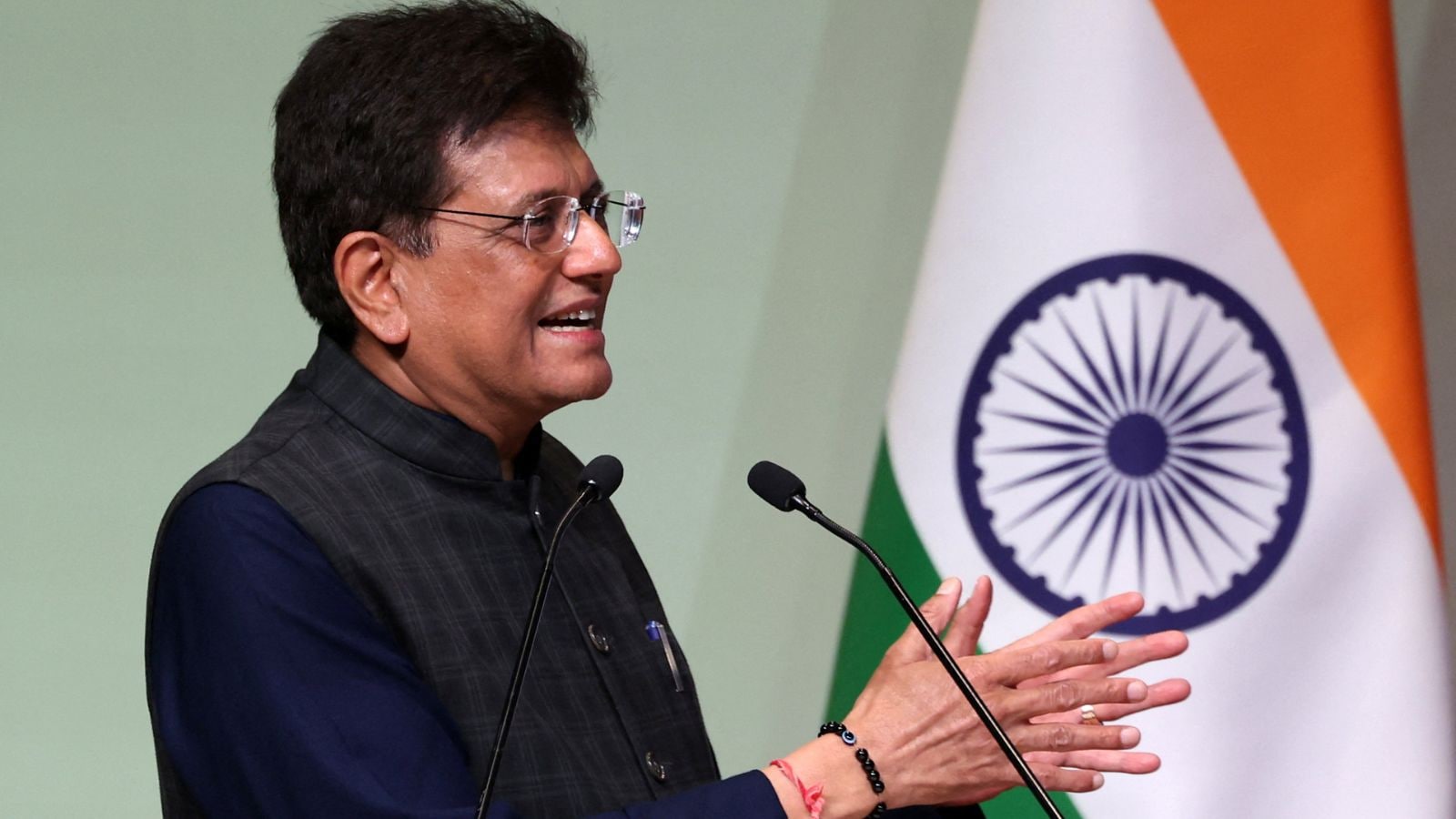
Piyush Goyal wants you to believe that India’s massive trade deficit with China is a willpower problem.
According to India’s Minister of Commerce and Industry, cutting Chinese imports comes down to individual consumer choice, not government force. If you just skip the cheap phone charger or the imported Diwali lights, the trade balance magically heals itself.
It is a neat, tidy soundbite. It also ignores every basic law of industrial economics.
Asking an average Indian household—already squeezed by food inflation and stagnant real wages—to voluntarily pay 30 percent more for a domestic alternative is not a trade policy. It is a guilt trip disguised as nationalism. And worse, it completely misdiagnoses why Chinese goods flood Indian ports in the first place.
The mainstream coverage of Goyal’s remarks treats this like a charming debate about patriotism at the checkout counter. That is lazy consensus. The reality is far more uncomfortable for New Delhi. Consumers aren't buying finished Chinese trinkets out of sheer apathy. Indian factories are buying Chinese intermediate goods because they literally cannot function without them.
The "Consumer Choice" Illusion
Let’s look at the actual anatomy of India’s imports from China, which routinely cross the $100 billion mark annually.
When a pundit talks about boycotting China, you probably picture cheap plastic toys, decorative lights, and budget smartphones. Those items make for great television segments. They represent a tiny fraction of the actual problem.
The overwhelming bulk of what India buys from China isn't sitting on a retail shelf waiting for an Indian shopper to make a "patriotic" choice. It consists of:
- Active Pharmaceutical Ingredients (APIs): India is rightly called the pharmacy of the world, yet our pharma giants rely on China for roughly 70 percent of their bulk drugs and chemical intermediates. When you buy a generic antibiotic at your local chemist, you do not get to choose whether the base molecules came from a fermentation plant in Shandong or Gujarat.
- Electronic Components: India’s smartphone assembly boom is real. Apple and Samsung are assembling millions of handsets locally. Yet the printed circuit boards, display modules, camera lenses, and lithium-ion cells inside those "Made in India" phones are overwhelmingly shipped in from Shenzhen and Dongguan.
- Industrial Machinery and Capital Goods: When an Indian entrepreneur sets up a textile mill, a solar panel assembly line, or an auto-parts factory, where do they buy the precision machinery? China. Because German and Japanese machines cost three times as much, and Indian capital goods manufacturing hasn't scaled to fill the gap.
Tell me: where is the "consumer choice" in a bulk chemical vat or an industrial injection-molding machine?
There isn't any. By framing the trade deficit as a retail problem, policymakers successfully shift the blame for decades of structural neglect onto the shoulders of ordinary citizens. If the trade gap widens, it’s because you bought the wrong kettle. It’s never because industrial policy failed to build a competitive domestic supply chain.
Why Tariffs and Boycotts Both Fail
You might think the obvious counter-argument is simply to slam the door shut. Raise import duties to 100 percent. Ban Chinese goods outright. Use the government force Goyal explicitly rejected.
That fails too, and I have watched businesses burn millions of dollars learning this exact lesson.
Over the past five years, I have advised mid-sized Indian electronics and appliance manufacturers trying to localize their supply chains in response to sudden tariff hikes and Quality Control Orders (QCOs). On paper, slapping a 20 percent tariff on an imported component looks like a brilliant way to protect local producers. In practice, without an existing local ecosystem, it just acts as a tax on Indian manufacturing.
Here is what actually happens on the factory floor when New Delhi blocks a Chinese input before a domestic alternative is ready:
- Costs Spike Immediately: The Indian manufacturer still has to import the part from China—because nobody in Pune or Chennai makes it at scale—and simply absorbs the tariff.
- Exports Become Uncompetitive: With higher input costs, that Indian factory can no longer compete against Vietnamese or Mexican rivals in global export markets.
- Quality Drops: When companies scramble to source from rushed, under-capitalized local vendors just to satisfy compliance rules, defect rates skyrocket.
Economist Jagdish Bhagwati spent decades warning against the traps of crude import substitution. When you wall off an economy without fixing the underlying cost of doing business, you don't create world-beating champions. You create bloated, inefficient monopolies that survive only because the Indian consumer is held hostage behind a tariff wall.
The Real Cost Disability Nobody Wants to Fix
If neither consumer guilt nor blunt tariffs will cure the China dependency, what will?
To answer that, you have to look at why a factory in Guangdong can land a product at Nhava Sheva port in Mumbai for less than it costs a factory in Haryana to make the exact same item. Economists call this "cost disability," and in India, it sits at roughly 12 to 15 percent across most manufacturing sectors.
China didn't conquer global manufacturing solely through state subsidies and currency manipulation—though both played massive roles. They won because they obsessed over the unsexy plumbing of industrial capitalism:
- Power and Logistics: Moving a container from a factory in inland China to a port costs a fraction of what it costs to move a container from North India to Mumbai. Industrial electricity tariffs in several Indian states are cross-subsidized to pay for free agricultural power, meaning Indian factories pay some of the highest industrial power rates in Asia.
- Cost of Capital: A Chinese manufacturer securing a loan to expand capacity often pays 3 to 4 percent interest. An Indian MSME (Micro, Small, and Medium Enterprise) trying to buy new CNC machines faces interest rates of 10 to 14 percent—if they can even get a bank to approve the collateral.
- Scale and Clusters: In China, an entire city exists just to make zippers, or socks, or micro-motors. Every sub-supplier is within a twenty-minute drive. In India, rigid land acquisition laws and archaic labor regulations historically penalized factories for growing too big, trapping businesses in the "missing middle"—too big to be informal, too small to achieve global economies of scale.
When a government official tells consumers to reject Chinese goods while leaving industrial power rates, logistics bottlenecks, and high interest rates untouched, they are asking shoppers to subsidize systemic inefficiency out of their own pockets.
The "China Plus One" Myth
Whenever critics point out these structural hurdles, defenders of the status quo trot out the "China Plus One" narrative. Global corporations are fleeing China, they say, and India is the natural beneficiary.
Let’s look at the actual scoreboard.
Yes, Apple’s ecosystem is expanding rapidly in Tamil Nadu and Karnataka. That is a genuine policy win driven by targeted Production Linked Incentives (PLIs).
However, outside of smartphone assembly, who captured the lion's share of companies leaving China over the last six years? Vietnam, Mexico, Malaysia, and Thailand. Vietnam—a country with less than one-tenth of India’s population—routinely exports more electronics than India. Why? Because Vietnam signed aggressive Free Trade Agreements, slashed red tape, built deep-water ports, and allowed foreign manufacturers to import components duty-free so they could focus on high-value assembly and export.
India, by contrast, spent years hiking tariffs and walking away from trade deals like the Regional Comprehensive Economic Partnership (RCEP). You cannot become the world’s factory by putting up walls. Every major manufacturing powerhouse in modern history—from postwar Japan and South Korea to Taiwan and China—grew rich by integrating deeply into global supply chains first, importing components freely, mastering the assembly process, and gradually moving up the value chain.
What People Get Wrong About Trade Deficits
We also need to dismantle the basic premise underlying almost every panicked headline about India-China trade: the idea that a bilateral trade deficit is automatically a moral and economic defeat.
If you buy groceries from your local supermarket every week, and the supermarket owner never buys anything from you, you have a 100 percent trade deficit with that store. Are you being exploited? No. You are trading money for food you need, freeing up your time to earn money doing whatever you are actually good at.
Countries work the exact same way, with one critical caveat: what you are importing matters infinitely more than the raw dollar figure of the deficit.
Importing $50 billion worth of cheap consumer junk on credit is terrible. Importing $50 billion worth of specialized industrial machinery, solar cells, and electronic sub-assemblies that allow Indian factories to manufacture $150 billion worth of finished goods for domestic use and global export is smart business.
Look at the data closely. As India’s electronics exports have surged over the last three years, imports of electronic components from China surged right alongside them. Politicians panic when they see the import line go up. Supply chain veterans know that in modern manufacturing, you have to import to export. Trying to choke off those imports to satisfy a political talking point doesn't hurt Beijing—it kneecaps Bengaluru and Chennai.
Admit the Trade-Offs (Because Nobody Else Will)
I am not arguing for naive laissez-faire economics. Relying on a geopolitical rival—one with whom India shares a contested, militarized Himalayan border—for critical pharmaceuticals, telecom gear, and power grid equipment is a massive national security vulnerability. When Beijing weaponizes supply chains, as it did with rare earth minerals against Japan in 2010 or gallium and germanium exports more recently, market purism offers zero protection.
There is a legitimate strategic case for decoupling in sensitive sectors.
But let’s be brutally honest about the price tag. Strategic autonomy is expensive. If New Delhi decides that India must produce its own APIs, solar wafers, and lithium-ion batteries regardless of global market prices, the government has to pay for it through targeted subsidies, cheap land, and R&D grants—or taxpayers and consumers will pay for it through higher prices and higher taxes.
Pretending we can achieve strategic decoupling for free just by asking shoppers to "be vocal for local" is pure fantasy.
What Actually Moves the Needle
If policymakers and industry leaders actually want to break the Chinese import habit over the next decade, they need to stop lecturing consumers and start executing a ruthless industrial strategy. Here is what works:
- Fix Factor Costs Before Erecting Tariffs: Lower industrial electricity tariffs, accelerate freight corridors to cut logistics costs from 13-14 percent of GDP down toward the global benchmark of 8 percent, and deepen domestic corporate bond markets so manufacturers can access cheap, long-term capital.
- Invite Chinese Capital on Indian Terms: This is the ultimate heresy in New Delhi right now, yet it is the fastest way to transfer technology. When China wanted Western technology in the 1990s, it didn't ban Western companies; it forced them into joint ventures on Chinese soil, absorbed their engineering know-how, and trained millions of local workers. India should allow Chinese component makers to set up factories in India—strictly as minority partners in joint ventures with Indian firms, with mandatory technology transfer and local hiring targets.
- Target the "Missing Middle" in Component Ecosystems: Stop celebrating final assembly and start subsidizing the boring, unglamorous Tier-2 and Tier-3 suppliers—the companies making precision molds, specialty chemicals, semiconductors, and high-grade industrial steel. Without them, "Make in India" remains "Assemble in India."
- Drop Performative Bans: Stop using sudden, arbitrary Quality Control Orders on raw materials that domestic producers can't supply in sufficient volume. Every time a chemical or textile mill shuts down because a port bureaucrat held up an imported input, China wins twice.
Stop Passing the Buck
Economics does not care about speeches. A middle-class family in Jaipur buying an air conditioner, a young engineer in Hyderabad buying a laptop, and a textile exporter in Tiruppur buying weaving looms are all making completely rational financial decisions based on the prices and quality in front of them.
Until Indian factories can match Chinese scale, logistics, and capital efficiency, Chinese goods will continue to flow into Indian ports—no matter how many patriotic slogans are printed on billboards.
It is time for New Delhi to stop blaming the Indian shopper for buying the best value on the market, and start doing the hard, unglamorous structural work required to build an economy that can actually beat China on price and quality.