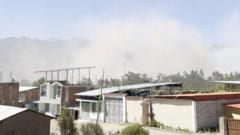
Every time the earth heaves in the Andes, the media machine spins up the exact same tired narrative. A major tremor hits, headlines shriek about cracked adobe walls and darkened power grids, and pundits nod gravely about the merciless fury of the Pacific Ring of Fire. It is a comforting, lazy consensus. It paints seismic disasters as acts of malicious divine intervention against which humanity is utterly helpless.
Stop buying the excuse. The recent 6.7 magnitude earthquake centered near Ayacucho, which registered up to 7.2 locally, did not damage buildings because the earth moved. Buildings collapsed because structural planning and civil enforcement failed long before the first shockwave hit.
The Myth Of Inevitable Destruction
Look past the surface-level panic. When news outlets report that a handful of healthcare facilities, schools, and homes took damage in the southern Andes, they frame it as a shocking anomaly. They treat tectonic energy like a sniper bullet picking targets at random.
Geophysics tells a completely different story. The earthquake occurred at a depth of roughly 66 to 100 kilometers. Intermediate-depth subduction zone earthquakes of this magnitude lose substantial kinetic punch by the time their shear waves break the surface. According to data from agencies like the USGS, much of the surrounding populace experienced light to moderate shaking.
When structures built out of unreinforced masonry or crumbling adobe crumble under moderate-to-strong surface acceleration, that is not an act of God. That is a failure of public infrastructure investment.
Engineering Realities Versus Political Shortcuts
Let us talk engineering. Modern seismic codes exist for a reason. Civil engineers have understood dampening, flexible foundations, and steel-reinforced concrete frames for decades. Yet, local municipalities across rural Peru routinely bypass zoning codes, look the other way on unlicensed construction, and leave historical and municipal buildings structurally hollow.
Imagine a scenario where a city council actually mandates retrofitting for public schools and medical centers instead of waiting for a disaster to unlock emergency relief funds. The economic loss equation changes overnight.
When power grids fail, cutting off electricity to thousands of users, the knee-jerk defense is that fragile mountain topography makes grid resilience impossible. That is false. Decentralized micro-grids and localized solar-storage setups are cheap enough today that relying on a single, fragile transmission line running through earthquake-prone valleys is an administrative choice, not a technical inevitability.
Dismantling The Casualty Count Distraction
Media coverage loves a low injury tally because it lets authorities off the hook. Officials breathe a sigh of relief when only a couple of dozen public buildings take minor structural hits and a handful of individuals report minor injuries. They spin it as a triumph of disaster response.
That logic is inverted. A 6.7 to 7.2 magnitude event occurring at a depth that distributes energy across hundreds of miles should result in zero structural failures, zero power cuts, and zero injuries in properly engineered zones. Treating minimal casualties as a victory normalizes mediocrity. Every cracked school wall represents a systemic choice to prioritize short-term municipal savings over long-term human safety.
Stop asking when the next earthquake will strike. Start asking why local contractors are still permitted to pour unreinforced concrete while bureaucrats pocket hazard-mitigation budgets.