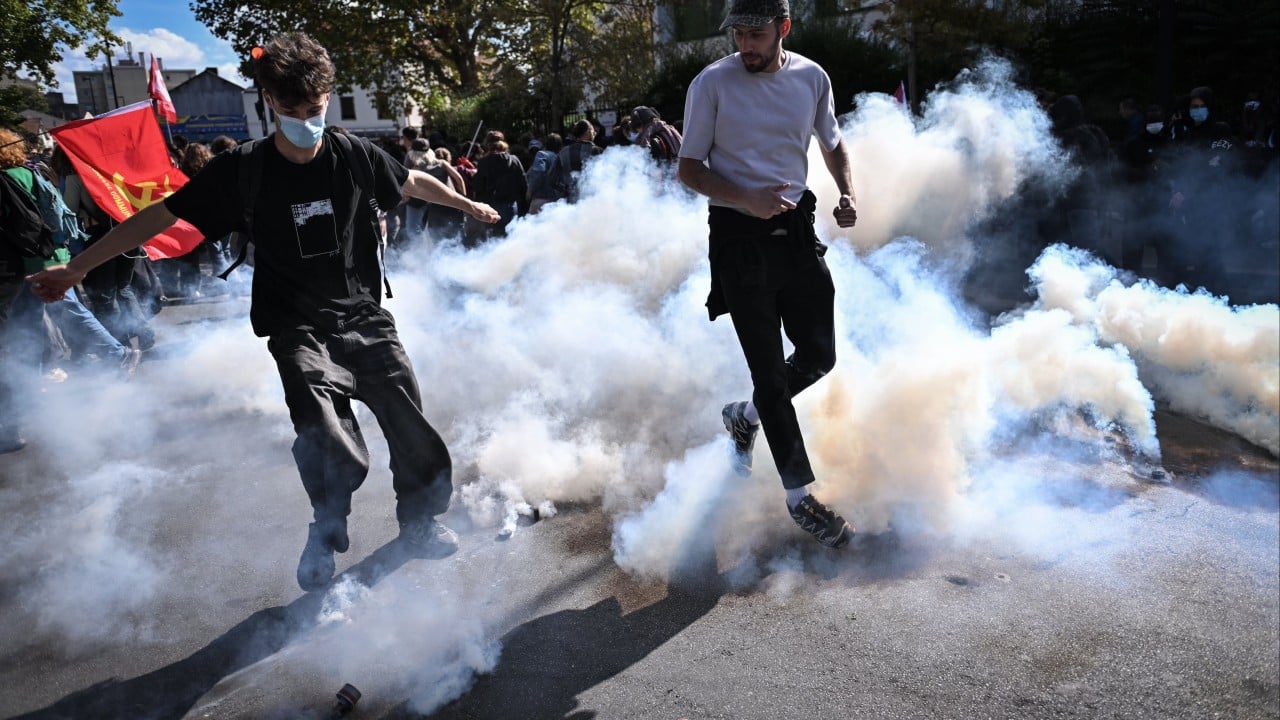
Every time smoke rolls across a Paris boulevard and teenagers push steel barricades against riot police, the media trots out the exact same tired script.
We get the hand-wringing op-eds about youthful rebellion, the predictable panels decrying generational disrespect
Why French School Protests Prove Public Education is Broken Beyond Reform
news
The media coverage surrounding the latest wave of French high school blockades and fiery street demonstrations follows a predictable, lazy script. Headlines flash across screens lamenting the unrest, framing the chaos as an episodic outburst of teenage angst mixed with labor union muscle, while pundits wring their hands over public property damage and traffic disruptions. Everyone treats these recurring riots as a temporary bug in an otherwise functional civic machine.
They are dead wrong.
These recurring uprisings are not a glitch. They are the loud, smoking symptom of a state monopoly on youth conditioning that has completely severed education from economic reality. When teenagers stack burning trash cans outside lycée gates, they are acting out a systemic rejection of a credentialist meat grinder that promises social mobility and delivers economic irrelevance. Yet, the mainstream commentary keeps missing the structural rot, focusing instead on rubber bullets and police perimeter lines.
To understand why France burns every few years over educational reforms, we have to stop looking at the matches and start inspecting the kindling.
The Myth of the Great Equalizer
The foundational premise of the French public education model is that uniform schooling creates equal citizens. Every child gets the same curriculum, sits at the same style of desk, and faces the same hyper-centralized examination system, epitomized by the sacred baccalauréat.
It sounds noble on paper. In practice, it is a catastrophic sorting machine designed to protect elite privileges while offering the working class a lottery ticket with terrible odds.
I have watched policy analysts praise this centralization for its rigidity, as if inflexibility equals fairness. It does not. A rigid curriculum deployed across a diverse, multi-ethnic, economically fractured society does not equalize outcomes; it masks systemic failure behind a facade of Republican equality. When reform proposals attempt to inject minor tweaks into this bloated apparatus—introducing vocational filters earlier or tinkering with grading scales—the system spasms.
The student protests erupt not because the reforms are uniquely evil, but because the entire edifice has lost its social contract. Students intuitively grasp what technocrats refuse to admit: the diploma no longer buys a career.
The Credential Bubble Burst
Look at the underlying economics. For decades, the implicit bargain of the French educational state was simple. Tolerate the mind-numbing rote learning, pass the exams, secure a university place, and walk into a stable bourgeois life, often cushioned by public sector employment.
That bargain expired years ago.
Youth unemployment in France stubbornly hovers at levels that would trigger emergency legislation in any functioning market economy. University lecture halls are severely overcrowded, acting as holding pens for young adults who have nowhere else to go. They are handed degrees that function as expensive wallpaper while the job market demands actual competency, technical agility, and adaptability—traits that a centralized, century-old pedagogy systematically stamps out.
When reformers try to introduce market realities or performance metrics into this protected ecosystem, teachers unions strike to protect their ironclad job security, and students riot because they sense the walls closing in on their futures. Both sides are fighting a rearguard action against a future that has already arrived. The students burning barricades are venting a legitimate rage against a system that forces them to memorize nineteenth-century literature while failing to teach them how to navigate a digitized, globalized economy.
The Brutal Solution Nobody Wants
If we want to stop the cycle of burning tires and tear gas outside Parisian suburbs, we have to stop trying to patch a leaking submarine with duct tape.
The solution is not another commission on educational reform. It is the radical decentralization and market exposure of youth development. France needs to strip away the monopoly of the national curriculum and embrace radical school choice, real apprenticeship pathways that match actual industry demand, and accountability metrics tied to employment outcomes rather than bureaucratic compliance.
Of course, proposing this in Paris is heresy. It invites accusations of dismantling the social safety net, as if youth unemployment and institutional decay were somehow preferable to market freedom.
The next time a blockade shuts down a dozen schools and the news anchors talk about youth unrest, ignore the noise. The teenagers are burning the symptoms of a dying model. Until we have the courage to dismantle the state-run credential factory, the smoke will only get thicker.