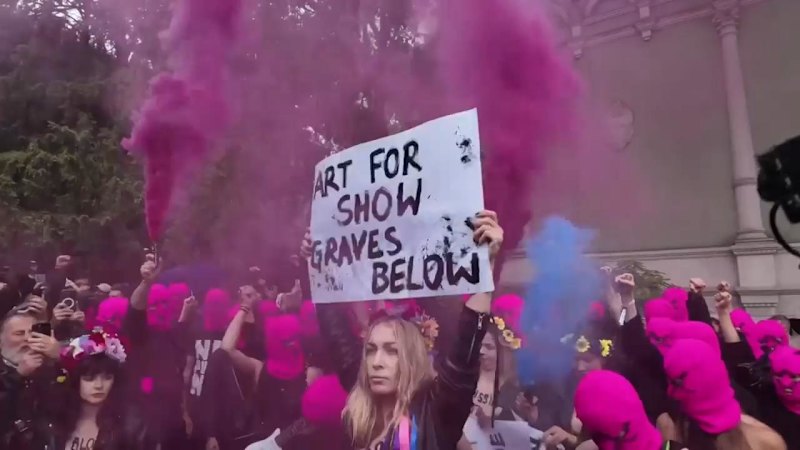
The art world loves a good moral crusade. It feels productive. It looks great on Instagram. It provides the illusion of consequence in a sphere often dismissed as a playground for the ultra-wealthy. When activists and protest groups descend on the Giardini to block the doors of the Russian pavilion at the Venice Biennale, the narrative is predictable: "Art world stands against tyranny."
It is a lie. Not just a small one, but a fundamental misunderstanding of how soft power and propaganda actually function in the 21st century. You might also find this connected article interesting: The El Niño Scare Is a Meteorological Ghost Story.
By physically or symbolically sealing off the Russian pavilion, protestors aren't silencing a regime. They are handing that regime exactly what it wants: a localized, easily digestible "cancel culture" narrative to sell back to a domestic audience. They are turning a stagnant, irrelevant architectural relic into a symbol of Western intolerance.
If you want to actually hurt a state-sponsored cultural machine, you don’t lock the doors. You leave them wide open and let the world see the intellectual vacuum inside. As reported in recent reports by Associated Press, the effects are worth noting.
The Myth of the "Clean" Biennale
The "lazy consensus" driving these protests is the idea that the Venice Biennale is a neutral, sacred space that has been "contaminated" by the presence of an aggressor state. This view ignores the reality of what the Biennale has been since 1895. It is a series of national pavilions—vestiges of 19th-century nationalism—designed specifically to project state power.
Every pavilion is a political instrument. To suggest that Russia's presence is a unique "stain" on a pristine canvas is to ignore the history of the event. We’ve seen this play out before. In 1934, Hitler visited the Biennale. In various decades, the Giardini hosted regimes that were actively engaged in colonial wars, proxy conflicts, and domestic purges.
The current strategy of "blockade" assumes that Russian art is a monolith. It assumes that every artist, curator, and technician associated with the pavilion is a direct mouthpiece for the Kremlin. This is a flattened, binary view of culture that serves no one but the censors.
When you block a pavilion, you aren't protesting "Russia." You are validating the Kremlin's claim that the West is irreconcilably hostile to Russian culture as a whole. You are doing their PR work for them.
Censure vs. Censorship: The High Cost of Moral Posturing
There is a vital distinction between censure—the formal expression of severe disapproval—and censorship. Protestors often confuse the two.
When a group blocks access to a pavilion, they are engaging in a form of physical censorship. In the short term, it feels like a victory. In the long term, it erodes the only defense the art world has against authoritarianism: the commitment to open, often uncomfortable, discourse.
I have seen art institutions across the globe buckle under the pressure of "vibe-based" activism. They cancel exhibitions of deceased Russian masters or pull funding from contemporary artists who haven't performed the required degree of public self-flagellation. This doesn't stop a single tank. It does, however, signal to every other artist that their inclusion is conditional on the current political climate.
Imagine a scenario where we applied this logic consistently. If we barred every nation involved in an illegal occupation, a drone strike campaign, or a human rights violation from exhibiting at Venice, the Giardini would be a ghost town. The park would be empty.
The fact that we pick and choose which "aggressors" to block reveals that these protests aren't about international law. They are about theatricality.
The Empty Pavilion Strategy
The most devastating thing that could happen to the Russian pavilion isn't a blockade. It’s a total, crushing indifference.
In 2022, the Russian curators and artists resigned, leaving the pavilion empty. That was a genuine, high-stakes act of protest. It sent a message of internal collapse. It showed that the creative class in Russia was in open revolt.
The "protest groups" currently blocking the doors are actually filling that void. They are providing the "content" that the pavilion currently lacks. They are making the Russian presence the most talked-about, most photographed, and most "urgent" part of the Biennale.
If you want to dismantle the Kremlin’s cultural prestige, ignore the building. Walk past it. Don't give it the oxygen of a confrontation. Don't give the state-run media clips of "angry Westerners" preventing people from seeing art.
By creating a spectacle at the door, you make the door the art. You turn the Russian pavilion into the "Forbidden Fruit" of Venice.
Stop Asking the Wrong Questions
People often ask: "Should Russia be allowed at the Biennale?"
This is the wrong question. It assumes the Biennale is a moral arbiter. It isn't. It’s a trade show with better lighting.
The real question is: "Does blocking a pavilion reduce the power of a state, or does it merely satisfy the ego of the protestor?"
The answer is almost always the latter.
Real disruption doesn't look like a human chain. It looks like the subversion of the space itself. It looks like Russian artists using their platform to smuggle out truths that the state wants buried. It looks like international collaborators refusing to let the Kremlin dictate what "Russianness" means.
When you block the door, you stop that subversion from happening. you force the artists who might have been working from the inside back into the arms of the state. You create a "Us vs. Them" dynamic that is the bread and butter of every strongman in history.
The "E-E-A-T" of Cultural Conflict
I’ve spent two decades watching the intersection of geopolitics and high art. I’ve seen the same cycle repeat: a crisis occurs, the art world panics, a superficial "ban" is implemented, and six months later, everyone is back to drinking Prosecco at the same parties.
These bans are cheap. They require no sacrifice from the organizers. They actually save money on insurance and security.
True authority in this space requires nuance. It requires admitting that Russian culture is not the same thing as the Russian state. It requires the backbone to host "difficult" conversations even when the mob is at the gates demanding a simple "Yes/No" answer to a complex "Why?"
The current trend of "de-platforming" nations at the Biennale is a race to the bottom. It turns a platform for global dialogue into a series of echo chambers. If we only speak to those we already agree with, we aren't having a biennial; we're having a brunch.
Actionable Subversion: A Better Way to Protest
If you actually want to make a difference in Venice, stop standing in front of doors. Try these instead:
- Fund the Underground: Instead of spending money on banners and travel to Venice to protest, redirect those funds to independent Russian artists who are currently in exile or operating at great risk.
- Contextualize, Don't Cancel: If a pavilion is open, organize "counter-tours" that provide the historical and political context the state-sponsored work omits. Use the space against itself.
- Weaponize the Absence: If the pavilion is empty, treat it like a tomb. Don't block it. Let the silence be the statement. A blocked door is a story; an empty, open door is a failure.
- Demand Transparency: Force the Biennale organizers to disclose the funding sources of every pavilion. Don't just target the "obvious" enemies. Look at the corporate sponsorships and the private donors. That is where the real power lies.
The "protest" in Venice right now is a performance for the converted. It's a low-risk, high-visibility act that changes exactly nothing on the ground in Eastern Europe.
The Kremlin is not afraid of your placards. They are afraid of being irrelevant. By blocking their pavilion, you have made them the center of the world's attention once again.
You haven't won. You've been recruited.
Stop being a prop in their propaganda play. Move out of the way, let the dust settle on the empty Russian halls, and watch how quickly their cultural "power" evaporates when no one is there to fight it.
The most radical thing you can do at the Venice Biennale is to treat the Russian pavilion like it doesn't matter. Because, in the grand scheme of things, it doesn't.
Unless you give it the one thing it can't generate on its own: a reason for people to care.