Glass rattles first.
Before the roar reaches your ribs, before the ceiling dust drifts down like gray snow onto a kitchen table where cold tea still sits in a chipped mug, the windowpanes hum with a frequency that makes your teeth ache. Everyone who has ever stood near an active front or watched a city brace for incoming fire knows that sound. It is not a movie sound. It is a vibration that enters your chest cavity and tries to rearrange your breathing.
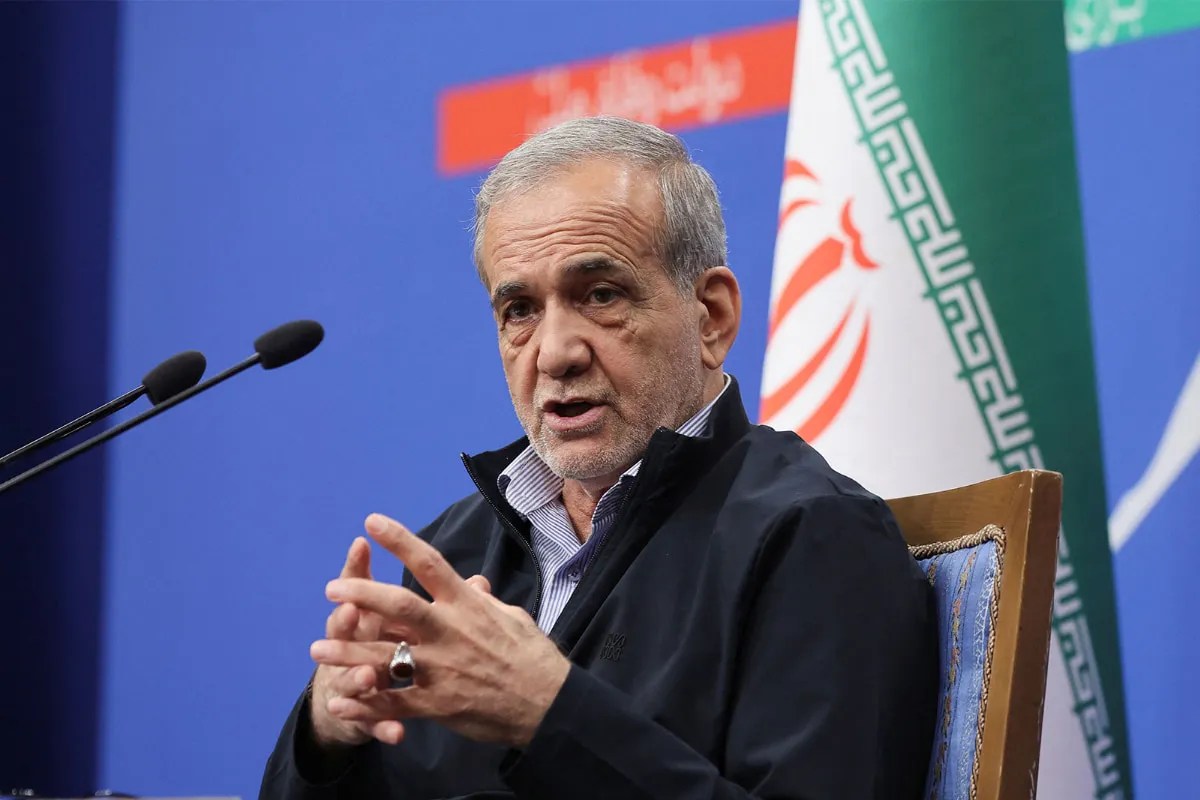
When Iranian President Masoud Pezeshkian declared that bombs and missiles cannot force surrender, he was speaking to a room full of strategists, diplomats, and citizens who already know what that vibration feels like in their bones. A headline reduces a statement like that to a slogan. A blunt pushback. A line on a ticker. Yet slogans rarely survive contact with ordinary Tuesday mornings unless they tap into something older and stranger than military arithmetic.
Surrender is not a math equation. It is a psychological threshold.
War planners love equations. Throw X amount of tonnage at Y coordinate, degrade Z infrastructure, and the adversary's political will drops below a sustainable line. On paper, it looks clean. Arrows on a map. Red circles over airfields, radar arrays, depots, and command bunkers. If you strike hard enough and often enough, logic dictates that someone eventually signs a paper, lowers a flag, or whispers enough.
History is littered with planners who were sure their math was airtight.
They forget how human beings actually break. People rarely break because a building collapses across town. They break when they feel utterly alone inside a storm with no horizon, no voice of their own, and no sense that their endurance means anything at all. When a leader stands before cameras and says that missiles and bombs cannot compel surrender, they are trying to pull a lever inside that exact psychological space—insisting that coercion from the sky has a ceiling, even when the firepower above seems limitless.
Whether you find that defiance inspiring, reckless, tragic, or strategically complicated depends entirely on where you are standing when the sirens start.
Let us step away from the war room and look at two people who never appear in diplomatic dispatches. Both are hypothetical characters, invented here to give flesh to forces that are otherwise discussed only in cold abstractions.
Meet Leyla, a retired high school physics teacher living in an apartment building in Tehran. For thirty years she taught teenagers how waves travel through air and water, how pressure builds inside closed vessels, how energy transforms rather than vanishing. Now her hands tremble slightly when she pours hot water for her morning tea, and her hearing is not what it used to be. When news breaks of escalating threats, strikes, or retaliatory warnings, Leyla does not think in terms of geopolitical leverage. She thinks about her younger brother's insulin supply, the price of bread at the corner bakery, and the sudden silence of neighbors who used to argue about soccer scores on the stairwell.
Now meet Tariq, a logistics coordinator in Basra, just across the border where the Shatt al-Arab meets the wider memory of forty years of regional turbulence. Tariq has watched shipping lanes tighten, insurance premiums spike, and trade routes stall over crises that began hundreds of miles away. When rhetoric hardens and missiles fly or threaten to fly, Tariq feels the shockwave in freight manifests, delayed containers, and the knot in his stomach every time his phone buzzes late at night.
Leyla and Tariq do not share a passport or a political lens. Yet both live inside the blast radius of escalation.
If you have never lived under the shadow of aerial bombardment or imminent strike warnings, it is easy to treat military pressure as a remote drama played out on screens. You watch footage of smoke rising in the distance, hear analysts debate escalation ladders, and move on to your next errand. I have spent enough time listening to people who have lived through air raids, curfews, and sudden blackouts to know how deceptive distance can be. In those environments, time stretches strangely. An ordinary errand—buying fruit, picking up medication, walking a child to school—carries a quiet subtext: What if the sky changes color before we get back?
That subtext changes how people react to threats.
To understand why coercion so often fails to produce the exact obedience its architects expect, consider a simple analogy—not a war metaphor, though war is never far from the frame. Imagine a stubborn oak tree rooted in rocky soil during a gale. High winds bend the upper branches violently, stripping leaves and snapping deadwood. A gust strong enough might even split the trunk. Yet the deeper the roots grip the stone, the more force the wind requires just to make the tree lean—and bending is not the same as uprooting. Sometimes the wind only convinces the tree to grow thicker wood at the base.
That is the trap of coercive strikes. Firepower can destroy hardware, shatter runways, kill commanders, and paralyze grids. It can inflict agonizing costs. What it struggles to control is the meaning people assign to those costs.
When a nation's leadership frames incoming strikes as an existential assault meant to dictate submission, the narrative of victimization and resistance locks together like gears. Citizens who already harbor frustrations with their own government—over inflation, governance, sanctions, or daily hardship—suddenly face an external threat that makes surrender feel like humiliation rather than relief. Fear and anger are fierce roommates. Fear tells you to run; anger tells you that running proves the bully right.
Here is the paradox that makes this entire subject so unsettling and so hard to read cleanly.
A leader can say bombs and missiles cannot force surrender from a position of genuine resolve, or from a position of desperate bravado, or both at once. Rhetoric in high-stakes confrontation is never purely descriptive. It is a tool. It is meant to stiffen spines at home, signal unpredictability abroad, and deny an adversary the satisfaction of seeing panic on television.
Yet words have a weight of their own. Once a government pledges uncompromising defiance under fire, backing down becomes politically radioactive, even if quiet de-escalation might spare ordinary families immense suffering. Defiance can protect dignity in the short run while boxing everyone into a narrower corner in the long run.
I have to admit something honest here: watching crises like this unfold leaves me uneasy, and I do not pretend to have a neat formula that resolves the tension between deterrence, sovereignty, and human survival. Anyone who claims certainty about how a volatile standoff will end is selling confidence they do not actually possess. History shows that miscalculation thrives precisely when each side believes its own red lines are clear while the other side's red lines are bluffs.
Look back at the twentieth century if you want proof of how stubbornly human societies resist being bombed into compliance.
During the Blitz in London, planners anticipated rapid psychological collapse under sustained aerial attack. Instead, communities adapted—improvising shelters in Underground stations, rationing, enduring nights of terror—while the state dug in deeper. Decades later, across Vietnam, prolonged bombing campaigns inflicted staggering destruction and loss of life, yet failed to break political will on the terms Washington expected. Even in modern conflicts, air power and missile barrages have repeatedly proven far better at destroying targets than at engineering clean political capitulation.
Why does that pattern keep repeating?
Because human beings are not rational utility calculators in the middle of a crisis. We are creatures of memory, pride, grievance, and attachment. When missiles strike or threaten to strike, people do not calmly weigh long-term macroeconomic recovery against short-term diplomatic concessions. They grieve. They brace. They look at their neighbors. And if they believe yielding to bombardment means forfeiting their agency or their future, endurance becomes a form of defiance—even when endurance hurts.
At the same time, ignoring the real physical toll of military escalation would be a different kind of blindness.
Defiance does not stop shrapnel. Resolve does not rebuild a damaged power substation or bring back someone killed in a strike. When leaders speak of enduring bombs and missiles without surrendering, the burden of that endurance falls unevenly. Officials and security forces operate inside protected structures and strategic chains of command; grandmothers like our hypothetical Leyla, shopkeepers, hospital workers, and commuters bear the brunt of blackouts, price spikes, trauma, and fear.
That gap—between the grandeur of defiant speech and the quiet grit required to survive scarcity and danger—is where the real human story lives.
In Basra, our hypothetical Tariq watches shipping delays ripple through local markets. A delayed shipment of spare parts or food staples doesn't look dramatic on a news broadcast. There are no explosions in that clip. Just a warehouse manager checking a screen that hasn't updated, a family paying more for basics, a small business owner wondering how long margins can hold before layoffs begin. Regional instability is a contagion. It travels through ports, pipelines, airspace closures, and nervous capital markets long before or long after a single projectile is launched.
When Pezeshkian's words circulate—that bombs and missiles cannot force surrender—they echo across all of these layers at once. For supporters, they sound like a refusal to kneel before external pressure. For critics and skeptics, they can sound like tough talk that masks deep economic and strategic strain or raises the stakes of misjudgment. For ordinary people caught between rival powers, they can feel like a reminder that the pressure cooker is turned up another notch.
Notice how easy it is to flatten a moment like this into cheerleading for one side or condemning the other from a comfortable distance.
Real clarity requires holding two uncomfortable truths at the same time. First, external military force has severe historical limits when trying to compel political surrender from a resilient or cornered state. Second, refusing to step back from escalation carries steep, tangible costs for real human lives and livelihoods across an entire region.
If you want to understand what comes next whenever rhetoric escalates around missiles, air strikes, and refusal to surrender, stop watching only the speeches. Watch the quiet indicators. Watch whether diplomatic channels stay cracked open behind closed doors even while public statements sound unyielding. Watch how civilian infrastructure, trade routes, and local economies absorb the strain. Watch whether the language leaves room for off-ramps, or whether every word is welding the doors shut.
Above all, remember that behind every strategic doctrine and every defiant line in a speech are people trying to hold onto normal life.
A cup of tea going cold on a table. A shipment waiting at a dock. A parent checking a phone in the dark.
The sky can roar with all the thunder modern engineering can muster, shaking glass in frames miles away and turning nights into flashes of dread, yet deep inside a quiet room someone is still deciding what they refuse to give up.