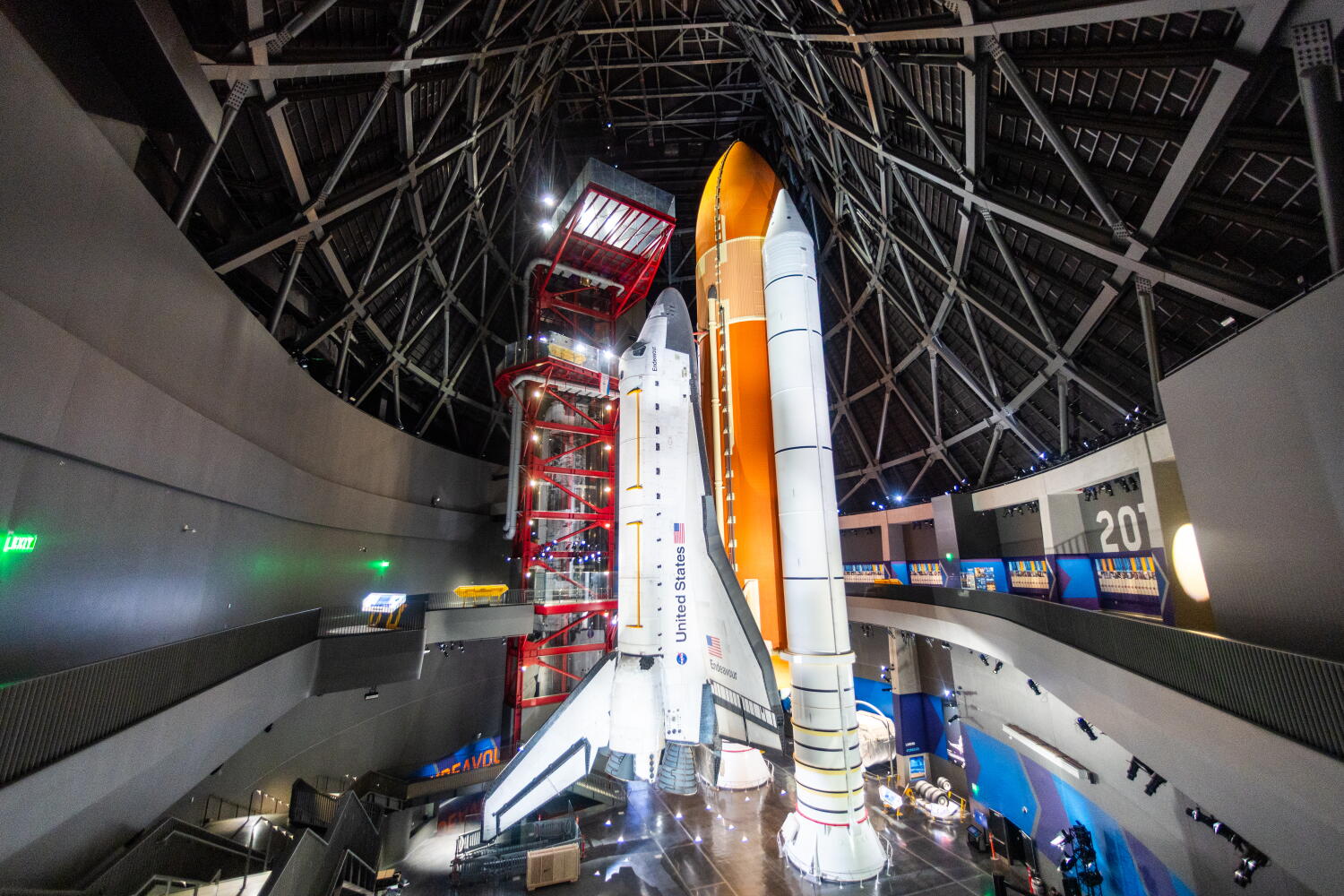
Reservations open next week. Cue the confetti. Cue the press releases. Cue thousands of people acting as if a timed-entry reservation at a Los Angeles museum is a passport to the stars.
It isn't. It's crowd control.
When a cultural institution announces reservations for a flagship attraction—especially one as iconic as Space Shuttle Endeavour—the standard coverage writes itself. Breathless excitement. Countdowns on calendars. Quotes about inspiration, wonder, and a "new permanent L.A. home." That lazy consensus treats a reservation system like a triumph of access and a vertical shuttle stack like a portal back to the golden age of spaceflight.
Wrong on both counts.
Timed-entry passes exist because space inside a building is finite, lines outside ruin reputations, and municipal fire codes do not care about childhood dreams of becoming an astronaut. Calling a ticketing rollout a milestone is like applauding a traffic light for turning green. And worshipping a stationary orbiter inside a museum hall while ignoring the economics, politics, and engineering reality behind it is pure nostalgia dressed up as insight.
I've spent years inside aerospace programs, museum exhibit planning, and capital-intensive attractions. I've seen institutions blow millions chasing spectacle while underfunding the actual educational mechanics that turn a wide-eyed kid into a working engineer. Shiny hardware draws a crowd once. Real intellectual rigor keeps a region scientifically literate for decades.
Let's tear down the comfortable assumptions around Endeavour's new home in Los Angeles—and look at what visitors, travelers, and taxpayers actually get when the reservation window opens.
The Myth of "Permanent" Aerospace Monuments
Words carry baggage. When people hear "permanent home," they picture an immortal artifact frozen in amber, untouched by time, physics, or budget cycles.
In aerospace, nothing is permanent except gravity and entropy.
An orbiter is not a bronze statue in a town square. Space Shuttle Endeavour is a complex aerospace vehicle built from aluminum-lithium alloys, silica thermal protection tiles, composite structures, and flight hardware designed around operating stresses, launch environments, and decades of wear. Even after retirement from orbit, preserving a flight-flown vehicle requires climate control, structural monitoring, seismic protection—especially in Southern California—and continuous conservation work that never shows up in a promotional brochure.
More importantly, a museum hall is a curated stage, not a time machine. Visitors looking at a vertical stack—orbiter mated to an external tank and solid rocket boosters—see the silhouette of launch day. What they don't see is the massive ground support infrastructure, crawler-transporter mechanics, cryogenic propellant logistics, or the brutal operational cost per flight that defined the Space Shuttle program from 1981 to 2011.
As aerospace historian Roger Launius and aviation writers like T.A. Heppenheimer have repeatedly documented across decades of shuttle scholarship, the Space Shuttle was a brilliant engineering compromise that became a fiscal and operational trap. It flew 135 missions across the fleet and built the International Space Station. It also cost far more per flight than early projections promised and suffered two catastrophic losses—Challenger in 1986 and Columbia in 2003—that exposed how unforgiving human spaceflight remains.
Turning Endeavour into a vertical centerpiece creates a dramatic visual punch. Nobody disputes that standing beneath a full-stack shuttle assembly hits harder than walking past a horizontal fuselage on a low pedestal. Still, dramatic staging can trick visitors into mistaking museum theater for aerospace reality. A vertical display tells a story of triumph and scale. It should never erase the friction, risk, and trade-offs that made every flight a high-wire act.
Reservations Are Not Access—They Are Rationing
Every time a high-demand attraction opens timed reservations, half the internet treats it like a golden ticket and the other half complains about scarcity. Both reactions miss the operational reality.
A timed-entry reservation system is capacity rationing. When a facility expects surges of visitors—local families, school groups, out-of-state travelers, and repeat fans—unmanaged entry creates bottlenecks, safety hazards, and miserable visits where nobody can see anything through a wall of phone screens.
Here is the uncomfortable truth for travelers planning a trip around reservation release dates:
- Reservations solve congestion, not curiosity. Getting a ticket gets you past the turnstile. It does not guarantee you will absorb a single technical concept.
- Peak windows punish spontaneity. Travelers who build rigid itineraries around a single reservation slot often discover that Southern California traffic, flight delays, or museum dwell times clash with rigid entry windows.
- Hype distorts value. A free or low-cost timed pass can still feel expensive if you fly across the country for a two-hour walkthrough that leaves you with more selfies than substance.
Imagine a scenario where a family books flights, hotel nights, and advance reservations months ahead because headlines treat the opening week like a once-in-a-lifetime event. They arrive during peak hours, rush through dense crowds, snap photos of the nose cone, and leave before reading a single technical panel on thermal tiles or orbital mechanics. They checked a box. They didn't experience the engineering.
Compare that to a quieter weekday morning or a slower pass through secondary galleries where propulsion systems, mission control history, and physical principles are explained clearly. Same building. Completely different return on attention.
What People Actually Ask (And Why the Questions Are Off)
Search behavior around major exhibit openings follows a predictable script. People type questions that sound smart on the surface while missing the real trade-offs underneath.
"Do I need reservations as soon as they open?"
If you are locked into a specific weekend, school break, or travel window—yes, treat release dates seriously. High-profile openings routinely see spikes in demand early on.
If your schedule has flexibility, rushing into opening-week chaos is rarely the smartest move. Early waves attract crowds chasing novelty rather than calm viewing. Waiting a few weeks often gives you smoother pacing and fewer people blocking sightlines. Even better: check whether walk-up options, off-peak hours, or companion exhibits offer breathing room without the frantic rush.
"Is it worth traveling to L.A. just to see Endeavour?"
If your entire trip hinges on standing in front of one spacecraft for forty-five minutes, probably not. Airfare, hotels, rideshares, and food add up fast.
If you treat Endeavour as one anchor inside a broader Southern California aerospace and science itinerary—paired with other regional museums, aerospace history sites, or coastal stops—the value equation shifts dramatically. Never let a single attraction carry the entire financial weight of a vacation unless you are a die-hard spaceflight nerd who finds joy just being in the room.
"What makes a vertical shuttle display better than a horizontal one?"
Visually, verticality changes spatial perception immediately. Human eyes read height and upward thrust differently than horizontal length; standing at the base of a tall stack conveys scale and power in a way a flat profile simply cannot match.
Technically, though, orientation does not automatically equal insight. A vertical display can look awe-inspiring while hiding details you can inspect up close at eye level on a horizontal mount. The smarter question isn't "Vertical or horizontal?" It's: Can I actually see how the systems connect, and does the exhibit explain why those choices were made?
The Downsides of Being Contrarian (And Where I'm Wrong)
Being the skeptic in the room is easy when everything is shiny. Being honest about the limits of skepticism is harder.
Here is where my contrarian take has real blind spots:
- Awe has real value. Not every visitor arrives ready to dissect orbital inclination or cryogenic insulation. Sometimes a kid stares up at a massive spacecraft and decides, for the first time, that science isn't just a textbook chore. Dismissing emotional awe because it isn't technical mastery is snobbery.
- Civic pride matters. Cities invest years and massive sums into major cultural anchors because shared landmarks give communities identity, momentum, and economic activity. Treating a flagship exhibit purely like a spreadsheet line item misses how public spaces function in real cities.
- Access is a moving target. Policies around timed tickets, pricing, and capacity evolve after launch as operators learn how crowds actually move through the space. Criticizing early friction doesn't mean the system can't improve.
I'll own that tension. You can be sharp about hype and logistics without pretending wonder is worthless. You just shouldn't confuse wonder with understanding.
How to Actually Do This Right Instead of Following the Herd
If you care about spaceflight, travel smart, or want your kids to walk away with real knowledge instead of souvenir fatigue, skip the herd mentality and run a better playbook.
1. Audit the Exhibit Like an Engineer, Not a Tourist
Don't just look at the big silhouette in the center of the room. Look at the seams. Look at the tile patterns, the engine bells, the structural joints, and the supporting artifacts around the perimeter. Ask yourself what problem each component solved—and what new problem it created. That single habit turns passive sightseeing into active learning.
2. Pair the Hardware With the History of Failure
Anyone can celebrate a launch photo. Real aerospace literacy requires understanding why programs stall, how engineers diagnose anomalies, and why safety margins cost time and money. Read up on shuttle mission history before you go so you recognize the significance of what you're looking at instead of reading plaques cold.
3. Time Your Visit for Attention, Not Hype
Skip the loudest crowd surges if your schedule allows. Go when you can actually pause, read, think, and talk through what you're seeing without feeling pushed along by a tide of bodies. Two unhurried hours beat four rushed ones every single time.
4. Don't Stop at the Museum Doors
A spacecraft on display is a monument to past engineering; commercial launch providers, orbital stations, deep-space probes, and aerospace manufacturing are happening right now. Use the visit as a starting line to follow current flight manifests, test campaigns, and engineering milestones rather than treating space exploration like a closed chapter.
Reservations opening next week is just a calendar date. What you bring with you—and what you walk away knowing—is entirely on you.