The dust at Dajabón never really settles. It rises off the Massacre River in the morning heat, coats the aluminum roofs of the market stalls, and settles into the creases of the hands of people who have spent three decades crossing a line that is only twenty yards wide and a hundred years deep.
Stand on the Dominican side of that bridge on a Tuesday morning and you can hear the two halves of Hispaniola breathing at completely different rates. On one side, engines idle, freight trucks back up toward Santiago, and border guards check manifests with the practiced boredom of men whose salaries clear on the fifteenth of every month. Across the shallow brown water, in Ouanaminthe, the sound is thinner, sharper, punctuated by the sudden scatter of motorcycles and the hollow crack of warning shots miles away in Port-au-Prince that somehow still echo up the Artibonite Valley. Meanwhile, you can read related events here: Asymmetric Retribution and Procedural Escalation in Legislative Impeachment Cycles.
For years, the men in tailored suits in Santo Domingo treated that river like a firewall. Build the concrete wall higher. Double the patrols. Suspend the visas. Keep the chaos on the western third of the island and pretend that geography can be negotiated with poured rebar and razor wire.
Then Luis Abinader looked across the Caribbean Sea—not north to Washington, where promises arrive in press releases and stall in committee hearings, and not east to Brussels, where diplomats express deep concern over coffee—and nodded toward a small, volcanic country on the Pacific coast of Central America. To explore the full picture, check out the detailed article by Reuters.
He backed Nayib Bukele. And he backed the idea of Salvadoran boots on Haitian soil.
To understand why the president of the Dominican Republic would publicly endorse the strongman of El Salvador sending soldiers into the western hemisphere’s worst security collapse, you have to stop reading diplomatic cables and start counting the hours a mother spends listening to the radio in a cinderblock house outside Port-au-Prince.
The Arithmetic of a Collapsing Neighbor
Let us create a composite figure, explicitly hypothetical, built from the documented testimony of thousands of families displaced over the last two years. Call her Mireille. She sells plantains and cooking oil near Croix-des-Bouquets, twelve miles northeast of the Haitian capital.
Three years ago, Mireille’s biggest worry was the price of fuel and whether the afternoon rain would flood the drainage ditch outside her stall. By early 2024, her calculation had narrowed to a single question every morning at dawn: which coalition of armed men controls the intersection between her house and the wholesale market today?
In Haiti, gangs do not operate in the shadows of a functioning state. They are the state’s replacement. Armed coalitions like Viv Ansanm have choked the ports, burned police stations, emptied prisons, and turned roughly eighty percent of Port-au-Prince into a patchwork of extortion checkpoints and sniper alleys. Over seven hundred thousand people have been driven from their homes inside their own country, sleeping in schoolyards and church basements with whatever they could carry in plastic laundry tubs.
Now walk thirty miles east, across the invisible line where Haiti ends and the Dominican Republic begins, and watch what that collapse does to the people who share the island.
Every hospital maternity ward in the Dominican border provinces feels the surge of women walking hours through scrubland because their local clinics in Haiti have neither electricity nor doctors. Every Dominican merchant in Dajabón watches their livelihood swing wildly whenever the border gates slam shut after another diplomatic standoff or armed clash. And every planner inside the National Palace in Santo Domingo looks at a map and realizes a brutal truth that no border wall can alter.
You cannot quarantine a fire when you share the same roof.
Abinader knows this. Reelected in a landslide largely because Dominican voters trusted him to hold the line on the Haitian crisis, he has spent years pleading with the international community to stop treating Haiti like a charitable afterthought. He stood before the United Nations General Assembly and warned that the Dominican Republic could not, and would not, absorb the collapse of its neighbor alone. He watched the Kenyan-led Multinational Security Support mission arrive in Port-au-Prince in mid-2024 with high expectations and painfully thin resources—a few hundred officers stepping into a city where heavily armed factions possessed military-grade rifles trafficked down from Florida and years of urban combat experience.
So when Nayib Bukele offered to fix Haiti, Abinader did not flinch. He applauded.
The Man Who Turned a Murder Capital Into a Slogan
To grasp the magnetic pull of Nayib Bukele across Latin America, you have to remember what San Salvador smelled like in 2015.
I remember walking through Soyapango, a densely packed working-class municipality on the eastern edge of the Salvadoran capital, back when the Mara Salvatrucha and Barrio 18 carved the streets into invisible death traps. The air smelled of diesel exhaust, grilled pupusas, and fear so thick that taxi drivers would turn off their headlights two blocks before an intersection so lookouts wouldn't mistake them for rivals. In 2015, El Salvador recorded more than a hundred homicides per hundred thousand residents—the highest murder rate of any country on earth not formally at war. Shopkeepers paid "rent" to teenagers with tattooed faces and rusting revolvers. Buses burned when owners missed a payment. Nobody walked across a neighborhood boundary after sunset unless they had a death wish.
Then Bukele took office, declared a state of exception in March 2022 after a weekend massacre killed eighty-seven people, suspended constitutional due process, and locked up more than eighty thousand suspected gang members in mega-prisons like CECOT.
The murder rate plummeted. Almost overnight, families in Soyapango began eating ice cream in public plazas at nine o'clock at night. Pupuserías stayed open past midnight. Bus drivers stopped paying extortion money.
And across the hemisphere, from Lima to Guayaquil to Santo Domingo, people watching their own streets descend into cartel and gang terror stopped asking how Bukele did it and started asking why their own leaders wouldn't do the exact same thing.
That is the emotional engine behind Abinader’s endorsement. When the Salvadoran president posted on social media that his government could fix the Haitian crisis—provided it received a United Nations mandate, the consent of the host country, and adequate funding—he wasn't speaking to human rights lawyers in Geneva. He was speaking directly to millions of exhausted Caribbean and Latin American citizens who have grown tired of watching polite international committees hold conferences while armed men burn hospitals.
When Abinader publicly backed Bukele and welcomed the prospect of Salvadoran troops deploying to Haiti, he was tapping into a visceral frustration that standard diplomatic reporting completely misses.
What Actually Happens When You Export a Doctrine
Strip away the applause lines and the social media bravado, and the picture gets far more complicated, far more dangerous, and far more revealing about the era we have entered.
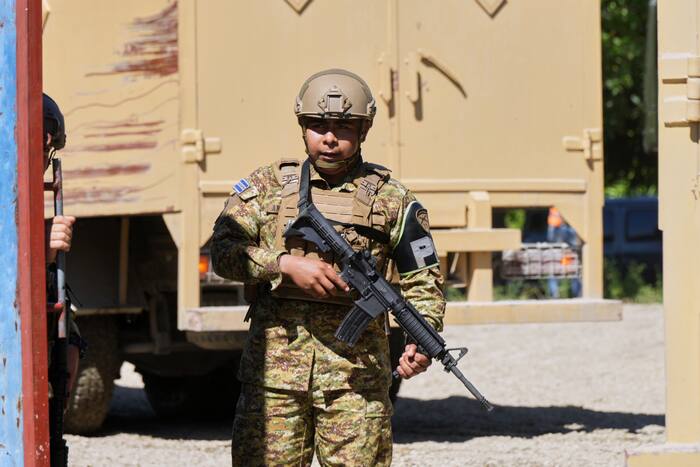
In October 2024, El Salvador formally committed to sending a contingent of military personnel to join the multinational mission in Haiti—initially focused on medical evacuation, logistics, and support rather than kicking down doors in Cité Soleil. Yet the symbolic weight of Abinader’s endorsement went light-years beyond medevac helicopters. By embracing Bukele’s involvement, the Dominican president legitimized the Bukele doctrine as a regional export.
Think of the Salvadoran security model like chemotherapy. When a patient is days away from dying of an aggressive, fast-moving cancer, nobody in the emergency room wants to debate the long-term toxicity of the drugs. They want the tumor stopped before the heart gives out. That is how Haitians dodging stray bullets in Delmas and Dominicans watching their border towns destabilize view armed intervention.
Except Haiti is not El Salvador.
Look closely at the differences, because the gap between the two countries is where grand political promises go to die.
In El Salvador, Bukele inherited a functioning, centralized state apparatus. He had a loyal national police force, an intact military chain of command, paved highways connecting every municipality, a working electrical grid, and courts—however compliant—that could process mass arrests. The gangs in El Salvador, brutal as they were, operated largely through extortion and localized street control rather than heavy weaponry and territorial warfare against an absent state.
Haiti has none of that infrastructure left.
Port-au-Prince has no elected president, no sitting parliament, and a Transitional Presidential Council fractured by internal rivalries and corruption scandals. The Haitian National Police has been hollowed out by attrition, underpayment, and casualties. The gangs in Haiti do not just extort corner stores; they control the highway arteries linking the capital to the northern and southern peninsulas, they siege international airports, and they have forged tactical alliances among themselves to fight foreign forces.
Even more starkly, there is the question of what happens to the innocent when you apply an iron-fist model without guardrails. Human rights organizations documented thousands of arbitrary arrests, deaths in custody, and vanished young men during El Salvador’s state of exception—collateral damage that Salvadorans largely accepted because their daily lives became measurably safer. In Haiti, where language barriers separate Spanish-speaking Central American troops from Creole-speaking neighborhoods, and where gang members blend seamlessly into densely packed informal settlements like Bel Air and Martissant, an aggressive pacification campaign without surgical intelligence risks turning entire communities against the very forces sent to liberate them.
The Invisible Stakes in Santo Domingo
Why, then, did Luis Abinader take the political risk of aligning himself so visibly with Bukele?
Because for Santo Domingo, the status quo is an existential slow bleed.
Look at the numbers that keep Dominican economists and generals awake at night. Haiti was once one of the Dominican Republic’s most important export markets—a natural trading partner right across a land border where Dominican agricultural goods, construction materials, and manufactured products flowed west in exchange for raw goods and seasonal labor. Gang control of Haitian ports and highways has strangled that legitimate trade, replacing formal commerce with smuggling, black-market fuel runs, and constant border closures.
At the same time, the political pressure inside the Dominican Republic has hardened into iron. Abinader’s government has launched aggressive deportation sweeps, expelling tens of thousands of undocumented Haitians back across the border—a policy fiercely criticized by the United Nations High Commissioner for Refugees and international advocates who warn that returning people to an active war zone violates basic humanitarian norms.
Abinader is caught in a vice. If he keeps the border porous, his domestic base punishes him for failing to protect Dominican sovereignty and social services. If he seals the border and deports migrants en masse, international bodies condemn him while the desperation on the Haitian side only intensifies.
The only exit from that trap is restoring enough order inside Haiti that Haitians do not have to flee their own neighborhoods just to survive.
And Washington wasn't coming to the rescue. With American attention split across Eastern Europe, the Middle East, and domestic immigration battles, the White House made it unmistakably clear that U.S. combat boots would not return to Port-au-Prince. The memory of past interventions—from the 1915 U.S. Marine occupation to the cholera outbreak introduced by UN peacekeepers in 2010—hung like a toxic cloud over every Western capital.
Into that vacuum stepped Bukele, offering soldiers without Western hand-wringing, and Abinader, welcoming any regional partner willing to share the burden sitting on his western doorstep.
A New Map of Power in the Americas
Step back from the border bridge at Dajabón for a moment and look at the broader pattern taking shape across Latin America.
For forty years after the end of the Cold War, the orthodox answer to insecurity in the Americas came from Washington and European think tanks: judicial reform, community policing, anti-corruption commissions, civil society grants, patient institutional building. Those programs produced thick reports and modest gains, until transnational criminal networks, synthetic drug profits, and the post-pandemic economic shock overwhelmed fragile democracies from Ecuador to Chile.
Citizens stopped waiting for five-year institutional reforms. They started looking for men who promised immediate, uncompromising force.
When the president of the Dominican Republic endorses the president of El Salvador sending troops to stabilize Haiti, we are watching a quiet realignment of hemispheric politics. Latin American leaders are no longer waiting for North American permission or European approval to construct their own security coalitions. They are trading in a new currency—one built on sovereign pragmatism, hard-edged deterrence, and the shared conviction that order must precede democracy, because democracy cannot breathe inside a burning house.
There is something undeniably seductive about that logic. If you are Mireille, hiding behind a concrete wall in Croix-des-Bouquets while armed men extort the water truck, you do not care about academic debates over the erosion of liberal norms in San Salvador. You care about whether your daughter can walk to school tomorrow morning without stepping over shell casings.
Yet history in the Caribbean carries a long, unforgiving memory. Every foreign uniform that has ever landed in Haiti arrived promising salvation, order, and a fresh start. Every single one eventually discovered that you cannot impose peace from the outside on a society whose political elite has spent generations treating the state as private loot, and whose poorest citizens have been abandoned by every institution meant to protect them.
Back at the River
Late in the afternoon, the gates at Dajabón clang shut.
The noise of the market dies down to the hiss of charcoal braziers and the slap of dominoes on wooden tables. On the Dominican side, soldiers in crisp olive fatigues lean against armored personnel carriers, watching the twilight settle over the hills of Ouanaminthe. Across the river, the lights flick on sporadically—a single bare bulb powered by a sputtering generator here, a cooking fire flickering in a courtyard there, swallowed quickly by the dark.
Luis Abinader has placed his bet on San Salvador’s iron fist, hoping that Salvadoran resolve and multinational backing can do what decades of diplomatic resolutions could not. Nayib Bukele has placed his bet on his own legend, wagering that the formula that emptied the streets of Soyapango of gunmen can survive the brutal reality of Port-au-Prince.
And on the western bank of the Massacre River, in the gathering dark where no press release ever reaches, millions of people wait to find out whether the men coming to save them will bring peace, or simply another uniform.


