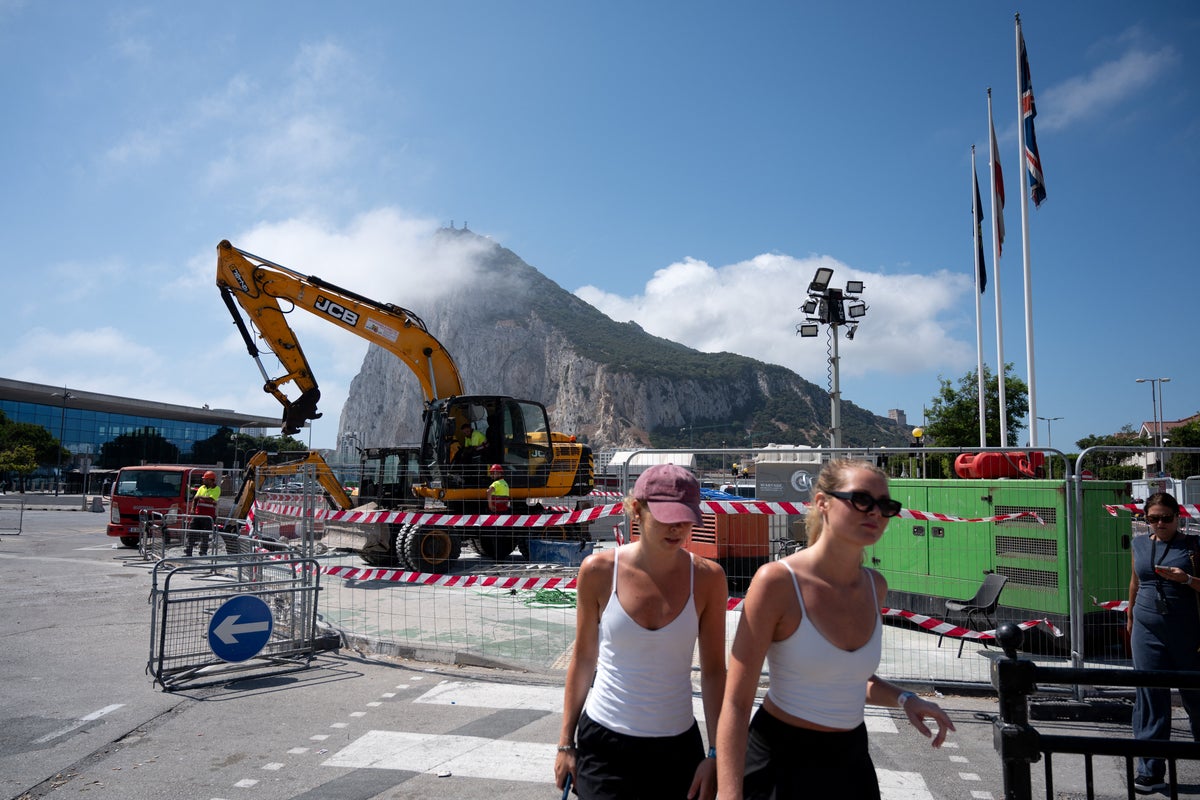
Every morning at 6:15, the alarm on Maria’s phone does not so much wake her as join a chorus. Outside her window in La Línea de la Concepción—the dusty, sun-bleached Spanish border town sitting in the literal shadow of the Rock of Gibraltar—hundreds of scooter engines are already warming up.
Maria is a nurse. Her patient is ninety-two, lives in a steep-stepped apartment flat high up on the limestone slopes of Gibraltar, and speaks a rapid-fire blend of English and Spanish known as Yanito. To get to him, Maria must cross an invisible, yet deeply felt, line.
For decades, this crossing has been a daily lottery of human patience. On a good day, Maria flashes her ID card to a Spanish officer, walks twenty yards, flashes it to a British-badged Gibraltar officer, and walks across the tarmac of an active airport runway to get to work. On a bad day, when political tensions flare in Madrid or London, the queue of cars stretches back for miles under a punishing Mediterranean sun. Exhaust fumes choke the air. Tempers fray.
Soon, that daily friction will simply evaporate.
The physical land border between Spain and Gibraltar is about to disappear. In a historic shift that untangles one of the most stubborn knots of the Brexit fallout, Gibraltar is set to join the Schengen zone. The passport checks, the metal gates, and the armed guards at the land border will vanish, replaced by an open, fluid boundary.
To understand why this is a monumental shift, you have to look past the treaties and the diplomatic handshakes in Brussels. You have to look at the scars on the land, and the people who carry them.
The Shadow of the Locked Gate
To the outside world, Gibraltar is a geographic oddity: a towering limestone monolith jutting into the Mediterranean, fiercely loyal to the British Crown, yet physically bolted to the southern tip of Spain.
But to Arthur, a seventy-eight-year-old retired dockworker who still lives in the narrow alleys of Gibraltar’s old town, the border is a living entity.
"In 1969, we heard the metal grind," Arthur says, his voice dropping to a gravelly whisper. He is referring to the day the Spanish dictator, Francisco Franco, completely closed the border in an attempt to starve the British territory into submission. "They didn't just close a gate. They tore families apart."
For thirteen years, the gate remained locked. Husbands were separated from wives; children were cut off from their grandparents. Arthur remembers standing at the green iron fence on the British side, clutching a megaphone, shouting family news across a hundred yards of empty, militarized no-man's-land to his cousins standing on the Spanish side. They would hold up newborn babies so relatives could see them through binoculars.
When the border finally reopened in 1985, the relief was overwhelming, but the psychological walls remained. The border became a barometer of geopolitical pressure. If Spain wanted to protest British sovereignty claims, the border checks slowed to a crawl. If the UK asserted its naval presence, the queues grew.
For the fifteen thousand Spanish workers who cross into Gibraltar every single day to keep its hospitals, restaurants, and financial offices running, the border was a daily tax on their time, their energy, and their dignity.
Moving the Line to the Sea
The solution to this decades-old headache is a masterclass in bureaucratic sleight of hand.
Instead of maintaining a hard border at the narrow neck of land connecting Gibraltar to Spain, the Schengen frontier is being pushed outward. The new border checks will not happen at the land gates. Instead, they will occur at Gibraltar’s port and its international airport.
Consider how this works in practice. If you fly into Gibraltar from London, you will step off the plane and immediately pass through a Schengen border control point. This will be staffed by Frontex, the European Union's border agency, alongside local Gibraltarian officers. Once you pass that point, you are technically inside the European free-travel zone. You can walk right out of the airport, across the old border line, and straight into Spain without ever showing your passport again.
It sounds simple. But the political tightrope required to achieve this was dizzying.
For Spain, allowing Gibraltar—a British territory—direct, unchecked access to the Spanish mainland required a massive leap of faith regarding security. For the United Kingdom and the people of Gibraltar, allowing EU border guards to operate on their soil felt, to some, like a quiet surrender of sovereignty.
To make it work, negotiators had to find a compromise that protected everyone's pride. The solution was Frontex. Because these officers represent a neutral, European agency rather than Spanish national police, Gibraltar could accept their presence on the Rock without feeling like Spain had finally conquered the territory through paperwork.
The Price of Freedom
Not everyone is celebrating with open arms. In the quiet pubs along Main Street, where Union Jacks hang alongside portraits of the royal family, there is a low-humming anxiety.
"We survived Franco's blockade because we knew exactly who we were," says Arthur, sipping a pint of bitter. "We were British, and that was that. Now, when the border goes, does the Rock start to drift away from London? Does it start to feel like just another Spanish coastal town?"
This is the invisible cost of the deal: a subtle, existential dread. For generations, the physical border, as annoying as it was, served as a protective shield. It kept the distinct identity of the Yanito people—with their unique blend of English grammar, Spanish vocabulary, and Genoese heritage—perfectly preserved in a cultural pressure cooker.
Without the gate, the economic integration will be absolute. Gibraltar's economy relies entirely on Spanish labor, while the neighboring Spanish region, Campo de Gibraltar, relies entirely on Gibraltarian investment and tourism. They are two halves of a single heart, forced to beat in separate chests for decades. Now, they are being stitched back together.
The sun is beginning to set over the Bay of Gibraltar, casting a long, amber glow across the runway. Maria is walking back toward Spain, her shift finally over.
She stops at the barrier, looking at the rusted metal structures that have dictated the rhythm of her life for fifteen years. Soon, these booths will be dismantled. The tarmac will be clear. The police officers will pack up their stamps and move to the docks.
For the politicians in Madrid, London, and Brussels, this is a complex treaty, a triumph of international law, and a post-Brexit compromise.
But for Maria, it is something much simpler. It is an extra hour of sleep in the morning. It is the ability to walk home to her children without checking a border-queue app first. It is the quiet realization that the metal gate which once tore families apart is finally being defeated, not by force, but by the unstoppable, mundane flow of daily life.