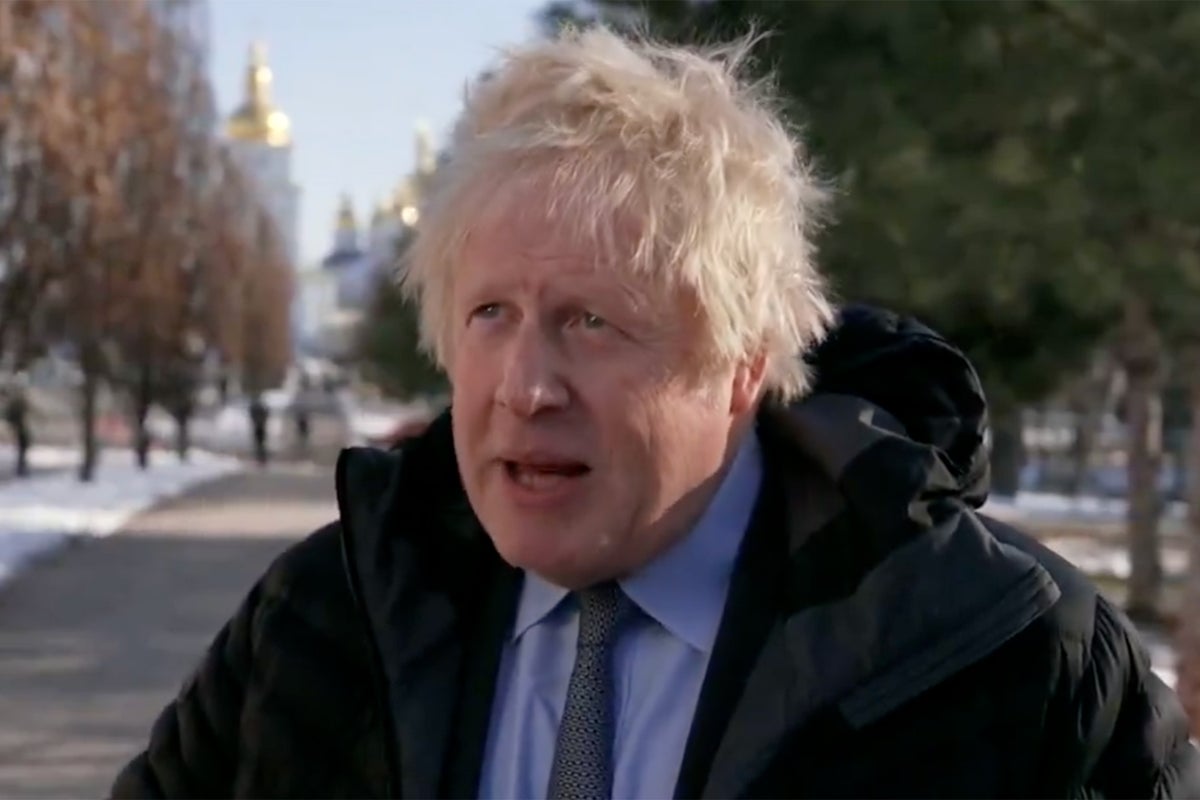
The headlines screamed about a narrow escape. A former British Prime Minister, a train in Ukraine, an evacuated carriage, and a Russian drone strike. The mainstream press immediately fell back on its favorite wartime trope: the dramatic brush with death for a Western VIP.
They got the story completely backward.
When news broke that Boris Johnson had been evacuated from a train in Ukraine following a nearby Russian drone strike, coverage centered on the personal peril of a high-profile visitor. Reports highlighted the sudden sirens, the brisk movement of security details, and the sheer luck of timing. That framing treats the incident like an action movie plot twist rather than what it actually is—a textbook demonstration of how modern infrastructure warfare operates and why VIP diplomacy in active combat zones carries strategic consequences that most commentators refuse to examine.
I have spent years analyzing crisis communications, geopolitical risk, and war-zone logistics. Watching legacy outlets recycle the same breathless "narrow escape" narrative is exhausting because it obscures the actual mechanics of the event. If you want to understand what happened on those tracks, stop looking at the celebrity passenger and start looking at the railway system, the drone doctrine, and the calculus of political theater.
The Myth of the Targeted VIP
The lazy consensus assumes that whenever a prominent Western figure is near an explosion in Ukraine, Moscow must have been aiming directly at them, or conversely, that the politician narrowly cheated a targeted assassination. Both assumptions misunderstand how Russian long-range strike packages actually work.
Long-range one-way attack drones—most notably the Geran-2, Russia's domestic production variant of the Iranian Shahed-136—are not precision sniper rifles designed to pick off a single moving railcar in real time. They are pre-programmed, inertial- and satellite-guided munitions built to hit fixed coordinates: electrical substations, marshaling yards, bridge abutments, and fuel depots.
To target a moving passenger train carrying a specific foreign dignitary requires an entirely different kill chain:
- Persistent real-time overhead intelligence, surveillance, and reconnaissance (ISR)
- Low-latency data links capable of updating terminal guidance mid-flight
- Munitions equipped with electro-optical or infrared seekers able to distinguish one locomotive from another
Russian forces certainly possess tactical reconnaissance drones near the front lines, such as the Orlan-10 and Zala series, which pair with Lancet loitering munitions for dynamic targeting. Deep inside Ukrainian territory, however, the primary threat to rail corridors comes from area-denial and infrastructure degradation strikes aimed at the grid and the tracks themselves.
When security teams evacuate a train during an air raid alert, they are not reacting to a missile locked onto a specific compartment. They are following standard Ukrainian Railways (Ukrzaliznytsia) and state security protocols triggered whenever air defense networks detect incoming strike packages crossing regional sectors. Calling it a "personal escape" inflates the drama while erasing the routine, grinding reality faced by millions of Ukrainian commuters every single week.
Why Ukrainian Railways Are the Real Protagonist
If there is an extraordinary story here, it belongs to Ukrzaliznytsia, not a visiting British politician.
Since February 2022, Ukraine's rail network has functioned as the circulatory system of the entire country. With civilian airspace completely closed, every head of state, foreign minister, weapons shipment, and displaced family moves by rail. Western leaders—from Joe Biden and Rishi Sunak to Emmanuel Macron and Olaf Scholz—have all ridden the same overnight sleeper cars out of Poland into Kyiv.
According to operational data published by Ukrainian Railways and documented by transport analysts at the Royal United Services Institute (RUSI), the rail network has absorbed hundreds of direct strikes on tracks, traction substations, and rolling stock since the full-scale invasion began. Yet train delays across the network routinely average mere minutes rather than days.
How does a state-run railway maintain near-peacetime punctuality under constant aerial bombardment?
- Decentralized Repair Brigades: Track maintenance crews are pre-positioned along major arteries with stockpiles of sleepers, rails, and ballast. When a crater opens up, repair teams are often on-site before the smoke clears.
- Diesel Redundancy: Because Russia routinely targets electrical substations to knock out overhead catenary lines, Ukrzaliznytsia keeps fleets of aging diesel locomotives on hot standby. When the grid goes dark, diesel engines haul electric trains past the dead zones.
- Dynamic Routing and Air-Raid Protocols: Dispatchers continuously reroute traffic around active engagement zones, halting trains outside high-risk urban junctions or moving passengers into reinforced shelters when air defense radars track inbound threats.
When Boris Johnson stepped off that train, he experienced a fraction of the standard operating procedure that keeps Ukraine running. Framing the incident around his personal survival treats a systemic triumph of wartime logistics as a fluke of individual fortune.
The Uncomfortable Truth About VIP Wartime Tourism
Here is the part that polite diplomatic commentary refuses to touch: high-profile visits to active war zones are not free of operational cost.
Supporters of frequent VIP trips to Kyiv argue—correctly, to a point—that physical presence signals solidarity, keeps media attention focused on the conflict, and counters fatigue among Western voters. Boris Johnson has leaned heavily into this role since leaving Downing Street, positioning himself as one of Ukraine's most vocal international champions.
Yet every foreign dignitary who enters a combat zone imposes a massive security tax on the host nation.
Consider what happens behind the scenes when a former prime minister or sitting cabinet official travels through Ukraine:
- Air Defense Reallocation: While officials rarely confirm specific deployments, host nations inevitably tighten air defense coverage along the transit corridors and cities hosting senior foreign guests. Every interceptor system prioritizing a VIP route is a system not covering a frontline brigade or a power plant elsewhere.
- Intelligence Exposure: Coordinating cross-border rail movements requires advance communication across multiple agencies, diplomatic missions, and security contractors. Even with strict operational security, the sudden appearance of specialized foreign protective details creates a digital and physical footprint that hostile intelligence services actively monitor.
- Publicity vs. Operational Security: Unlike sitting heads of state, whose visits are kept strictly embargoed until they are safely back across the Polish border, former officials and political figures often operate with looser media protocols, sometimes broadcasting their presence while still inside the country.
Imagine a scenario where a prominent Western figure is injured or killed during one of these unscheduled or loosely coordinated solidarity trips. The political fallout in London, Washington, or Brussels would be immediate—not necessarily resulting in stronger support for Ukraine, but potentially triggering domestic demands to restrict travel, pull back advisory personnel, or second-guess entanglement altogether.
The counterargument, voiced by many Ukrainian officials themselves, is that the diplomatic return on investment outweighs the security burden. When cameras follow a recognizable Western leader into Kyiv or Odesa, global news cycles briefly pivot back to the war. For a country fighting for sustained financial and military aid, visibility is oxygen.
Both realities exist simultaneously. The visits generate real political capital, and they carry real operational friction. Pretending it is simply a heroic adventure does a disservice to the professionals managing the risk on the ground.
What People Actually Get Wrong About War-Zone Rail Travel
Whenever an incident like this hits the news, search engines fill up with the same predictable questions from readers trying to make sense of how leaders move through an active war. Most of the conventional answers miss the mark.
Are foreign leaders deliberately targeted by Russian strikes during Ukraine visits?
There is little credible evidence that Russia conducts deliberate decapitation strikes against visiting Western politicians. A strike that kills a former British Prime Minister or a sitting European minister would cross an escalation threshold that Moscow has consistently avoided, risking direct NATO military intervention. High-profile incidents—such as the March 2024 missile strike in Odesa that landed several hundred meters from Ukrainian President Volodymyr Zelenskyy and Greek Prime Minister Kyriakos Mitsotakis—appear to reflect Russia's ongoing bombardment of strategic port infrastructure rather than an attempt to assassinate a visiting European head of government. The danger to VIPs is collateral, not bespoke—which makes it harder, not easier, to predict.
Why do world leaders still take trains instead of helicopters or armored convoys?
Armored road convoys over hundreds of kilometers are slow, predictable, and vulnerable to ambush, mines, and road bottlenecks. Low-flying helicopters risk friendly fire from jumpy short-range air defense units and remain exposed to long-range radar-guided missiles. Heavy rail offers speed, comfort for overnight transit, physical mass, and integration into an existing air-raid warning architecture. More importantly, dozens of diplomatic trains run every month without incident; the rare disruption makes headlines precisely because the system works quietly the other 99 percent of the time.
Does evacuating a train actually protect passengers from a drone strike?
It depends entirely on what is nearby. Getting passengers out of a stationary carriage sitting inside a major rail junction or next to a fuel depot reduces the risk of secondary explosions and flying glass—the leading cause of blast injuries in urban strikes. Stepping out into an open field with no overhead cover, however, offers minimal protection against fragmentation if a warhead detonates nearby. Evacuation protocols are calculated risk-reduction measures designed to get people away from high-value infrastructure targets, not magical shields.
The Real Lesson Behind the Headline
The obsession with Boris Johnson's evacuated train reveals a persistent blind spot in how Western audiences consume war coverage. We crave relatable protagonists. A single recognizable face stepping off a train in the dark is easier to process than the mechanics of Russian strike attrition, Ukrainian air-defense interception rates, or the quiet endurance of railway workers repairing high-voltage lines under fire.
There is a legitimate downside to stripping away the celebrity angle: without famous names attached to these dispatches, international attention drifts away from the conflict altogether. Media editors know that a headline about a former prime minister draws ten times the clicks of a technical briefing on transformer replacements in central Ukraine.
That attention economy is precisely why the narrative gets distorted. Every time a drone explodes within earshot of a visiting dignitary, the coverage turns the event into a story about Western bravery and narrow escapes. Meanwhile, the actual war—a grinding contest of industrial production, grid resilience, and air-defense math—happens in the background, largely ignored until the next VIP buys a train ticket.
Stop measuring the danger in Ukraine by how close a drone gets to a visiting politician, and start paying attention to the infrastructure those drones are actually trying to destroy.