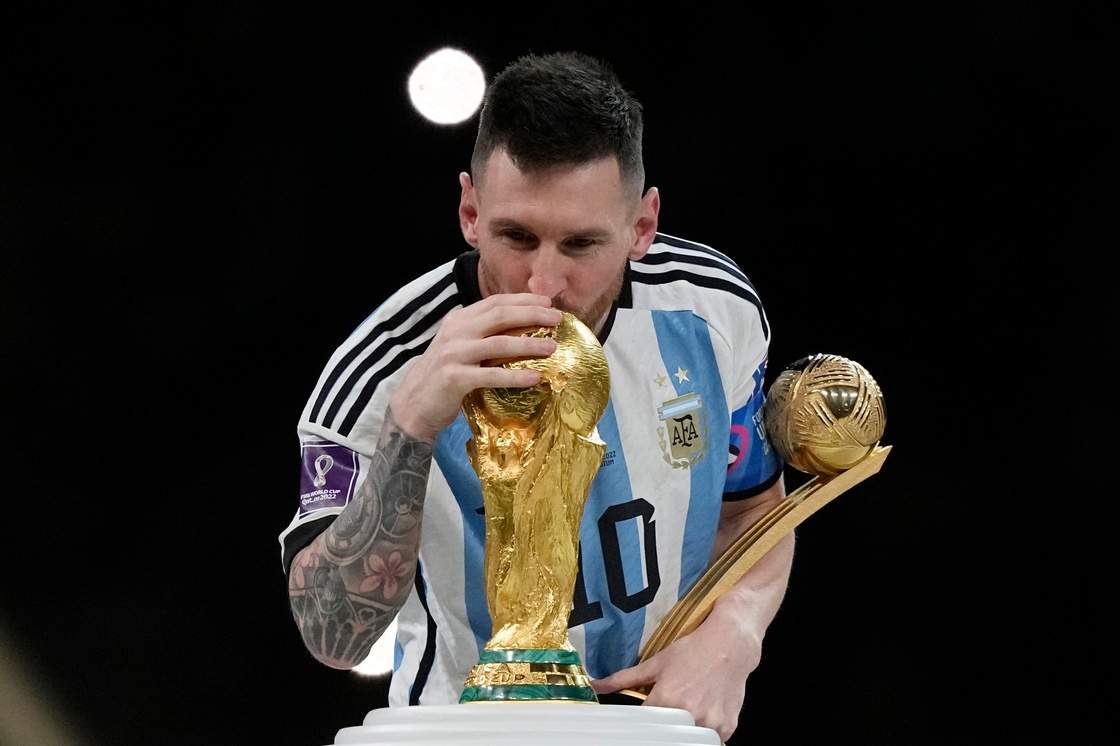
The air in Buenos Aires always tastes like smoke and rain when the national team plays, a heavy, electric fog that clings to the iron balconies of San Telmo and turns the asphalt black. On that Tuesday, twenty-one years after a teenage Lionel Messi first pulled the heavy wool of the Albiceleste shirt over his head, the city held its breath. Not because of a match. Not because of a scoreline. But because the ghost that had haunted Argentine football for two generations had finally been laid to rest, and the man who conjured it was walking away.
Twenty-one years. Think of what a generation means in human terms. A child born the day Messi made his senior international debut in 2005 was old enough to vote, to drink, to fall in love and have their heart broken twice over by the time the boots were laced up for the very last time. For two decades, this small, quiet man from Rosario was not merely an athlete playing a game. He was the nation's collective nervous system. When he scored, inflation seemed less steep, the potholes in the provincial roads felt a little shallower, and the bruised pride of a turbulent South American economy found a temporary, euphoric anchor. When he lost, a suffocating silence settled over the plazas, broken only by the hum of radios and the quiet weeping of old men who remembered Maradona in '86. For an alternative look, read: this related article.
We forget how fragile it all was in the beginning. In his very first appearance against Hungary, a twenty-second cameo as a substitute, he was shown a straight red card for a stray arm. A red card. Expelled before he could sweat through his jersey. It felt almost poetic, a cruel foreshadowing of the persecution that awaited him by his own people. For years, the Argentine press—that ravenous, beautiful beast—treated him like a foreign prince who refused to kiss the ring. They said he lacked the blood. They said he was Catalan, a Barcelona boy who cared more about Camp Nou than the dust of the River Plate. They whispered it in the cafes of Palermo Soho and screamed it on Sunday night talk shows. Pecho frío. Cold-chested. Mercenary.
I remember standing outside the Estadio Monumental after the 2016 Copa América Centenarian final, the night he missed a penalty in the shootout against Chile and announced his retirement for the first time. The air was thick with despair. Grown men sat on the curbs with their heads in their hands, staring at the empty beer cans rolling in the gutter. Messi walked through the mixed zone that night, his eyes hollow, and told reporters, "It's for the good of everyone. My time with the national team is over." That wasn't a tantrum. That was exhaustion. Imagine carrying a continent's worth of generational trauma in your kit bag, match after match, year after year, while millions of people who have never kicked a ball scream that you are not enough. Related analysis regarding this has been published by Bleacher Report.
Yet he came back. Because he had to. Because the unfinished business was a physical weight, an ache in his joints that no physiotherapist could massage away.
To understand what Messi’s career with Argentina truly means, you have to look past the hardware, though the hardware is staggering: 180 international appearances, 106 goals, a Copa América in 2021, and the holy grail itself, the World Cup in Qatar in December 2022. But numbers are just dry bones. The flesh and blood of his international legacy lie in the transformation of his relationship with the pressure.
For the first fifteen years, he played with the posture of a man carrying a piano up a steep flight of stairs. Every touch of the ball was scrutinized. Every missed free kick was interpreted as a betrayal. He was quiet, almost painfully so, retreating into his own shell while the Argentine media tore at his reputation. But something shifted around 2019. The boy who hid behind his hair grew a beard, found his voice, and began to roar. He stopped trying to be Maradona and finally allowed himself to be the first, terrifyingly brilliant Lionel Messi.
By the time Qatar rolled around, the transformation was complete. He was no longer just the tactical fulcrum of the team; he was the spiritual father to a band of young warriors—De Paul, Alvarez, Mac Allister—who looked at him not with the distant reverence due a deity, but with the fierce, protective loyalty of younger brothers willing to bleed for their elder.
Consider that quarterfinal against the Netherlands in Lusail. The tension was so thick you could cut it with a knife. When Messi scored his penalty, he didn't run to the corner flag to celebrate. He turned toward the Dutch bench, cupped his ears in a direct nod to Juan Román Riquelme, and stared down Louis van Gaal with a cold, unblinking fire that nobody knew lived inside the polite Rosario boy. That wasn't petulance. That was liberation. For the first time in his life, he was enjoying the violence of the arena. He was owning the noise.
And then came the final against France. A match that defied cinema. Two hours of exquisite agony, where Argentina surrendered a two-goal lead, climbed back up the mountain, surrendered it again, and finally found salvation in the lottery of penalties. When Gonzalo Montiel slotted home the winning kick, Messi didn't drop to his knees in relief. He fell forward onto his face, his arms outstretched, weeping into the turf of the Lusail Stadium. All those years of being called a failure by his own countrymen, all those flights across the Atlantic after yet another heartbreaking loss, all those quiet nights staring at the ceiling in hotel rooms—washed away in a single, golden instant.
He stayed for two more years after that night, playing exhibition matches like a man visiting his favorite childhood haunts after selling the house. He walked the pitches of South America and the United States, smiling more, running a fraction less, drinking mate with the younger lads, savoring the warmth of a country that finally loved him back without reservation.
Now, the boots are off for good. Twenty-one years of sweat, heartbreak, and eventual redemption, distilled into a single, quiet departure.
The streets of Buenos Aires are quiet tonight. The rain has stopped, leaving the pavement shimmering under the amber glow of the streetlamps. Somewhere in a cramped apartment in Boedo, a father is telling his ten-year-old daughter about a man who was smaller than everyone else on the pitch, but somehow managed to make the entire world look up. The game will go on. Another number ten will eventually pull on the shirt, carrying the impossible weight of the national expectation. But there will never be another afternoon quite like the ones where he touched the ball, and for ninety minutes, everything was going to be alright.