Dirt is just dirt until it is not.
Most people walk across the earth thinking only of the pavement beneath their shoes or the garden weeds choking last season's tomatoes. We treat the ground as a passive floor, an endless, heavy rug spread over the bones of the planet. But beneath our feet lies a silent, frantic race. Every battery humming in an electric vehicle, every smartphone glowing in a teenager's palm, every wind turbine spinning on a remote ridge is tethered to a single, finite substance. Lithium. Learn more on a connected topic: this related article.
The white gold of the twenty-first century.
For decades, finding it meant brute force. It meant geologists sweating under desert suns in South America or drilling core samples in remote Australian outposts, spending millions of dollars and years of labor on hunches. It was an industry built on heavy boots, muddy maps, and geological intuition honed over a lifetime. More reporting by TechCrunch delves into comparable perspectives on the subject.
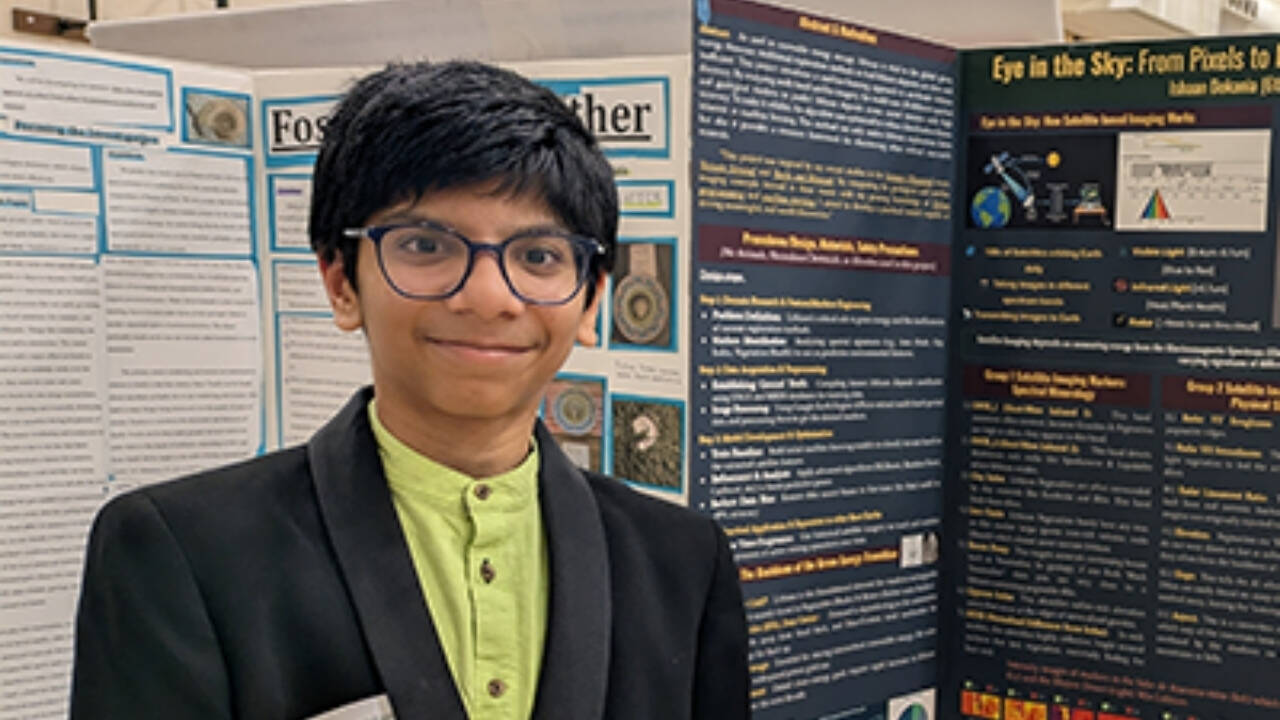
Then came a sixth-grader from India, sitting in front of a glowing laptop screen while his peers were presumably arguing over video games or struggling with fraction homework.
His name is Siddharth Mandala. While other children saw satellite images as pretty pictures of swirling green forests and arid brown plains, Siddharth saw a puzzle. He wondered if the Earth was whispering its secrets in a language we simply refused to decode.
The Quiet Obsession
We live in an age of automated convenience, where artificial intelligence is routinely deployed to write corporate emails or generate whimsical pictures of cats in space. But every so often, a young mind strips away the corporate gloss and uses the exact same technology to ask a question that actually matters.
Siddharth did not have a multi-million-dollar laboratory. He did not have a fleet of survey helicopters or a corporate research budget. What he had was patience, an internet connection, and an unquenchable curiosity about how machine learning could solve a physical crisis.
Consider what happens when you train a computer. You feed it mountains of data—thousands of examples of what a thing looks like, how it behaves, where it hides. You let the algorithm chew on the patterns until it can pick out a needle in a haystack of digital noise.
For months, Siddharth poured over satellite data and geological surveys. He mapped the spectral signatures associated with lithium-rich brines and clay deposits. He tested, failed, adjusted, and tested again. He taught a machine-learning model to look at the same surface features that human prospectors spent lifetimes learning to identify.
The result was startling.
When the model was finally put to the test, it did not merely guess. It identified lithium deposits with eighty-nine percent accuracy.
Let that number settle for a moment. Eighty-nine percent. A child, utilizing code and public data, matched or exceeded the preliminary efficiency rates of seasoned exploration teams who rely on expensive, invasive physical surveys.
The Invisible Stakes
To understand why this matters, you have to look up from the laptop and look at the macro picture of our energy transition.
The world is trying to pivot away from fossil fuels. It is a massive, clumsy, urgent migration. Governments have set ambitious timelines. Automakers have billions of dollars pinned to supply chains that are dangerously fragile. If we cannot secure enough lithium, the transition stalls. Factories go dark. Prices skyrocket. The entire green dream hits a physical wall of scarcity.
Traditional prospecting is slow. It tears up ecosystems, demands massive capital, and often yields nothing. Imagine funding an expedition into a remote, fragile ecosystem, drilling dozens of deep holes, only to find trace elements too meager to extract. The environmental cost is high; the financial risk is higher.
Now, imagine shifting that initial friction entirely into the digital realm.
What Siddharth built—and what his success represents—is a profound shift in how we interact with the planet's physical resources. By letting algorithms narrow the search field from millions of square kilometers down to a few high-probability hectares, we change the entire geometry of resource extraction. We stop guessing blindly. We stop tearing up landscapes on a mere hunch.
We listen to the data first.
The Human Element in the Code
There is a temptation in modern tech journalism to turn stories like this into superhero fables. We look for the prodigy narrative, as if genius arrives fully formed out of nowhere, touched by some divine lightning bolt.
That is not how it happens.
Genius, at least at this scale, is mostly about permission. It is about a kid who was not told that machine-learning algorithms are only for Silicon Valley engineers or doctoral candidates at MIT. It is about an educational environment—or perhaps just a stubborn internal drive—that allowed him to wander into fields usually reserved for gray-haired experts with clipboards.
When we look at Siddharth’s work, we are looking at the democratization of expertise. The tools of advanced science are no longer locked behind university gates or corporate vaults. They are sitting on open-source repositories, waiting for anyone with enough curiosity to download them.
Yet, we should also feel a mild, constructive sting of humility.
If a sixth-grader can build a model that pinpoints critical energy minerals with high precision using publicly available satellite data, what are the legacy industries doing? Why are billion-dollar corporations still relying on twentieth-century methods in a twenty-first-century crisis?
The answer, of course, is institutional inertia. Large systems move like oil tankers. They are heavy, cautious, and resistant to change until a nimble outsider proves that the old way is obsolete.
Looking Beyond the Algorithm
It would be a mistake to assume this is just a story about a cool science fair project. It is a cautionary tale for how we approach complex problems.
We often wait for permission to care. We wait for official institutions to solve climate change, supply chain bottlenecks, and resource depletion. We assume that because a problem is massive, the solution must require an equally massive, centralized bureaucracy.
Siddharth’s project reminds us that the leverage points of the future are decentralized. They are built by individuals sitting in bedrooms, armed with open-source libraries and a willingness to look at old problems through a completely different lens.
The lithium deposits are still in the ground. The batteries still need to be built. The climate clock still ticks away its relentless seconds.
But the map has changed. The barrier to entry has collapsed.
Somewhere out there right now, another kid is looking at a dataset about water scarcity, or carbon capture, or agricultural yields, wondering if a simple algorithm can see what everyone else is missing. They aren't waiting for a corporate memo. They aren't waiting for a grant. They are just writing code, testing hypotheses, and quietly rewriting the rules of what is possible.
The earth holds its secrets tightly, locked in complex chemistry and ancient geology. But the locks are rusting. And the next generation has already learned how to pick them.