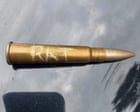
Cold metal on warm glass.
It is a tiny thing, really, no longer than the first joint of a human thumb, weighing barely a few grams, designed to sit quietly inside a chamber until a firing pin strikes its base. When you find one resting deliberately on the hood or windshield of your parked car, the physical object itself has not been fired. Nobody has pulled a trigger. Yet the sound of the threat echoes louder than any gunshot could.
"Someone has been following me."
Those five words, spoken in the aftermath of a chilling discovery in Victoria, Australia, carry the weight of a sudden, irreversible rupture in a person's sense of safety. A state government minister walks out to a vehicle, expecting the mundane rhythm of another day spent debating policy, answering constituents, and navigating the bureaucratic machinery of public life. Instead, there is a bullet. And scratched into the casing, deliberate and unmistakable, are three letters.
RAT.
Stop for a second. Put down the newspaper, step away from the glowing screen of your phone, and inhabit that exact moment.
You are standing in a driveway or a quiet suburban street. The morning air is crisp, the neighborhood dogs are barking three doors down, and a neighbor is probably wheeling a rubbish bin back toward their garage. Everything looks entirely normal. That is the precise horror of targeted intimidation. It takes the ordinary architecture of your daily life—your commute, your front porch, the car you use to pick up groceries—and turns every shadow into a potential vantage point. You suddenly realize that while you were buying milk or unlocking your front door, someone else was watching you. Someone knew your schedule. Someone stood inches from your personal property, reached into a pocket, and left a message meant only for your eyes.
We read headlines like this over morning coffee and shake our heads. We mutter about how crazy politics has gotten, click to the next story about interest rates or weekend football scores, and move on. We treat political intimidation like a weather report—an unfortunate storm blowing through someone else's town.
We have gotten the entire story backward.
The Architecture of Fear
To understand why a single inscribed bullet left on a Victorian minister’s car matters to every single person who never intends to run for office, we have to look past the partisan noise and examine the mechanics of intimidation.
Let us construct a hypothetical scenario to make the invisible visible. Imagine a local school board member or a regional councilor—let’s call her Sarah. Sarah isn't a career politician; she’s a former nurse who ran for office because the local clinic was losing funding. For two years, she spends her evenings reading hundred-page zoning reports at her kitchen table while her kids do homework. She takes calls from angry residents about potholes and property taxes. She accepts the yelling at town halls because she believes, deep in her bones, that democracy is supposed to be loud, messy, and occasionally uncomfortable.
Then, one Tuesday, Sarah makes a vote that upsets a vocal faction. By Thursday, her home address is posted online. By Saturday, she finds a dead bird on her doorstep, or a brick through her front window, or a piece of brass ammunition resting neatly beneath her windshield wiper.
What happens to Sarah on Sunday morning?
She doesn't resign immediately—most people in public life are stubborn enough to resist giving bullies an instant victory. Instead, something far more insidious takes root. Sarah starts checking her rearview mirror every thirty seconds on the drive to work. She stops walking her dog after sunset. When the next controversial vote comes up on the council agenda, a vote she knows is right for the community, she hesitates. Her stomach tightens. She thinks about her kids sleeping upstairs next to the ground-floor windows.
Intimidation rarely needs to pull a trigger to achieve its objective. Its true weapon is the quiet, creeping paralysis it induces in the human nervous system.
When a Victorian minister says, "Someone has been following me," that is not merely a statement of fact for a police report. It is an admission that the invisible perimeter every human being relies upon to feel safe in the world has been breached. Psychologists who study stalking and targeted harassment describe this as a state of chronic hypervigilance. Your brain, evolutionary wired to scan the savanna for predators, never powers down. Every stranger at a crosswalk becomes a suspect. Every parked sedan with tinted windows becomes a surveillance post.
The Slow Poisoning of the Public Square
History offers a grim warning about what happens when societies normalize threats against public officials. You do not need to look at distant authoritarian regimes to see the pattern; behavioral criminologists have tracked a steady, unmistakable escalation across Western democracies over the past decade.
In the United Kingdom, the murders of Members of Parliament Jo Cox and Sir David Amess forced a national reckoning over the vulnerability of elected representatives who hold open constituency surgeries. In the United States, threats against federal judges, election workers, and local mayors have surged to levels that would have been unthinkable twenty years ago. In Australia—a country that has long prided itself on a robust, irreverent, yet fundamentally peaceful political culture—the temperature has risen sharply since the pandemic years. Protests outside politicians' private residences, gallows erected on the steps of Victoria's Parliament House, and now, a bullet etched with a slur left directly on a minister's vehicle.
Think about the word chosen by the perpetrator: RAT.
In the lexicon of underworld slang and extremist grievance, a "rat" is a traitor. Someone who broke a code. Someone who deserves punishment. By carving that specific word into ammunition, the sender was doing two things simultaneously. First, they were framing an elected official not as a public servant with whom they disagreed, but as an enemy combatant who had committed treason against their worldview. Second, they were issuing a promise of retribution.
Look at how quickly the goalposts have moved.
Twenty years ago, political anger in places like Melbourne or regional Victoria looked like a heated letter to the editor, a boycott, or a noisy rally outside Treasury Place. People argued fiercely, sometimes cruelly, about taxes, infrastructure, and social policy. Yet there was an unspoken consensus—a collective agreement—that the fight stayed inside the arena. When the bell rang, the politicians went home to their families, and the protesters went home to theirs.
That boundary has dissolved. The digital age, with its algorithmic reward systems for outrage, has convinced millions of isolated, angry individuals that their political grievances are existential emergencies. When you spend six hours a day inside online echo chambers that tell you your government is an illegitimate cabal destroying your way of life, leaving a bullet on a minister's car doesn't feel like a crime to you. It feels like a righteous warning shot.
Who Will Be Left Standing?
Here is the real problem, and it has nothing to do with the personal courage of any single Victorian politician.
Democracy relies on a massive, largely invisible pipeline of ordinary people willing to step forward and take responsibility for how their communities are run. Most of them do it for modest pay, brutal hours, and relentless public scrutiny. They do it because they want better schools, safer roads, cleaner hospitals, and fairer laws.
Now ask yourself: if the price of admission to public service includes having strangers follow you home, track your movements, and leave ammunition on your car, who is going to apply for the job?
Normal, empathetic, well-adjusted human beings will look at the cost and walk away. Parents will choose their children's peace of mind over a seat in parliament. Doctors, teachers, small business owners, and community organizers will decide that trying to fix the system simply isn't worth the terror of looking over their shoulders every time they walk through a parking lot.
And who will replace them?
The narcissists. The extremists. The people who thrive on chaos, who have no empathy to wound, and who view politics not as a mechanism for solving human problems, but as a blood sport.
When we allow intimidation to fester, we don't just hurt the target on the receiving end of the threat. We systematically filter out the best of us from leadership, leaving behind only those callous enough to stomach the toxicity. It is a slow-motion coup conducted not with tanks in the streets, but with whispered threats, doxxed addresses, and pieces of brass left on windshields.
The Weight of Unanswered Threats
I remember speaking years ago with a local councilor who had received a series of escalating threats over a controversial housing development. What struck me wasn't the anger in his voice; it was the exhaustion. He showed me a folder of emails and police incident numbers, his hands trembling slightly as he turned the pages. He told me that the hardest part wasn't the threats themselves—it was the feeling of isolation that followed. Friends stopped calling as often because they didn't know what to say. Colleagues offered platitudes in the hallway and then hurried away, grateful the crosshairs were pointed elsewhere.
"You start to feel like you're radioactive," he told me quietly. "Like your mere presence puts everyone around you in danger."
That is the exact psychological toll the Victorian minister is navigating right now. Beyond the immediate police investigation—the forensic swabbing of the bullet casing for DNA, the scouring of CCTV footage from nearby streetlights, the increased security briefings—there is the quiet, private reckoning that happens when the house goes dark at night.
Every creak of the floorboards sounds different. Every set of headlights slowing down outside the front gate triggers a surge of adrenaline that leaves you wide awake at three in the morning, staring at the ceiling.
It is easy to dismiss this as an occupational hazard. People love to say, "If you can't stand the heat, get out of the kitchen." It is one of the laziest, most corrosive clichés in modern public life. Criticism is heat. Scrutiny is heat. Tough questions from journalists, protests on the steps of parliament, and losing an election are all part of the kitchen.
Stalking is not heat. A bullet with a threat scratched into the brass is not heat. It is arson.
Drawing the Line in the Daylight
If a society wants to preserve the fragile experiment of self-governance, it cannot outsource the defense of democratic norms solely to the police force. Law enforcement can trace fingerprints, monitor threats, and arrest perpetrators, and they must pursue every single one of these incidents with relentless seriousness. There can be zero ambiguity about the consequences of threatening an elected official.
Yet the deeper cure is cultural, and it belongs to all of us.
It requires a collective refusal to excuse, minimize, or laugh off political intimidation, regardless of which side of the ideological divide the target stands on. If you only care about threats when they are directed at politicians you voted for, you do not actually care about democracy; you only care about your team winning.
It means calling out the toxic rhetoric in our own circles—the casual jokes about violence, the dehumanizing labels that turn neighbors into "traitors" and "rats," the performative cruelty that treats human beings in public office as cardboard cutouts rather than flesh-and-blood people with families who love them.
Think back to that car parked on a Victorian street.
The person who left that bullet did so in the shadows, counting on fear to do the rest of the work. They wanted the minister to feel hunted. They wanted the silence that follows a threat to settle over the hallways of power, chilling debate and bending decisions through sheer terror.
A piece of brass sits on a table inside a forensic laboratory now, tagged and bagged as evidence. The physical threat has been removed from the windshield. Yet the real test remains open before us, asking a simple, unforgiving question: will we allow the shadows to dictate who speaks for us, or will we stand in the daylight and insist that no one has to risk their life simply to serve?