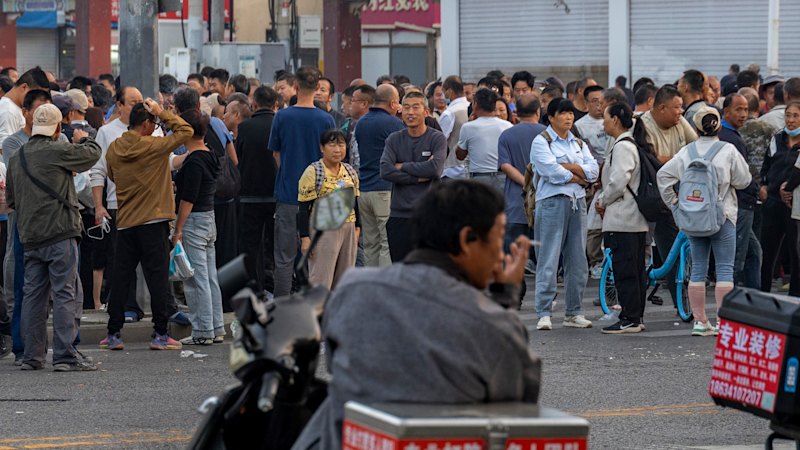
The screen flashes. A delivery order appears, offering the equivalent of seventy cents for a grueling four-kilometer route through a choked urban maze. Seconds tick away. Hesitate, and the penalty points accumulate, pushing you further down the dispatch hierarchy until your phone goes entirely silent. Across China’s sprawling megacities, millions of gig workers face this relentless digital arbitration every single day. Work is vanishingly difficult to find not because the demand for deliveries and rides has dried up, but because the algorithmic gatekeepers have rewritten the rules of survival.
This crisis of precarity extends far beyond a simple economic slowdown. It represents a fundamental structural collision between hyper-optimized platform capitalism and an oversupplied labor market where human workers have been commodified into disposable routing variables.
The Anatomy of Over-Saturation
Deciphering the current labor squeeze requires looking closely at how the platform economy absorbed millions of displaced factory workers, real estate agents, and small business owners over the past half-decade. When traditional manufacturing and service sectors contracted, app-based platforms served as the ultimate sponge. Barriers to entry were near zero. A rented electric scooter, a smartphone, and a verified ID were enough to join the ranks of Meituan, Ele.me, or Didi.
That vast influx changed the math permanently. When labor supply outpaces demand by an exponential factor, platforms face no incentive to maintain favorable piece-rates. Instead, dispatch systems drive prices downward through competitive bidding mechanics hidden behind proprietary software code. Workers find themselves trapped in a race to the bottom, accepting lower unit pay simply to secure enough volume to cover rent and battery rentals.
Consider the mechanics of peak-hour allocation. A veteran courier in Shanghai or Chengdu does not merely hustle; they manage multiple phones, decode proprietary geofencing patterns, and gamble on residential compound security rules that shift weekly. When a rookie joins, they might secure initial priority boosts, but the long-term reality is brutal attrition.
The Algorithmic Panopticon
Technology promised liberation from traditional management structures. In practice, it replaced the human boss with an invisible, unappealable tyrant. The software tracks every second, punishing delays caused by broken elevators, blocked traffic, or recalcitrant restaurant staff who prioritize in-house diners over app couriers.
The psychological toll of this setup is severe. Workers speak of the constant hum of the notification sound as a source of acute anxiety. Missing a quota or failing to meet an aggressive delivery window triggers automated rating drops, which translates directly into fewer orders during the next shift. It is a closed-loop system designed to extract maximum output while shielding the corporate entity from labor laws, insurance liabilities, and basic human accountability.
Labor advocates and economic researchers point out that traditional employment protections were built for physical workplaces with fixed hours. The gig economy bypassed these frameworks entirely by classifying workers as independent contractors. Yet, these contractors exercise zero control over pricing, routing logic, or customer dispute resolutions. They bear all the operational risk—vehicle maintenance, fuel, bodily injury—while the platform skims its percentage off the top of every transaction.
The Broader Economic Ripple
The plight of these workers serves as a canary in the coal mine for China’s broader domestic consumption model. When millions of urban delivery drivers and ride-share operators see their net earnings compress, their purchasing power evaporates. They stop buying discretionary goods. They delay medical procedures. They cut back on remittances sent home to rural families.
Policymakers in Beijing have recognized these pressures, issuing guidelines aimed at forcing platforms to ensure minimum wages, relax rigid delivery timeframes, and provide basic social insurance coverage. Yet enforcement remains uneven. Platforms often comply on paper while adjusting internal algorithms to bypass the spirit of the regulations. For every loophole closed, the software adapts to find a new vector of efficiency optimization that ultimately squeezes the human at the end of the chain.
Solutions that rely solely on corporate benevolence are bound to fail. Sustainable reform demands transparent pricing mechanisms where workers have collective bargaining power over base rates, rather than being subjected to unilateral algorithmic decrees. Without structural intervention, the digital gig economy risks entrenching a permanent, hyper-exploited underclass whose labor powers the convenience of modern urban life while leaving them entirely unprotected against economic shocks.
The smartphone screen lights up again. Another low-fare delivery pops into view. Somewhere in the concrete expanse, a rider sighs, twists the throttle, and accepts the route because the alternative is nothing at all.


