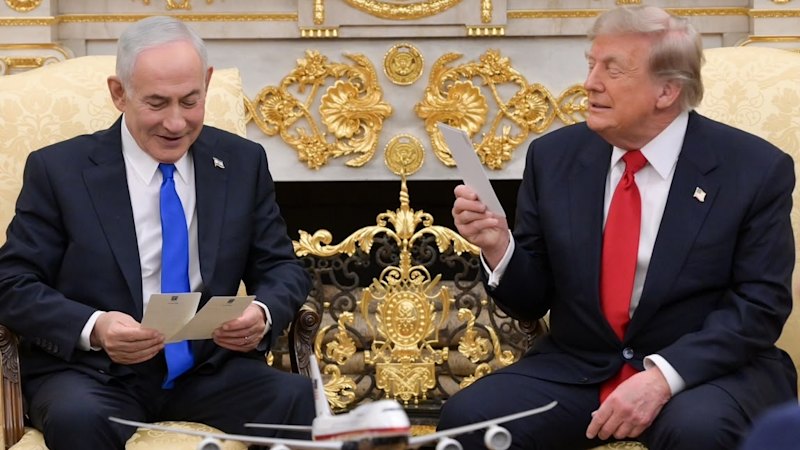
The room was entirely too quiet for a conversation reshaping the Middle East. Behind closed doors, Donald Trump looked across the table at Benjamin Netanyahu, listening to a familiar pitch about Iranian aggression, before offering a blunt public rebuff that caught veteran diplomats flat-footed: "Don't need him to tell me that." That single sentence exposed a widening fissure between Washington and Jerusalem, stripping away decades of carefully choreographed political theater to reveal a volatile strategic calculation on the future of Iran.
Decades of bipartisan consensus built an unbreakable public bond between American administrations and Israeli prime ministers. Publicly, the script demanded absolute solidarity, shared intelligence talking points, and synchronized talking points on the existential threat posed by Tehran. Privately, however, friction has always simmered. Today, that friction has broken through the surface, driven by conflicting electoral timelines, divergent risk tolerances regarding regional war, and a fundamental disagreement over whether maximum pressure or diplomatic maneuvering remains the viable path forward. You might also find this connected story insightful: The Battle for Ancient Soil Why Islamabad Claims Harappa While Sponsoring Terror.
The Anatomy of a Public Snub
When Donald Trump publicly dismissed Netanyahu's warnings with a casual dismissal during their meeting, he was not just speaking off the cuff. He was signaling a strategic pivot. Trump views foreign entanglements through a transactional lens. Endless regional escalation threatens economic stability at home and distracts from domestic political priorities. Netanyahu, by contrast, operates under the existential weight of regional containment, viewing any hesitation from Washington as a direct threat to Israeli survival.
This tension defines modern geopolitics. The Israeli security apparatus wants absolute alignment from the United States, expecting Washington to underwrite its military initiatives against Iranian proxies across Lebanon, Syria, and Yemen. Yet Washington increasingly balks at writing a blank check that could drag American forces into a protracted quagmire. The rebuff was a warning shot. Netanyahu learned that his traditional playbook of rallying American public opinion against the White House might no longer guarantee compliance from a mercurial American leader focused on his own legacy. As discussed in latest reports by NBC News, the implications are worth noting.
Historical Parallels and Diverging Interests
Friction between American presidents and Israeli leaders is nothing new. Dwight Eisenhower forced Israel to withdraw from the Sinai in 1956. George H.W. Bush withheld loan guarantees to pressure Yitzhak Shamir into peace talks. Barack Obama fought bitterly with Netanyahu over the Joint Comprehensive Plan of Action.
History shows that strategic alignment never equals total subordination.
Trump wants a deal. Netanyahu wants decisive disruption. These two objectives cannot coexist in the long term without friction. While Washington evaluates the geopolitical chess board through the prism of global superpower competition with China and Russia, Jerusalem sees an immediate, localized battle for survival against an advancing nuclear threshold state.
The Iran Calculus
To understand why Trump pushed back against Netanyahu, one must look at the shifting calculus inside Tehran. Iran has mastered the art of asymmetric warfare through its regional network, often referred to as the Axis of Resistance. Hezbollah in Lebanon, the Houthis in Yemen, and various militias in Iraq and Syria form a protective ring around the Iranian nuclear program.
Netanyahu argues that trimming the branches does nothing while the roots remain intact. His strategy demands direct, overwhelming force applied to Tehran's core infrastructure.
Trump sees the situation differently. Having orchestrated the Abraham Accords during his first term, he favors economic strangulation combined with regional economic integration. His logic suggests that normalization agreements between Israel and Arab states build a self-sustaining regional security architecture that isolates Iran organically, without requiring thousands of American boots on the ground or trillion-dollar interventions.
The Intelligence Gap
Intelligence sharing between the Mossad and American agencies remains deep, but the interpretation of that intelligence often diverges wildly. Israeli assessments frequently project worst-case scenarios regarding Iranian breakout timelines for a nuclear weapon. American intelligence agencies, while acknowledging the severe threat, often maintain a more measured timeline, factoring in technical hurdles and economic constraints facing the regime in Tehran.
When Netanyahu brings his dossier of intelligence to Washington, he is selling urgency. When Trump responds with skepticism, he is buying time. This divergence creates a dangerous gap in execution. If Jerusalem believes time has run out, it may act unilaterally, forcing Washington to choose between abandoning a crucial ally or being dragged into a war it explicitly sought to avoid.
Domestic Pressures Dictate Foreign Policy
Both leaders face intense domestic headwinds that complicate their partnership.
Netanyahu leads a fragile coalition government tethered to right-wing hardliners who view any display of moderation as treason. His political survival depends on maintaining a posture of unyielding strength. Showing deference to American pressure weakens his standing at home, where public trust has been severely tested by security failures and protracted conflict.
Trump operates in a political landscape weary of foreign wars. The populist wing of the American electorate demands an "America First" foreign policy that avoids entanglements in the Middle East. Siding unconditionally with an Israeli prime minister who pushes for aggressive escalation runs counter to that mandate.
+------------------------+------------------------------------------+
| Leader                 | Core Strategic Objective                 |
+------------------------+------------------------------------------+
| Benjamin Netanyahu     | Elimination of the Iranian threat engine |
+------------------------+------------------------------------------+
| Donald Trump           | Regional stability via economic leverage |
+------------------------+------------------------------------------+
This matrix highlights the structural incompatibility of their current positions. When two leaders are bound by mutual necessity yet divided by domestic imperatives, diplomacy becomes a high-stakes game of chicken.
The Regional Fallout
The ripple effects of this public discord extend far beyond Washington and Jerusalem. Regional capitals are watching closely. Saudi Arabia, pursuing its own complex diplomatic normalization track with Iran brokered by Beijing, notes every sign of daylight between the United States and Israel.
If Jerusalem and Washington cannot agree on a unified strategy toward Tehran, regional actors will hedge their bets. Middle Eastern diplomacy is rarely governed by sentiment; it runs on power dynamics. A fractured alliance invites opportunistic behavior from adversaries and forces middle powers to seek alternative security guarantees.
The Myth of Unconditional Compliance
For decades, political analysts treated the U.S.-Israel relationship as an unbreakable monolith. That framework is obsolete. The reality on the ground is transactional, tense, and increasingly fragile.
When Trump declared he did not need Netanyahu to explain the threat of Iran, he punctured the illusion of absolute obedience. He communicated that American support is not a blank check, and that Washington retains its own independent calculus regarding regional peace and conflict.
As the chess pieces move across the Middle Eastern board, the friction between these two dominant personalities will dictate the trajectory of regional stability or lack thereof. The alliance survives, but it has changed fundamentally, operating now under the cold light of divergent national interests rather than shared sentimental rhetoric.


