The sea in Okinawa does not look like a place where history goes to die. It is a brilliant, blinding turquoise, shallow enough near the seawall to watch tiny silver fish dart through the coral rubble, deep enough further out to swallow the horizon in a haze of salt and humidity.
To stand on the seawall in Chatan is to feel a deceptive peace. The air smells of charred squid from a nearby stall and the heavy, sweet rot of tropical flowers after a morning downpour. But if you turn your back to the water, the peace shatters.
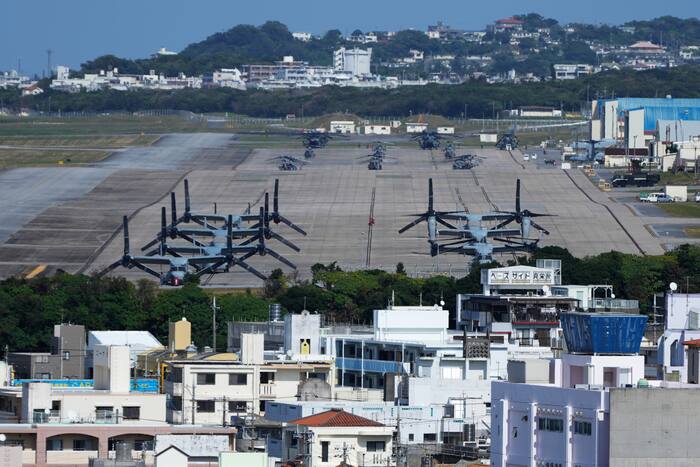
Concertina wire gleams atop chain-link fences. Warning signs in Japanese and English bark instructions about restricted zones, federal jurisdiction, and the Status of Forces Agreement. Behind those fences lie the sprawling installations of the United States military, occupying nearly a fifth of an island that makes up less than one percent of Japan’s total landmass.
Here, two worlds collide daily, rubbing against each other like tectonic plates deep in the trench offshore. They share a highway, a currency, and a security alliance that has anchored the geopolitical architecture of East Asia for nearly eighty years. They do not share a language, a history, or an understanding of justice.
And then, a woman is dead. And the tectonic plates slip.
Consider what happens next in a quiet neighborhood outside a base gate. A siren cuts through the sticky night air. Blue lights flash against concrete balconies and convenience store signs. Within hours, a name is whispered, then shouted, then broadcast across national networks: a United States Marine, stationed thousands of miles from home, arrested for a crime that defies comprehension.
Anger does not arrive as an explosion. It rises like tide water in a harbor, silent at first, lapping against the pilings of daily life until suddenly, people are standing ankle-deep in something they cannot control.
This is not a new story. That is the tragedy of it.
Decade after decade, the script repeats itself with a grim, exhausting predictability. A strategic necessity demands a forward-deployed deterrent. An alliance requires bases on sovereign soil. Thousands of young service members, trained for combat and thrust into the humid monotony of garrison life, interact with a local population that never asked for them to bear the heaviest burden of a distant superpower's defense.
Statistically, the vast majority of personnel stationed in Okinawa serve quietly. They buy canned coffee from vending machines, eat bowls of Okinawan soba, and follow the rules. But statistics are cold comfort to a mother looking at an empty bedroom. When a crime occurs, the math changes entirely. One life lost erases ten thousand quiet days.
The frustration on the island is deeply rooted in geography and memory. Okinawans carry a historical weight that mainland Japanese politicians in Tokyo often treat as a remote abstraction. During World War II, the island became a horrific slaughterhouse, the site of the bloodiest land battle in the Pacific, where a quarter of the local population perished in the crossfire. When the war ended, Tokyo traded Okinawan sovereignty for mainland independence, leaving the island under American administration for another twenty-seven years.
Even after reversion to Japan in 1972, the burden never left. The heavy armor remained. The low-slung roar of Osprey aircraft overhead remained. The sense of being a sacrificed pawn on a global chessboard remained.
When a crime is committed by a member of the armed forces, a secondary injustice immediately triggers the raw nerve of local residents: jurisdiction.
Under the intricate legal machinery of the Status of Forces Agreement, or SOFA, American military personnel accused of crimes committed off-duty and off-base are often held by United States authorities until an indictment is formally brought by Japanese prosecutors. To the average citizen walking the streets of Naha or Ginowan, this looks like an escape hatch. It looks like foreign privilege riding roughshod over local law. It feels like an occupation that
The Broken Promise Written in Okinawa Rain
news
The rain on Okinawa does not fall softly. It drives sideways, heavy with the salt of the East China Sea, drumming a relentless rhythm against the corrugated tin roofs of Ginowan. For the people who live in the shadow of the sprawling military fence lines, that sound is a familiar neighbor. It is the soundtrack of an uneasy coexistence that has lasted for generations.
Then came the news. Another arrest. Another life shattered.
To understand why a single incident thousands of miles from Washington can detonate a province into fury, you have to stand on the seawall at Henoko. You have to watch the gray silhouettes of Marine Corps helicopters slicing through the low-hanging clouds, day after day, year after year. You have to feel the psychic weight of an island that carries three quarters of all United States military presence in Japan while making up less than one percent of its total landmass.
When a young woman’s life was abruptly stolen, and a U.S. Marine found himself in handcuffs, accused of the unthinkable, it did not register merely as a tragic crime. It triggered an earthquake of collective memory.
Consider the arithmetic of occupation. It is an arrangement built on an unspoken bargain: the protection of the geopolitical shield in exchange for the quiet endurance of local friction. Curfews, noise pollution, traffic accidents, environmental strains—these are the small taxes paid for the alliance. But when the safety of the populace is breached by the very forces stationed to defend it, the contract voids itself in an instant.
Anger. It is a slow-burning fuel on this island.
Governor Denny Tamaki stood before bank of microphones, his voice tight with a grief that felt entirely communal, demanding an immediate overhaul of the status of forces agreement. That bureaucratic acronym, SOFA, sounds dry as dust on a Pentagon memo. To an Okinawan, it reads like a shield of impunity. It governs how local laws intersect with foreign service members, frequently keeping suspects out of local hands until formal indictments are laid down. It creates an institutional chasm between the gated compounds and the neighborhoods that surround them.
The protests outside Camp Futenma did not begin with megaphones. They began with silence. Mothers standing shoulder to shoulder under black umbrellas, staring up at the razor wire. They remember 1995. They remember the horrific assault that galvanized half a million people into the streets, forcing governments to promise change, to reduce footprints, to redistribute the burden.
Decades have passed since those historic crowds filled the parks of Ginowan. Yet here they are again, staring at the same horizon, asking the same agonizing question: How many times must history repeat its worst chapters before the blueprint changes?
Washington issues statements of deep regret. Tokyo expresses grave concern. The machinery of diplomacy grinds forward with its well-worn scripts, offering condolences and pledging cooperation. But diplomacy is cold comfort when the rain is falling and a family is burying their daughter.
The tragedy on Okinawa transcends a single criminal docket. It exposes the fraying edges of a security architecture designed in the mid-twentieth century, straining to hold together in a world that has entirely transformed. Strategic necessity cannot permanently override human dignity. When a population feels treated as an expendable parking lot for foreign power projection rather than a community of human beings with rights to safety and sovereignty, the breaking point is never a question of if.
It is a question of when.
Night falls quickly over the island. The neon signs of Naha flicker through the mist, reflecting off the wet pavement. In the narrow alleys, away from the barricades and the television cameras, people sit in quiet rooms, listening to the wind whip through the sugar cane fields. The fence line remains where it has always been, cutting through the landscape, dividing the protected from the protectors, waiting for the storm to pass.
Except this storm is different. This one has settled deep into the soil, and it will not wash away with the tide.