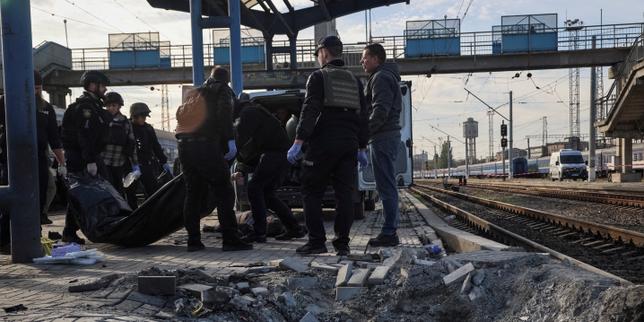
European Union officials are calling on international allies to tighten economic and military pressure on Russia following a wave of deadly aerial strikes across Ukraine that killed at least 20 people. The diplomatic push highlights a growing frustration in Brussels. While European leaders condemn the ongoing bombardment of Ukrainian cities and critical infrastructure, their immediate capacity to alter the battlefield calculus remains constrained by supply bottlenecks, sanction evasion networks, and political divisions over long-range weapons restrictions.
The latest barrage underscores a grim pattern that has defined the war since its third year. Russian forces continue to exploit gaps in Ukrainian air defense coverage, launching coordinated salvos of ballistic missiles, cruise missiles, and one-way attack drones against residential areas and energy grids. When at least 20 civilians die in a single wave of attacks, the political response in European capitals follows a predictable script of outrage and renewed pledges of solidarity. Yet behind closed doors in Brussels, diplomats acknowledge that condemnation does not intercept incoming ballistic missiles.
The Anatomy of a Deterrence Crisis
To understand why the European Union is urgently appealing to broader international allies—including the G7 and partners outside the traditional Western bloc—one must examine the mechanics of modern attrition warfare. Russia has shifted its economy onto a war footing, dedicating roughly a third of its national budget to defense and security. Factories in the Urals and central Russia run around the clock, churning out artillery shells, glide bombs, and long-range strike drones at a pace that outstrips combined Western production in several key categories.
Air defense is a game of asymmetric economics. A single Russian Shahed-type drone costs tens of thousands of dollars to manufacture. The interceptor missiles fired by Western-supplied systems like Patriot or IRIS-T to shoot them down often cost between one million and four million dollars apiece. Moscow knows this math. By saturating Ukrainian skies with cheap decoys alongside sophisticated ballistic missiles, Russian commanders force Kyiv to expend scarce, expensive interceptors just to protect basic civilian infrastructure.
When Brussels urges allies to "accentuate the pressure," it is effectively admitting that current measures have not broken this cycle. Europe has already passed more than a dozen sanctions packages against the Kremlin. It has frozen hundreds of billions of euros in Russian central bank assets and drastically reduced its reliance on Russian pipeline gas. Still, the missiles keep flying.
Where Sanctions Meet Reality
The primary lever available to the EU without direct military intervention is economic strangulation, yet the global economy rarely cooperates with neat diplomatic boundaries. Western export controls were designed to starve Russia’s military-industrial complex of microchips, optical sensors, and precision machine tools. In practice, those components still reach Russian assembly lines through a sprawling web of shell companies and third-party intermediaries.
Trade data consistently reveals sudden spikes in European exports of dual-use goods—items with both civilian and military applications—to countries bordering Russia in Central Asia and the Caucasus. From there, the goods quietly cross into Russian territory. Customs officials in Frankfurt, Rotterdam, and Riga struggle to police every shipment of washing machine semiconductors or commercial ball bearings that end up inside a Kh-101 cruise missile.
Energy revenues tell a similarly complicated story. The G7 price cap on Russian seaborne crude oil was meant to keep oil flowing to global markets while slashing the Kremlin's profit margins. Moscow responded by assembling a massive "shadow fleet" of aging, poorly insured oil tankers operating outside Western maritime insurance and shipping networks. These vessels routinely turn off their transponders, conduct ship-to-ship transfers in international waters, and deliver millions of barrels of crude to buyers in Asia.
Pressuring allies means forcing uncomfortable conversations with nations that profit from this gray market. European diplomats face the difficult task of convincing non-aligned states that enforcing Western sanctions is in their interest, even when discounted Russian energy and lucrative re-export trade offer immediate domestic benefits. Without secondary sanctions—penalties aimed directly at foreign banks and firms doing business with Russia—European appeals rely heavily on moral persuasion. History shows moral persuasion rarely beats discounted crude.
The Weapons Debate and Political Hesitation
Economic pressure takes months or years to bite. Air defense and long-range strike capabilities matter in minutes.
Whenever deadly strikes hit Ukrainian cities, Kyiv renews two specific requests: more air defense batteries and permission to use Western-supplied long-range missiles against military airfields inside Russian territory. The logic from a military standpoint is straightforward. Shooting down archers is far more efficient than trying to catch every arrow in mid-air. If Ukrainian forces can strike the bases where Russian bombers load their cruise missiles, the frequency and scale of attacks on Ukrainian civilians drop immediately.
Yet this is precisely where European unity fractures. Several EU member states, particularly those along NATO's eastern flank like Poland and the Baltic states, argue forcefully for lifting all restrictions on how Ukraine uses donated weapons. They view Russian aggression as an existential threat that grows stronger every time the West hesitates.
Other major European powers remain cautious, worried about triggering direct escalation between NATO and Moscow. They fear that permitting deep strikes into Russia with European or American weaponry could prompt Russian retaliation against European infrastructure, cyber networks, or overseas interests. As a result, EU statements often settle on the lowest common denominator: strong rhetorical condemnation paired with incremental increases in financial aid and defensive equipment.
The Industrial Bottleneck
Even when political will aligns, physical reality intervenes. Decades of post-Cold War peace dividends left European defense industries scaled for boutique production rather than mass industrial warfare.
Consider the timeline required to build a modern surface-to-air missile system. Manufacturing the radar arrays, command stations, and interceptors requires specialized titanium alloys, rare earth elements, and skilled aerospace engineers. You cannot simply flip a switch and triple output overnight. Defense contractors demand multi-year, legally binding government contracts before they will invest billions in new factory floor space and assembly lines.
European governments have made significant strides in pooling procurement and funding ammunition production, yet deliveries frequently lag behind pledges. When an EU official calls on allies to step up pressure on Russia, part of that message is aimed inward at member states that have been slow to convert budgetary promises into actual hardware arriving at the Polish-Ukrainian border.
Meanwhile, Ukraine's power grid remains on life support. Repeated strikes on thermal and hydroelectric power plants have destroyed a massive percentage of the country's electricity generation capacity. Preparing for winter under constant threat of bombardment requires not just air defense missiles, but thousands of transformers, mobile generators, and repair crews working under fire.
The Strategic Blind Spot in Brussels
A candid assessment of the European response reveals a deeper structural issue. The EU was built as a regulatory and economic union designed to prevent war among its members through trade interdependence. It was never engineered to fight a proxy war of attrition against a nuclear-armed autocracy on its eastern border.
Decision-making in Brussels requires consensus among 27 diverse nations, each with its own domestic political pressures, economic vulnerabilities, and historical relationships with Moscow. A single dissenting government can delay aid packages or water down sanctions for months, extracting unrelated political concessions in exchange for its vote. Moscow understands this institutional friction and actively exploits it through disinformation campaigns, energy leverage, and political interference.
Furthermore, European leaders must constantly manage domestic voter fatigue. Inflation, high energy costs, and sluggish economic growth across the Eurozone make sustained multi-billion-euro commitments to Ukraine a harder sell at the ballot box. Populist movements on both the political right and left routinely campaign on cutting foreign aid and pushing for immediate negotiations with the Kremlin, regardless of the territorial concessions that would require from Kyiv.
What Actual Pressure Looks Like
If the European Union and its allies intend to move beyond diplomatic statements after the latest wave of civilian deaths, the mechanisms for doing so are well known, even if the political appetite remains uncertain.
First, seizing—rather than merely freezing—the roughly 300 billion dollars in immobilized Russian sovereign assets held primarily in European clearinghouses would fundamentally alter the financial equation. Currently, allies are using only the windfall profits generated by those assets to back loans for Ukraine. Confiscating the principal would provide Kyiv with a massive, multi-year war chest, though European central bankers warn it could undermine global trust in the euro as a reserve currency.
Second, cracking down on the shadow fleet requires aggressive maritime enforcement. Denmark, Sweden, and other coastal states control narrow straits through which much of Russia's Baltic oil exports must pass. Requiring strict environmental and insurance inspections for uninsured tankers transiting these waters could legally choke off a substantial portion of Moscow's oil revenue without firing a shot.
Third, targeting third-country intermediaries through coordinated secondary sanctions would force banks in Turkey, the United Arab Emirates, and Central Asia to choose between access to Western financial markets and facilitating Russian trade. When Washington threatened secondary sanctions on foreign financial institutions earlier in the conflict, payment processing between Russia and several major trading partners froze almost overnight.
Ultimately, the gap between European rhetoric and battlefield outcomes comes down to risk tolerance. Russia has demonstrated a willingness to absorb staggering human and economic costs to achieve its objectives in Ukraine. Until Brussels and its allies match that resolve with faster weapons deliveries, aggressive enforcement against sanctions-busters, and the removal of operational restrictions on Kyiv, statements of outrage following deadly strikes will remain a recurring feature of European diplomacy.