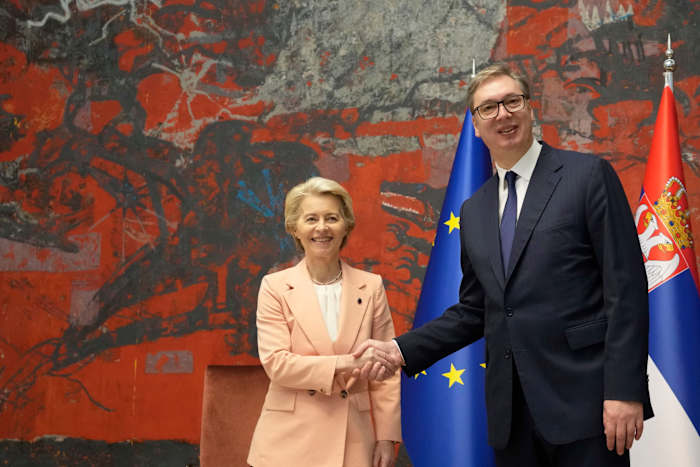
Every time a mural goes up in a gritty Belgrade neighborhood or a politician makes a tone-deaf gesture honoring convicted war criminals, Brussels rolls out the predictable outrage machine. Bureaucrats clutch their pearls, issue stern communiques about European values, and threaten to stall accession talks. The lazy narrative in every major newsroom says the same thing: Serbia is torpedoing its own European Union membership bid by failing to break completely with its 1990s ghosts, proving it is culturally unready for the club.
That diagnosis is comfortable, clean, and completely wrong.
The Western press treats the enlargement process as a high school civics class where good behavior earns a gold star and bad behavior lands you in detention. Realpolitik does not work that way. The truth nobody in Brussels wants to admit on the record is that the European Union needs Serbia far more than Serbia needs a formal card-carrying membership tomorrow. Geopolitics abhors a vacuum, and the Western Balkans are not a quiet backyard waiting to be landscaped; they are a high-stakes strategic corridor surrounded entirely by EU member states.
Stop looking at the Ratko Mladic murals as a dealbreaker and start looking at them as domestic political theater for a weary electorate. President Aleksandar Vucic plays a masterclass in transactional diplomacy, balancing nationalist symbolism at home with pragmatic economic integration toward the West. European capitals hyperventilate over every historical grievance because they measure progress through the narrow lens of transitional justice. Yet, they simultaneously ignore the concrete reality on the ground: Serbia’s economy is deeply tethered to the single market, German automakers rely on its supply chains, and its security apparatus coordinates daily with Western intelligence agencies on border management and migration control.
When pundits ask whether Serbia's historical revisionism spells the permanent death of its EU integration, they are asking the wrong question entirely. The real question is how long the European Union can afford to keep a geostrategic anchor in limbo before rival global powers fill the vacuum with capital, infrastructure loans, and diplomatic pressure. Moscow and Beijing do not demand judicial reforms, anti-corruption benchmarks, or public recantations of wartime history. They demand signed contracts and obedience.
Brussels knows this better than anyone. The threats of halting accession funds and freezing chapters are real, but they operate as a slow-moving bureaucratic dance rather than a sudden divorce. European integration in the Western Balkans is stalled not because of murals or commemorative plaques, but because of enlargement fatigue within EU capitals like Paris and Berlin. Leaders there have zero domestic appetite for absorbing a new member state with complex regional disputes, regardless of who is buried where or praised in public squares.
The transaction is brutally simple. Serbia gets access to structural funds and foreign direct investment while maintaining sovereign foreign policy manoeuvrability. The European Union gets a stable buffer zone that prevents instability from bleeding into its southeastern borders. Both sides grench, posture, and issue condemnations for domestic consumption, while the underlying pipeline of trade and geopolitical alignment remains completely untouched.
Pretending that a diplomatic reprimand over a funeral honor will derail a decade-long economic integration project is an insult to anyone who understands how power actually operates on the continent. The accession talks will drag on indefinitely, stuck in a permanent purgatory of conditional compliance, because neither side can afford to walk away.