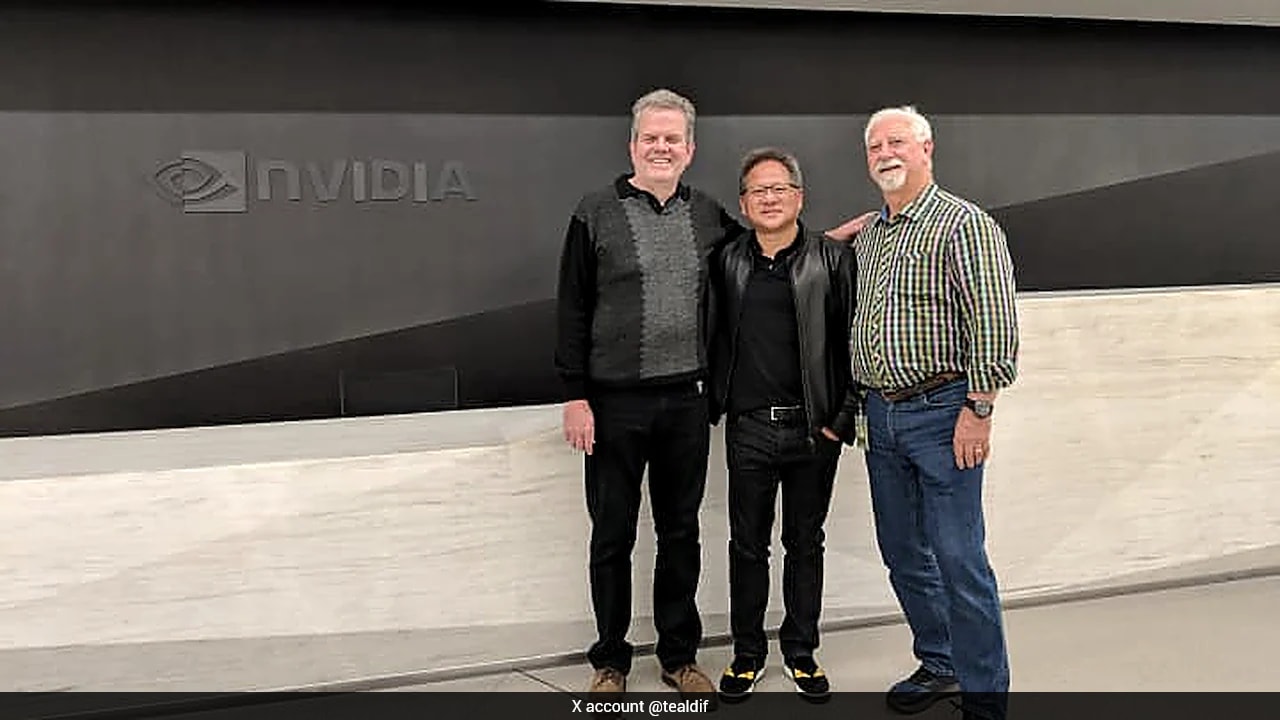
Silicon Valley loves a clean origin myth, and few stories get recycled as aggressively as the 1993 breakfast meetings at a San Jose Denny's where Jensen Huang, Chris Malachowsky, and Curtis Priem sketched out the blueprint for Nvidia. The popular version sells the romance of three engineers, bottomless coffee, and a napkin sketch that somehow manifested a multi-trillion-dollar semiconductor colossus. The reality is far less whimsical and vastly more instructive. Nvidia did not survive because of a lucky booth at a roadside diner; it survived because three battle-hardened chip architects recognized a massive structural failure in how computers processed visual data, nearly went bankrupt twice trying to fix it, and eventually forced the entire software industry to rebuild itself around their silicon.
Strip away the diner folklore, and you find an engineering origin story rooted in cold market timing and extreme capital risk. In 1993, the personal computer industry was undergoing a violent transition. Microsoft was preparing Windows 95, shifting users away from text-based command lines toward graphical interfaces, while early 3D video games like Doom were proving that consumers would pay steep premiums for immersive visual realism. Yet the hardware inside standard desktop PCs was fundamentally incapable of rendering complex three-dimensional worlds in real time.
Why Three Senior Engineers Walked Away From Safe Careers
To understand why the Denny's meetings mattered, you have to look at the resumes sitting in that booth. Huang, Malachowsky, and Priem were not wide-eyed college dropouts tinkering in a garage. They were mid-career insiders who had already seen how the semiconductor sausage was made—and where the incumbents were blind.
Jensen Huang was an electrical engineer from Oregon State and Stanford who had cut his teeth designing microprocessors at AMD before moving to LSI Logic, where he ran the CoreWare business unit. Curtis Priem and Chris Malachowsky were senior hardware engineers at Sun Microsystems, the workstation titan that dominated high-end enterprise computing in the late 1980s and early 1990s. At Sun, Priem had architected the GX graphics chip, one of the earliest accelerators capable of offloading 2D rendering tasks from the main processor.
They left those comfortable salaries because they saw an architectural collision coming. At the time, high-end 3D graphics existed only on specialized workstations costing tens of thousands of dollars, built by companies like Silicon Graphics (SGI). Meanwhile, consumer PCs relied on the Central Processing Unit (CPU) to handle everything—operating system logic, audio, input, and graphics.
CPUs are built for sequential speed. They execute complex instructions one after another at blistering pace, optimized for low latency. Rendering a 3D frame, however, requires millions of relatively simple mathematical calculations—transforming vertices, shading pixels, mapping textures—all happening at the exact same moment. Asking a 1993 CPU to render complex 3D graphics was like hiring a team of neurosurgeons to paint a suspension bridge. They were overqualified for the individual tasks and catastrophically slow at doing them in bulk.
The three founders bet that consumer PCs would soon demand workstation-grade 3D graphics at a fraction of the price. They chose the name Nvidia from invidia, the Latin word for envy, initially naming their internal project files "NV" for "next version." The booth at the Berryessa Road Denny's in East San Jose—chosen simply because it was quiet, cheap, and had reliable coffee—served as their makeshift boardroom because none of them wanted to tip off their current employers. Even then, the diner had a rough reputation; police were regular visitors, and the founders spent months nursing cheap breakfasts while hashing out their initial business plan.
The $20 Million Lesson of the NV1 Failure
If the Denny's booth provided the spark, the company's first actual product nearly burned the whole enterprise to the ground. Silicon Valley biographies tend to gloss over how badly Nvidia botched its debut, yet that failure is the single most important event in the company's history.
Backed by $20 million in venture capital from Sequoia Capital and Sutter Hill Ventures—secured largely on the strength of Huang's reputation at LSI Logic rather than a finished business plan—Nvidia released the NV1 in 1995. On paper, it was an ambitious multimedia Swiss Army knife. It combined 2D graphics, 3D rendering, audio processing, and even a port for Sega Saturn game controllers on a single PCI card.
Technologically, the NV1 was a dead end.
Instead of building 3D environments out of triangles—the geometric standard the rest of the graphics industry was rapidly adopting—Priem and the Nvidia engineering team bet on quadratic texture mapping, a technique that rendered curved surfaces using four-sided patches called quads. In theory, curved surfaces looked smoother with fewer polygons. In practice, it was an architectural nightmare for game developers.
Just weeks after the NV1 hit retail shelves, Microsoft released DirectX, a foundational set of application programming interfaces (APIs) designed to standardize how Windows games talked to hardware. DirectX mandated triangle-based rendering. Suddenly, Nvidia's flagship chip was incompatible with the dominant software ecosystem overnight.
Sales collapsed. Sega, which had contracted Nvidia to build the graphics chip for its upcoming Dreamcast console using the same quadratic architecture, realized the technology was obsolete. In a moment of blunt honesty that likely saved his company, Huang flew to Japan, admitted to Sega's leadership that their architecture was wrong, and asked Sega to cancel the contract—while still paying Nvidia the remaining $5 million in development fees so the startup wouldn't die on the spot. Sega's CEO, Shoichiro Irimajiri, agreed.
Without that $5 million lifeline, Nvidia would have vanished into the graveyard of forgotten 1990s hardware startups alongside 3dfx, S3 Graphics, and Matrox. Huang laid off roughly half the company, leaving about 40 employees, and used every remaining dollar to buy an expensive Ikos hardware emulator. Instead of building physical silicon prototypes—a slow, multi-million-dollar process that took months—Nvidia could now simulate chip designs in software, catch bugs before manufacturing, and compress development cycles from two years down to six months.
Abandoning the Console Dream for Pure Graphics Velocity
The near-death experience of the NV1 forced a ruthless strategic pivot. Nvidia stopped trying to build all-in-one multimedia cards and abandoned proprietary rendering math. With the RIVA 128 in 1997, the company embraced Microsoft's Direct3D standards and focused exclusively on raw, unadulterated 3D triangle throughput.
It worked. The RIVA 128 sold over a million units in four months, proving that Nvidia could execute at speed.
By 1999, Nvidia introduced the GeForce 256, marketing it as the world's first Graphics Processing Unit (GPU). While competitors argued over whether the term was merely a clever branding exercise, the GeForce 256 introduced a genuine architectural breakthrough: it moved the transform and lighting (T&L) pipeline off the CPU and directly onto the graphics card.
Think of a 3D video game scene as a dark room filled with wire sculptures. Before the GeForce 256, the CPU had to calculate the exact position of every wire vertex in space and determine how light bounced off every surface before handing the data to the graphics card to color in the pixels. By pulling transform and lighting onto the GPU, Nvidia turned the graphics card from a passive display adapter into an independent, massively parallel math engine.
To understand why this architecture became unstoppable, consider a hypothetical example of two factories. Factory A (a traditional CPU) has four master craftsmen who can build intricate, custom clockwork mechanisms at blinding speed, one step at a time. Factory B (a GPU) has ten thousand assembly-line workers who each perform one simple stamping task simultaneously. If you need to solve a complex logic puzzle, Factory A wins easily. If you need to stamp out ten million identical metal plates in ten seconds, Factory B obliterates Factory A.
Throughout the early 2000s, Nvidia weaponized that parallel factory model. While dozens of rival graphics chipmakers went bankrupt because they couldn't keep up with the capital costs of shrinking transistors, Nvidia established a relentless product cadence—releasing new architectures every six to twelve months, systematically starving competitors of revenue and engineering talent.
How CUDA Turned a Gaming Chip Company Into an AI Monopoly
For over a decade, Wall Street viewed Nvidia as a volatile, cyclical vendor tethered to teenage PC gamers and holiday hardware cycles. Even after Nvidia acquired rival 3dfx in 2000 and secured contracts to build graphics chips for Microsoft's original Xbox and Sony's PlayStation 3, institutional investors remained skeptical. GPUs were seen as niche accelerators for polygons and pixels.
Inside Nvidia, however, engineers noticed an unexpected trend. Academic researchers in physics, fluid dynamics, and molecular biology were buying off-the-shelf GeForce gaming cards and hacking them to run scientific simulations. These researchers realized that if they disguised their mathematical equations as fake 3D graphics textures, the GPU's thousands of parallel cores could crunch the numbers orders of magnitude faster than expensive supercomputer CPUs.
Recognizing this signal, Huang and Nvidia's chief scientist David Kirk made a decision in 2006 that nearly broke the company's stock price all over again. They launched CUDA (Compute Unified Device Architecture)—a software platform and programming model that allowed developers to bypass graphics APIs entirely and write standard C/C++ code directly for the GPU's parallel cores.
To make CUDA work, Nvidia had to add dedicated circuits and memory caches to every single gaming chip it manufactured, increasing the silicon die size and eating directly into gross margins. For years, Wall Street analysts hammered Huang on quarterly earnings calls. Few customers were paying for general-purpose GPU computing, yet Nvidia was voluntarily inflating its manufacturing costs on millions of consumer gaming cards just to put CUDA-capable hardware into the hands of every developer on earth.
The stock languished for nearly a decade. Investors saw bloated expenses; Huang was building a closed-loop developer moat.
Then came October 2012. At the ImageNet computer vision competition, a team from the University of Toronto led by Geoffrey Hinton, Alex Krizhevsky, and Ilya Sutskever unveiled AlexNet, a deep neural network that crushed every traditional computer vision algorithm by an unprecedented margin. The secret behind AlexNet was not a new mathematical theory—neural networks had existed since the 1950s. The breakthrough was that Krizhevsky had trained the network on two consumer Nvidia GTX 580 gaming GPUs using CUDA.
Deep learning relies almost entirely on massive matrix multiplications—multiplying huge grids of numbers together millions of times to adjust weights inside an artificial neural network. Matrix math is structurally identical to rendering 3D pixels. Because Nvidia had spent six years embedding CUDA into every GPU on the market, every AI researcher on the planet already had Nvidia hardware sitting under their desk and CUDA libraries installed on their machines.
The Structural Moat Competitors Still Cannot Cross
A common misconception among outside observers is that Nvidia's dominance rests purely on designing the fastest chips. That misses the actual mechanism of their control.
Competitors like AMD, Intel, and hyperscale cloud providers designing custom silicon (such as Google's TPUs or Amazon's Trainium chips) routinely build hardware that rivals Nvidia's raw floating-point math performance on paper. Yet Nvidia continues to command the overwhelming majority of the AI accelerator market, alongside gross margins exceeding 70 percent—a figure virtually unheard of in physical hardware manufacturing.
The reason is that Nvidia does not sell chips; it sells a full-stack computing platform locked together by two decades of proprietary software.
When an enterprise engineering team builds an AI model on Nvidia hardware, they are not just using raw silicon. They are writing code on top of cuDNN (for deep neural networks), TensorRT (for inference optimization), NCCL (for high-speed communication across thousands of linked GPUs), and NVLink (proprietary physical interconnects that allow multiple GPUs to pool memory as if they were a single giant processor).
Switching from Nvidia to a rival chipmaker is not like swapping out a hard drive or a monitor. It requires rewriting core software infrastructure, retraining engineering teams, debugging obscure memory bottlenecks across massive server clusters, and risking months of lost development time while competitors race ahead. For companies spending hundreds of millions of dollars to train frontier AI models, saving 20 percent on hardware costs is meaningless if the software stack crashes halfway through a three-month training run.
Huang understood early on that hardware without an ecosystem is just expensive sand. By controlling the compiler, the networking interconnects, the server architecture, and the software libraries, Nvidia turned a commodity component business into an indispensable utility.
The Real Meaning of That San Jose Diner Booth
Looking back at the original trio from the Berryessa Road Denny's, their paths diverged long before Nvidia became a household name. Curtis Priem retired from the company in 2003, selling off his shares over the following years to focus on philanthropy and his alma mater, Rensselaer Polytechnic Institute—a decision that cost him tens of billions of dollars in eventual paper wealth, though he has publicly stated he has zero regrets. Chris Malachowsky remained with the company as an Nvidia Fellow, stepping back from day-to-day executive management while continuing to shape technical architecture.
Only Jensen Huang stayed in the CEO chair for over three decades, making him the longest-tenured chief executive in the modern technology industry.
In 2023, Denny's installed a brass plaque at the exact corner booth in San Jose where the three engineers used to sit, commemorating the birthplace of a trillion-dollar company. It makes for a great tourist photo, yet it obscures the harsher truth that founders and investors actually need to remember.
The booth at Denny's did not make Nvidia inevitable. What built Nvidia was the willingness to admit a flagship product was fatally flawed in front of a major customer, the discipline to compress engineering cycles when cash was nearly gone, and the nerve to absorb years of Wall Street punishment while funding a software ecosystem nobody yet knew they needed.