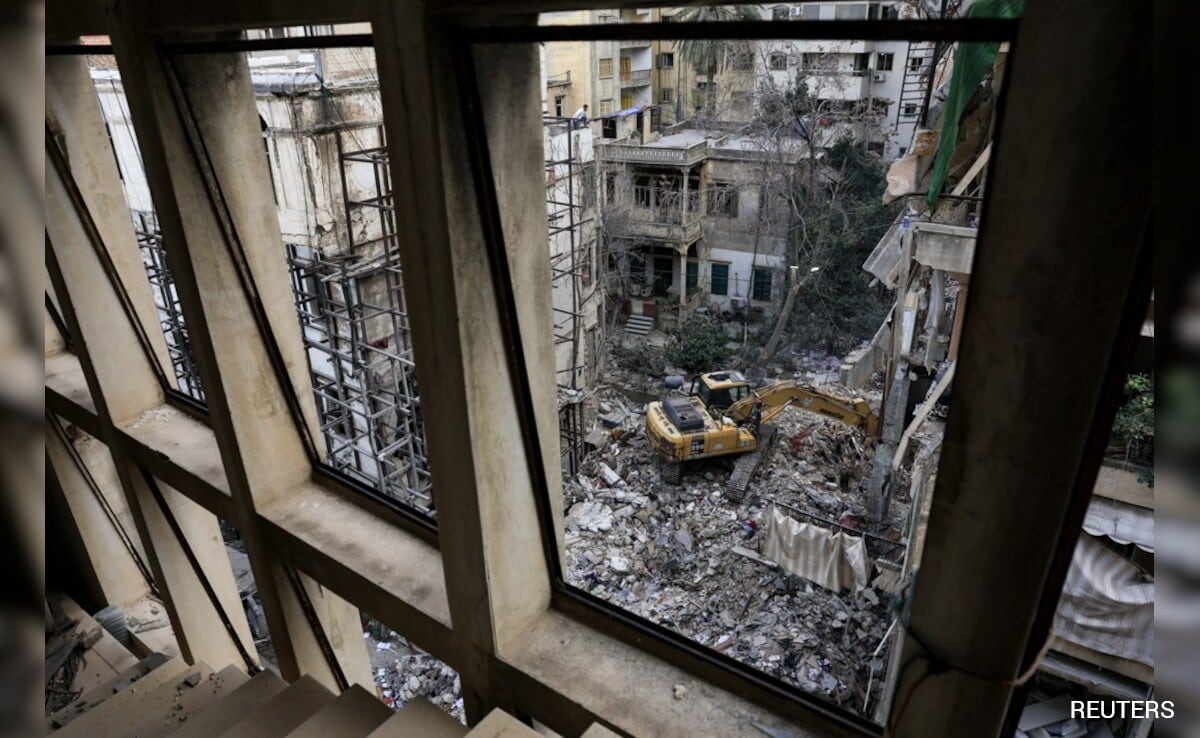
The Israeli Air Force just completed a 24-hour cycle of violence that saw more than 200 strikes across Lebanese territory. While official military briefings frame these sorties as a precise dismantling of Hezbollah’s infrastructure, the sheer volume of ordinance suggests a transition from targeted operations to a campaign of systemic exhaustion. This isn't just about hitting launchers. It is about a calculated effort to strip away the social and logistical fabric that allows a non-state actor to function as a conventional army.
When a modern air force drops bombs on 200 sites in a single day, they aren't looking for needles in haystacks anymore. They are burning the haystack. The Israeli Defense Forces (IDF) claim these targets included rocket launch sites, command centers, and weapon storage facilities. However, looking at the geographic spread—from the southern border villages to the Bekaa Valley—reveals a broader strategic intent. Israel is attempting to solve a decades-old security dilemma through a high-intensity aerial blitz, betting that the cost of endurance will eventually become too high for the Lebanese population and Hezbollah’s leadership to bear.
The Logistics of a High Intensity Blitz
Conducting 200 strikes in 24 hours requires a massive intelligence-to-execution pipeline. It is an industrial process. For every target hit, there are hours of drone surveillance, signals intelligence, and verification. When the tempo reaches this level, the margin for error shrinks. The IDF is utilizing a "target factory" model, where artificial intelligence assists human analysts in identifying anomalies in the terrain that suggest hidden bunkers or buried launch tubes.
This speed is a double-edged sword. On one hand, it prevents Hezbollah from moving assets between strikes. On the other, it creates an environment where the distinction between a civilian home and a military warehouse becomes dangerously thin. In many of these southern villages, Hezbollah’s tactical doctrine relies on "human shielding" not just as a defensive tactic, but as a logistical reality. Weapons are stored in kitchens. Launchers are kept in garages. When Israel says it hit a "weapon storage facility," it is often hitting a residential structure that has been repurposed.
The human cost is the inevitable byproduct of this doctrine. If the target is a missile hidden in a basement, the house above it is considered collateral. This is the grim arithmetic of urban warfare in 2026. Israel is gambling that the international community’s appetite for a ceasefire will remain lower than the IDF’s need to clear the border zone.
Hezbollah’s Strategy of Subterranean Survival
Despite the intensity of the bombardment, Hezbollah remains a functional fighting force. They have spent nearly twenty years preparing for this exact scenario. Their primary defense is not in the air, but under the earth.
The "Nature Reserves"—a network of deep, reinforced tunnels carved into the limestone hills of Southern Lebanon—are designed to withstand the very munitions Israel is currently using. These aren't just holes in the ground. They are self-contained ecosystems with ventilation, power generation, and enough food to last months. While 200 strikes sounds like a knockout blow, it often only scratches the surface of this underground architecture.
Hezbollah’s response has been a disciplined, if degraded, series of retaliatory launches. They are playing a long game of attrition. Their goal is not to defeat the Israeli Air Force—an impossible task—but to maintain a steady stream of fire into Northern Israel. By forcing hundreds of thousands of Israelis to remain in shelters or displaced from their homes, Hezbollah maintains leverage. They want to prove that no amount of aerial bombardment can truly secure the Galilee.
The Problem of Intelligence Decay
There is a concept in military science known as intelligence decay. The most valuable targets are often hit in the first 48 hours of a conflict. These are the "fixed" targets: known headquarters, long-range missile silos, and major communications hubs.
Once those are gone, the air force begins hitting "dynamic" targets. These are much harder to verify. As the war drags on, the quality of intelligence naturally fluctuates. When a military reports 200 strikes a day weeks into a campaign, it suggests they are moving further down the priority list, hitting smaller caches and lower-level operatives. The question for the Israeli cabinet is whether these lower-tier targets are worth the escalating diplomatic cost and the risk of widening the war into a regional conflagration involving Iran.
The Bekaa Valley and the Iranian Pipeline
To understand why the strikes have moved north into the Bekaa Valley, you have to look at the map of Syrian-Lebanese border crossings. The Bekaa is Hezbollah's logistical heartland. It is the primary transit point for hardware coming in from Tehran via Damascus.
By striking 200 targets, Israel is attempting to sever the "land bridge" that feeds Hezbollah’s arsenal. They are hitting trucking convoys, warehouses, and even small bridges that facilitate the movement of Iranian-made precision-guided munitions (PGMs). These PGMs are the real red line for Jerusalem. A standard Katyusha rocket is a nuisance; a GPS-guided missile that can hit the Ministry of Defense in Tel Aviv is an existential threat.
The intensity of the strikes in the Bekaa indicates that Israel believes Hezbollah is attempting to replenish its stocks mid-conflict. This leads to a cycle of perpetual bombardment. As long as the border with Syria remains porous, the IAF will feel compelled to keep the sortie rate high.
The Collapse of the Lebanese State
While the military focus remains on the combatants, the state of Lebanon is the silent casualty of these 200-strike days. The national infrastructure—roads, power grids, and telecommunications—is being shredded. The Lebanese Armed Forces (LAF), which are funded largely by Western interests, remain on the sidelines, powerless to intervene.
This vacuum is dangerous. When the dust eventually settles, the lack of a functional state makes it nearly impossible to enforce any diplomatic solution, such as UN Resolution 1701. If there is no one to police the border except a decimated Hezbollah and an exhausted IAF, the cycle of violence is guaranteed to reset.
Investors and analysts looking at the region's stability must realize that the "victory" Israel seeks is not a surrender document. It is a "period of quiet" bought with high explosives. But quiet is not peace. It is merely the interval between the current bombardment and the next mobilization.
Economic Aftershocks
The cost of this operation is staggering for both sides. For Israel, the cost of interceptor missiles for Iron Dome and David’s Sling, combined with the fuel and maintenance for F-15 and F-35 squadrons, runs into the billions. For Lebanon, the damage to the civilian economy is likely to take a decade to repair.
We are seeing a shift in how middle-east conflicts are managed. It is no longer about seizing territory; it is about "mowing the grass" with such violence that the opponent cannot regrow their capabilities for several years. The 200 strikes in 24 hours are a message to Tehran as much as they are a tactical necessity. Israel is signaling that it is willing to burn through its own high-end munitions to reset the regional balance of power.
The Limits of Air Power
History is littered with generals who believed air power alone could win a war. From the Blitz to Vietnam, the narrative is always the same: if we just drop enough bombs, the enemy will break. But Hezbollah is a grassroots organization with deep ideological roots. You cannot bomb an ideology into submission.
The 200 strikes might destroy the physical launchers, but they often harden the resolve of the survivors. Every strike that results in civilian casualties becomes a recruitment poster for the next generation of fighters. Israel knows this, but they feel they have no choice. The political pressure to return displaced citizens to the North outweighs the long-term strategic risks of radicalization.
The military reality is that a ground incursion remains the only way to physically clear the border area of short-range threats. The air strikes are the preamble. They are designed to "soften" the landscape, destroying the anti-tank positions and minefields that would make a ground move a bloody affair for the IDF.
The Strategic Dead End
What comes after the 200th strike? If the rockets continue to fall on Haifa and Safed, the air campaign has failed its primary objective. If Hezbollah continues to move fighters south through the tunnel network, the billions of dollars in ordinance spent over the last 24 hours will be seen as a tactical success but a strategic failure.
The international community is currently calling for a 21-day ceasefire, but the momentum of the IAF’s operations suggests Israel is not interested in a pause that allows Hezbollah to regroup. They are leaning into the escalation, betting that they can achieve a "decisive blow" before the pressure from Washington becomes untenable.
We are witnessing the death of the "low-intensity" conflict. The era of skirmishes is over. In its place is a total air war that treats an entire country as a battlefield. The 200 targets hit yesterday are just the beginning of a process that seeks to fundamentally alter the map of the Levant. Whether it brings security or just a deeper, more permanent state of war remains to be seen. The math of 200 strikes is simple; the politics of what follows is anything but.
The IAF's jets are currently refueling for the next wave. In the command centers of Tel Aviv and the bunkers of Beirut, the calculations are being refreshed. Both sides are trapped in a logic of escalation where the only way out is through more violence. The bombs will continue to fall because, in the absence of a political path, the only tool left is the hammer.