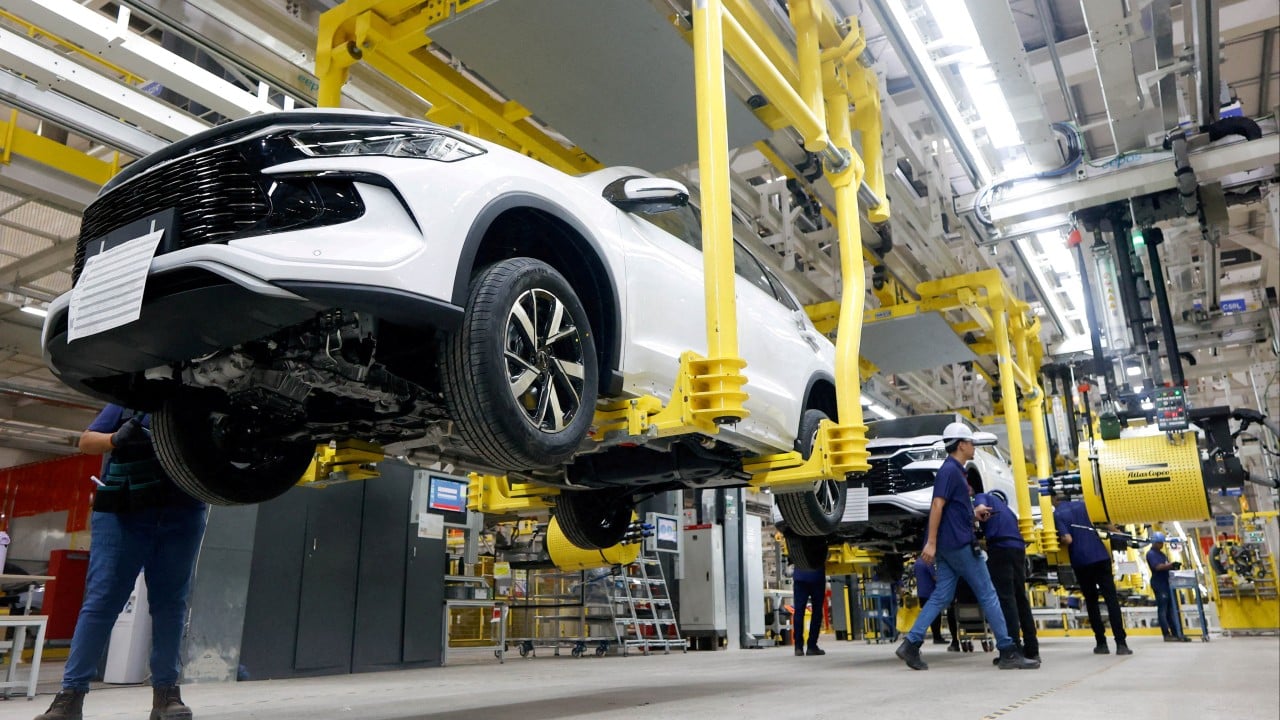
When BYD rolled its 100,000th electric vehicle off the assembly line at its Camaçari complex in Bahia, Brazil, executives in Shenzhen were not merely celebrating a factory landmark. They were demonstrating the complete irrelevance of Western protectionist tariffs.
While Brussels spends months calculating punitive duties and trade penalties on Chinese electric cars, BYD and its domestic rivals have quietly pivoted. Instead of pounding their heads against European regulatory walls, Chinese automotive manufacturers are constructing assembly networks across Latin America, Southeast Asia, and Eastern Europe. The strategy is clear: bypass high tariffs by manufacturing locally, capture vast emerging markets, and build supply chains that traditional automakers cannot match.
The Camaçari Playbook and the Flaw in Western Tariffs
The Camaçari plant, once a sprawling Ford facility that the American automaker abandoned during its South American restructuring, now stands as a symbol of global realignment. BYD acquired the site, retooled the assembly lines in just fifteen months, and hired over 5,000 local workers.
Western regulators believed that raising import levies would force Chinese EV makers to back down or raise prices to uncompetitive levels. That assumption failed to account for two factors: massive vertical integration and sheer industrial speed.
BYD controls its own battery manufacturing, semiconductor design, and mining supply chains. This structural cost advantage allows the company to absorb trade penalties that would paralyze European or American competitors. When Brazil moved to restore import tariffs on electric vehicles up to 35 percent, traditional legacy manufacturers—including Volkswagen, General Motors, Toyota, and Stellantis—lobbied fiercely to deny tariff relief for imported knock-down vehicle kits.
Yet BYD's response was swift. Rather than retreating, the company accelerated its transition toward 50 percent local component sourcing in Brazil by 2027. It also secured export contracts for 100,000 vehicles destined for Argentina and Mexico directly from its Brazilian operations.
┌─────────────────────────────────────────────────────────┐
│              CHINA'S EV EXPANSION MODEL                │
└─────────────────────────────────────────────────────────┘
                            │
       ┌────────────────────┴────────────────────┐
       ▼                                         ▼
[ Phase 1: Export CBU ]                  [ Phase 2: Local Assembly ]
Direct exports of finished units         CKD/SKD kits shipped to hubs
High tariff vulnerability                Lowers tariff exposure
       │                                         │
       └────────────────────┬────────────────────┘
                            ▼
                 [ Phase 3: Regional Hub ]
                 50%+ Localized Sourcing
                 Tariff-Free Regional Exports
This pivot converts Brazil from a mere consumer market into an export springboard for the entire Western Hemisphere, completely circumventing North American trade restrictions.
Why European Policy is Playing Yesterday's Game
In Europe, policymakers operate under the assumption that tariffs will buy domestic manufacturers time to catch up on battery chemistry and software integration. That logic is fundamentally flawed.
While European regulators debate trade duties ranging between 17 and 38 percent on imported Chinese battery electric vehicles, Chinese manufacturers are already building factories inside Europe. BYD's upcoming facility in Hungary and planned sites in Turkey will place production squarely within the European Union's customs union by late 2026.
Once these European facilities are fully operational, tariffs become completely meaningless.
Legacy European automakers face a severe structural disadvantage. Years of relying on premium margins from internal combustion engines left them unprepared for the rapid cost reductions achieved by Chinese competitors. In Germany and France, high energy costs, rigid labor structures, and fragmented software development have pushed vehicle production costs significantly higher than in Asian facilities.
Furthermore, European carmakers remain deeply dependent on the Chinese consumer market for their own profits. When Volkswagen or BMW faces retaliatory pressures in Shanghai, their global balance sheets suffer far more than Chinese brands suffer from European tariffs.
The Cost Gap Europe Cannot Policy Away
Consider the basic economics of battery electric vehicle manufacturing. Batteries account for roughly 35 to 40 percent of a modern EV's total cost. Chinese producers benefit from direct access to domestic lithium refining, cathode production, and automated cell assembly.
- Battery Cost Disparity: Chinese cell manufacturing costs hover near $60 to $70 per kilowatt-hour, compared to European operational averages exceeding $100 per kilowatt-hour.
- Time-to-Market: A standard vehicle platform development cycle takes Chinese automakers roughly 18 to 24 months, whereas European legacy platforms routinely require 48 months.
- Software Verticalization: Chinese manufacturers develop unified vehicle electronics in-house, eliminating supplier markup layers that plague traditional Western supply chains.
Tariffs do not fix these engineering and operational realities. They merely delay the inevitable adjustment while inflating prices for European consumers who are increasingly demanding affordable zero-emission mobility.
Emerging Markets as the Real Battleground
While Western media focuses heavily on trade friction between Washington, Brussels, and Beijing, the real decisive shift is happening across the Global South.
Automotive markets in Southeast Asia, South America, and the Middle East are expanding rapidly. In these regions, brand loyalty is less entrenched, and price sensitivity is extreme. By establishing manufacturing footprints in countries like Brazil and Thailand, Chinese automakers are locking out Western and Japanese competitors before those legacy brands can even deploy affordable electric models.
In Brazil, electric vehicle sales doubled year-over-year, driven almost entirely by accessible Chinese models like the Dolphin Mini. Legacy automakers who relied on flex-fuel internal combustion engines in South America now find themselves defending shrinking market shares against fully electric and plug-in hybrid alternatives that cost less to operate.
When legacy carmakers write formal letters to government authorities pleading for tariff protections—as four major Western manufacturers recently did in Brasília—it exposes a stark reality. They are attempting to use political lobbying to stall competitors who are winning on price, software capability, and production execution.
Protectionist trade barriers have never created long-term industrial competitiveness. They buy temporary breathing room, but that time is only valuable if domestic industries use it to fundamentally overhaul their cost structures. Right now, European and American automotive sectors are spending that bought time lobbying for more protection rather than matching the manufacturing efficiency of their global rivals.
BYD's rapid scale-up in South America demonstrates that China's automotive expansion cannot be contained by tariff walls. As production scales across regional manufacturing bases, the global auto industry is entering an era defined not by where a company was founded, but by who can build the most efficient supply chain.