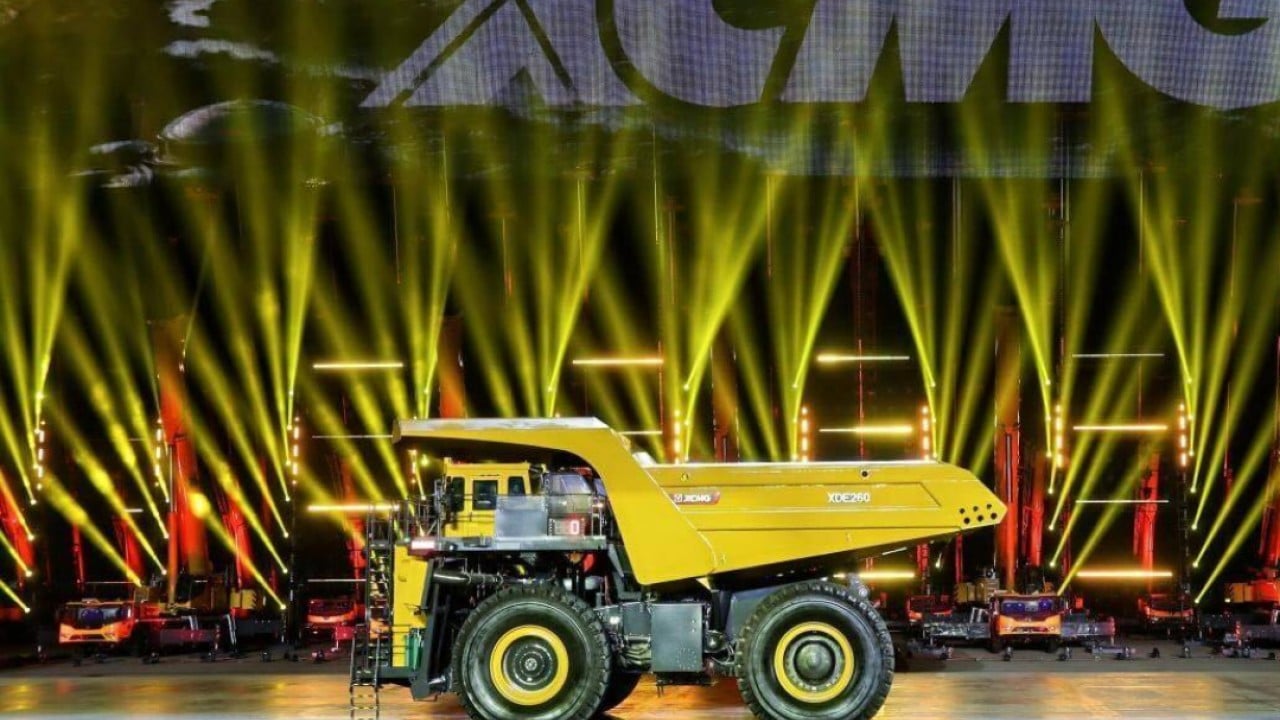
Xuzhou Construction Machinery Group (XCMG) is aggressively expanding outside China to counter a domestic property slump, using cheap capital and battery-electric heavy equipment to capture global market share. The state-owned enterprise recently climbed to the number three spot on the KHL Yellow Table, generating 100.8 billion yuan ($13.9 billion) in 2025 revenue. Nearly half of that revenue now comes from international markets. While the company positions its rapid expansion as an eco-friendly technological triumph, the strategy is actually a calculated survival mechanism forced by a domestic construction market that contracted by over 50 percent from its peak. Legacy giants Caterpillar and Komatsu face a competitor weaponizing China's unmatched battery supply chain to undercut Western equipment prices.
This aggressive push is hitting significant geopolitical and technical resistance. Western governments are responding with strict trade barriers, and international buyers remain highly skeptical of Chinese equipment durability. Transitioning from selling diesel excavators in Jiangsu to deploying autonomous mining trucks in Western Australia requires more than just low prices.
The Margin Cushion and the Tariff Wall
XCMG reported a 2025 gross margin of 22.61 percent, driven primarily by higher-margin overseas sales which grew 16.58 percent year-over-year. Selling premium equipment abroad helps offset the low-margin price wars that have hollowed out China's domestic market. For decades, Chinese heavy equipment manufacturers relied on high-volume, low-cost domestic infrastructure projects. When those projects dried up, overseas expansion became mandatory rather than optional.
The financial incentive to export is clear, but the geopolitical risks are rising rapidly. The European Union and the United States have increased anti-dumping duties and targeted tariffs on Chinese industrial imports. This protectionism alters the total cost of ownership calculations for foreign rental companies and contractors. Shipping a completed 50-ton excavator from Xuzhou to Rotterdam is no longer financially viable when hit with double-digit border taxes.
To bypass these trade walls, XCMG is decentralizing its production footprint. The company has expanded its manufacturing plant in Pouso Alegre, Brazil, built parts hubs in Dubai and Rotterdam, and established aerial work platform factories in Mexico where production is now 50 percent localized.
XCMG 2025 Revenue Breakdown by Product Category:
+------------------------+---------+
| Category               | Share   |
+------------------------+---------+
| Earthmoving Machinery  | 29.9%   |
| Hoisting Equipment     | 20.8%   |
| New-Energy / Electric  | 13.2%   |
| Mining Machinery       | 9.3%    |
| Other / Services       | 26.8%   |
+------------------------+---------+
By manufacturing within regional trade blocs, XCMG avoids direct tariffs while utilizing local labor and procurement. This localized strategy is costly, capital-intensive, and carries execution risks, but it is the only way to maintain a footprint in protected Western economies.
The Battery Monopoly on the Jobsite
XCMG's primary competitive advantage in the global energy transition is its direct access to China's dominant battery supply chain. The company established a battery manufacturing joint venture with EV giant BYD, giving it a secure supply of lithium iron phosphate cells at lower costs than Western competitors can match. In 2025, XCMG's new-energy revenue grew 23.6 percent to 13.3 billion yuan.
Electric heavy equipment is gaining traction because operating costs are lower than diesel alternatives. In predictable, high-utilization environments like quarries, ports, and mines, electric machines make financial sense. For instance, mid-sized electric wheel loaders running multi-shift operations see rapid payback periods by eliminating diesel fuel costs.
The underlying technology relies on a simple economic formula. A standard industrial battery pack degrades over time based on thermal cycles, as represented by:
$$SOH = f(\int I(t) dt, T)$$
Where $SOH$ represents the state of health, $I(t)$ is the operating current, and $T$ is the internal cell temperature. Maintaining optimal battery health during rapid megawatt-level charging requires advanced liquid cooling and thermal management systems.
While XCMG exports of electric machinery grew by 280 percent off a small baseline, new-energy equipment still represents only about 13 percent of total sales. The technology remains unviable for remote construction sites lacking high-voltage grid infrastructure. Battery weight also presents a major design challenge. A 20-ton electric excavator requires a massive battery pack just to match the eight-hour runtime of a standard diesel tank, which adds deadweight and reduces overall hydraulic efficiency.
Autonomy and the Aftermarket Trust Gap
At its recent International Customer Festival, XCMG showcased unmanned construction clusters featuring L4-level autonomous driving and remote control systems linked via its X-Link industrial IoT platform. These automated mining fleets are currently operating in several Chinese coal and iron ore mines. The company is trying to sell these autonomous systems to major global mining operations in Australia and South America, aiming to capture 15 percent of the global large-scale mining machinery market.
This software-heavy strategy faces steep opposition from entrenched incumbents. Giant mining corporations like Rio Tinto and BHP have built their operations around Komatsu and Caterpillar autonomous haulage ecosystems. Replacing these legacy operating systems with Chinese software platforms introducing data sovereignty and cybersecurity concerns is a tough sell for Western compliance officers.
A much larger hurdle is the aftermarket service network. High-end equipment buyers prioritize uptime above all else. A single broken hydraulic valve on a 400-ton mining excavator can cost an operator tens of thousands of dollars per hour in lost productivity. Caterpillar and Komatsu spent decades building ironclad global dealership networks that guarantee spare parts delivery within hours.
XCMG’s aftermarket and lifecycle services currently account for just 12 percent of its revenue mix. The company aims to increase this share to 18-20 percent in core export regions by 2027. Relying on third-party equipment dealers to stock specialized parts for complex electric drivetrains is highly risky. Western buyers frequently purchase cheaper Chinese excavators for secondary tasks, but they still rely on premium American or Japanese machinery for critical, high-uptime operations.
The Limit of Self-Funded Growth
XCMG Chairman Yang Dongsheng recently acknowledged that relying purely on organic internal development is no longer sufficient to hit the company's target of 60 percent overseas revenue by 2030. The manufacturer is actively building an international mergers and acquisitions team to target foreign firms specializing in digital hydraulics, autonomous driving software, and advanced electrification components.
This shift in strategy reveals an internal bottleneck. While XCMG excels at heavy steel fabrication and assembling battery packs at scale, it still lags behind in precision mechatronics and advanced software architecture. Buying international technology firms is the fastest way to bridge this expertise gap, but these cross-border acquisitions face intense scrutiny from foreign investment regulators wary of Chinese state-owned enterprises buying sensitive industrial software assets.
Western heavy equipment majors are not sitting still. They are deploying their own electric and hybrid machines while leveraging their dominant position in dealer support networks. XCMG's global expansion is not a guaranteed victory march. It is a capital-heavy gamble to outrun domestic stagnation before rising tariffs and infrastructure bottlenecks block its path abroad. Capitalize on low production costs today, because the windows of open access to Western markets are slamming shut.