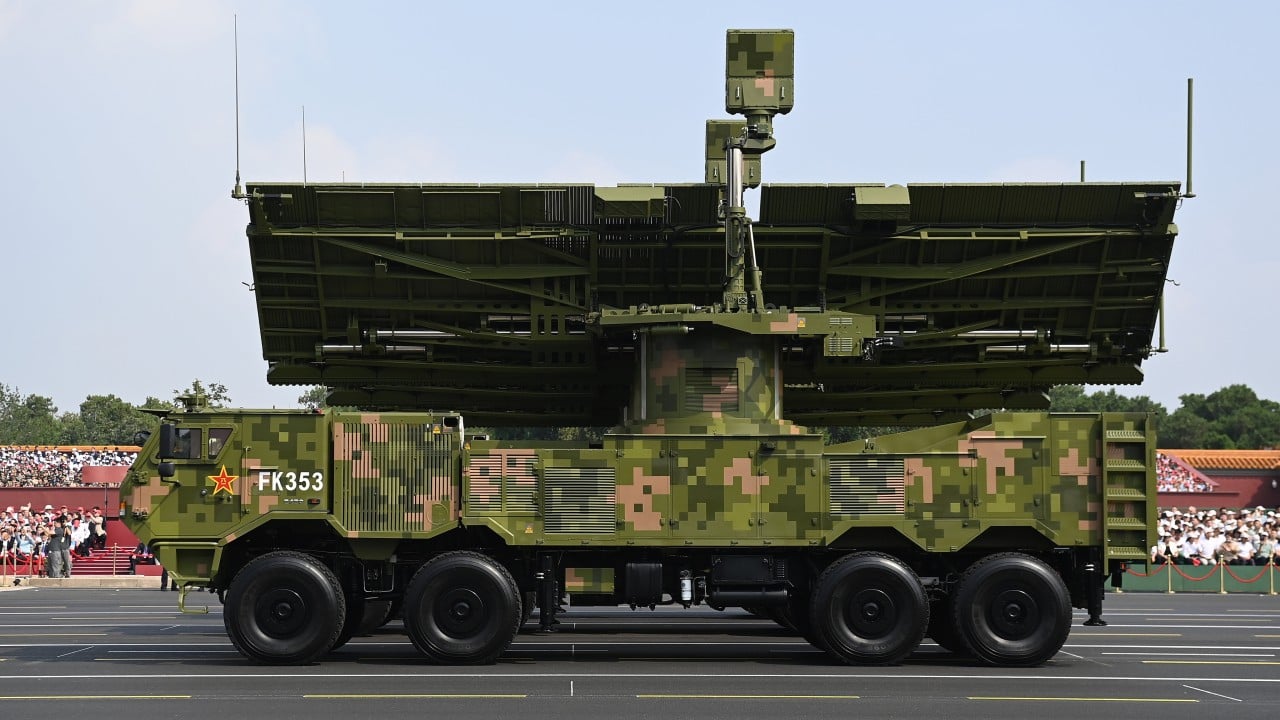
Beijing has raised the stakes in the electronic warfare race by publicizing a high-power microwave weapon system capable of hitting peak outputs near 100 gigawatts. This development signals a deliberate shift toward active denial and hardware-frying capabilities aimed directly at modern satellite networks and drone swarms. While the raw power figure sounds terrifying, the real story lies in the engineering breakthroughs and logistical bottlenecks that determine whether this weapon is a true strategic asset or a highly localized lab experiment.
The defense community has watched high-power microwave (HPM) technology for decades. Most efforts stalled because of power-supply limitations and atmospheric degradation. China claims its new system scales down the physical footprint of the required pulsed-power sources while dramatically increasing the energy output. If these metrics hold true under field conditions, the weapon can burn out the sensitive gallium arsenide or gallium nitride semi-conductors inside guided missiles, loitering munitions, and low-Earth-orbit satellites from kilometers away.
The Physics of a Counter Electronics Strike
To understand why 100 gigawatts matters, you have to look at how modern military hardware is built. Armored vehicles and warships carry heavy physical plating. Silicon chips do not.
When a high-power microwave burst hits a drone or a cruise missile, the energy creates an intense electromagnetic field. This field induces unexpected, massive electrical currents inside the target's internal wiring. The result is instantaneous. The delicate junctions inside computer chips overheat, melt, or fuse together.
Engineers split these electronic strikes into two categories.
- Soft Kills: The microwave energy temporarily blinds sensors, corrupts data streams, or forces a computer system to reboot. The drone crashes because its guidance system loses its orientation.
- Hard Kills: The energy physically destroys components. Capacitors explode, circuit boards catch fire, and the system is permanently fried.
Achieving a hard kill at distance requires immense peak power. That is where the 100-gigawatt metric comes into play. For a fraction of a microsecond, the system discharges an ocean of energy. It is the equivalent of focusing a lightning bolt into a steerable beam.
Moving From Laboratories to the Field
It is easy to generate a massive electromagnetic pulse inside a shielded bunker. Doing it on the back of a mobile military chassis is a nightmare.
The primary obstacle has always been the size of the power supply. Historically, a 100-gigawatt generator required a facility the size of a small power station. China's state-backed research institutes appear to have made progress in compressing these power architectures. They are using advanced energy storage systems, such as compact Marx generators and linear induction accelerators, which can dump stored electricity in nanosecond bursts.
Cooling is another massive hurdle. When you manipulate that much energy, thermal waste builds up instantly. A system that can only fire once every twenty minutes is useless against a coordinated swarm of sixty incoming kamikaze drones. Western intelligence analysts suggest that Chinese researchers are experimenting with novel cryogenic cooling loops and advanced superconducting materials to shorten the recharge cycle. If they reduce the cycle to seconds, the tactical balance changes completely.
The Atmospheric Boundary
The air itself fights against microwave weapons. When a high-energy microwave beam travels through the atmosphere, it can ionize the air molecules around it.
This ionization creates a plasma sheath. The plasma acts as a shield, absorbing or scattering the rest of the beam before it reaches the target. This phenomenon, known as atmospheric thermal blooming, places a hard physical ceiling on the effective range of ground-based HPM weapons.
To bypass this, Chinese engineers are likely tuning the frequency of the emissions. By operating within specific atmospheric "windows" where the air is more transparent to certain microwave bands, they can push the effective range further out. However, heavy rain, dense fog, or thick battlefield smoke will still degrade the performance of these systems significantly.
The Satellite Vulnerability Matrix
The most significant implication of a 100-gigawatt HPM system is not drone defense. It is the threat posed to low-Earth-orbit (LEO) satellite constellations.
Modern military logistics, reconnaissance, and communication rely heavily on commercial and state-owned satellite bands. These satellites are designed to be light. Because they operate in space, they lack the heavy electromagnetic shielding found on ground-based nuclear command vehicles.
A ground-based or ship-borne HPM system with sufficient power can project an energy beam upward, targeting these constellations as they pass overhead. It does not need to obliterate the satellite physically. By frying the sensitive receivers used to pick up weak signals from Earth, the weapon effectively renders the satellite a multi-million-dollar piece of space junk.
The Countermeasure Race
Military technology is an endless loop of measure and countermeasure. China’s public disclosure of this arsenal will inevitably accelerate global investments in electromagnetic hardening.
Building a microwave-resistant drone is possible, but it comes at a steep price. Faradic shielding, specialized conductive coatings, and optical data links instead of copper wires can protect internal systems from microwave bursts. However, these additions add weight and reduce payload capacity.
A drone wrapped in heavy shielding flies slower, carries fewer explosives, and costs three times as much to produce.
This economic reality plays directly into Beijing's hands. By forcing adversaries to harden their equipment, they drive up the cost and complexity of Western manufacturing, diluting the numerical advantage of cheap, expendable autonomous systems.
Geopolitical Posturing and Reality
We must look at the timing of these announcements through a cynical lens. Beijing rarely showcases its actual cutting-edge capabilities without a political motive.
By broadcasting a 100-gigawatt capability, China is signaling to its regional neighbors and global rivals that conventional drone swarms and precision-guided munitions may no longer guarantee tactical dominance in the Taiwan Strait or the South China Sea. It is a form of non-kinetic deterrence.
The true operational status of these weapons remains obscured by state secrecy. Field deployments will reveal the flaws that laboratory press releases hide. True combat readiness requires the weapon to survive the vibration of cross-country transport, the corrosive salt air of naval deployment, and the chaotic realities of electronic counter-jamming. Until a 100-gigawatt system proves it can maintain sustained fire rates in a tropical downpour, it remains a potent symbol rather than a guaranteed tactical veto.



