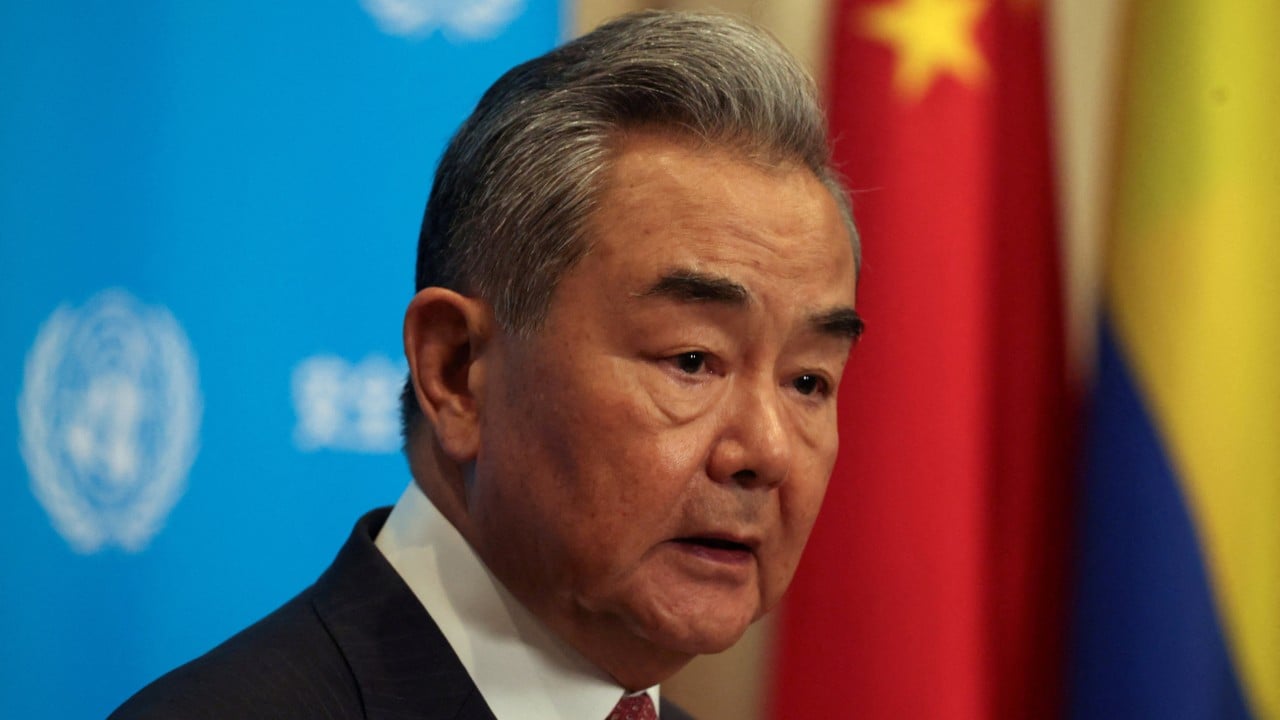
China expects immediate submission when it draws its diplomatic lines, but the recent phone call between Chinese Foreign Minister Wang Yi and US Secretary of State Marco Rubio shows a much messier reality. When Wang warned Rubio to handle Taiwan with the utmost caution, the subtext was not just about an island. It was about testing the mettle of a newly installed American foreign policy apparatus that Beijing still does not entirely trust or understand. The official readouts painted a picture of predictable diplomacy, but behind the scenes, this conversation represents a dangerous calibration period between two superpowers trying to avoid an outright collision while refusing to yield an inch of ground.
Public statements from state media focused heavily on warnings and abstract calls for strategic stability. This is standard theatre for the Chinese Communist Party. But look closer at the timing and the participants. The dialogue follows a high-stakes May summit in Beijing between Xi Jinping and Donald Trump, an event that was supposed to set the track for bilateral relations for the next three years. Instead of stabilization, we are seeing an immediate return to rhetorical skirmishing, with Beijing using its favorite point of leverage to see if the new State Department leadership will flinch under pressure.
The Direct Pressure on Washingtons New Diplomatic Team
Beijing does not make phone calls just to repeat talking points. The specific target of this warning is highly significant because Marco Rubio is not just any Secretary of State. For years, Rubio was the standard-bearer for congressional opposition to Chinese economic and political expansion, earning himself official sanctions from Beijing in the process. The fact that Wang Yi is now holding direct, constructive phone calls with a man his government officially banned tells you everything you need to know about Chinese pragmatism. When survival and core interests are on the line, ideological purges take a back seat to cold, hard statecraft.
Wang stated plainly that a single misstep on Taiwan could disrupt the entire global framework. It was a blunt reminder. China wants to establish a psychological advantage early in the administration's tenure. By characterizing the Taiwan issue as an explosive trigger that can detonate the entire bilateral relationship at any moment, Beijing attempts to induce a state of constant anxiety in American policymakers. The goal is to make Washington second-guess every weapon sale, every diplomatic visit, and every statement of support offered to Taipei.
This psychological warfare relies on the assumption that American leaders are inherently short-sighted and overly sensitive to short-term escalations. Wang urged the American side to move from empty rhetoric to concrete action. This is a classic inversion of reality. Beijing regularly uses these exchanges to demand unilateral concessions from the United States while offering absolutely nothing in return, framing their own aggressive military maneuvers around Taiwan as mere defensive reactions to American provocation.
Breaking Down the Strategic Stability Framework
The phrase strategic stability appeared repeatedly in the official Chinese summary of the discussion. This is a technical term borrowed from Cold War nuclear diplomacy, and its deployment here is entirely deliberate. When Beijing talks about stability, it does not mean a status quo where both sides agree to disagree while maintaining a balance of power. It means an environment where the United States quietly steps back from its security commitments in East Asia, allowing China to expand its sphere of influence without facing meaningful resistance or counter-alliances.
+--------------------------------------------------------------------------+
|                     Two Conflicting Definitions                          |
+--------------------------------------------------------------------------+
| Washington's View:                                                       |
| - Maintaining open lines of communication to prevent accidental conflict |
| - Upholding the Taiwan Relations Act via defensive arms sales            |
| - Preserving a free and open Indo-Pacific maritime corridor              |
+--------------------------------------------------------------------------+
| Beijing's View:                                                          |
| - Demanding the cessation of all US-Taiwan official interactions         |
| - Framing American regional alliances as hostile encirclement            |
| - Requiring Washington to accept Chinese hegemony over the Taiwan Strait |
+--------------------------------------------------------------------------+
True stability requires mutual concessions. Beijing refuses to offer them. While Wang Yi demands extra prudence from Washington, Chinese fighter jets continue to violate Taiwan’s air defense identification zone with rhythmic regularity, and naval vessels rehearse blockades of the island's primary ports. The message is clear: the United States must show restraint, while China reserves the absolute right to escalate whenever it sees fit.
This double standard is the structural flaw at the heart of the current diplomatic engagement. Washington views communication as a tool to manage active risks and prevent accidents. Beijing views communication as a reward for good behavior or a lever to extract political compliance. When the Chinese government warns that a slight move could affect the whole situation, they are attempting to build a cage around American foreign policy, restricting Washington’s options before a true crisis even materializes.
Why Chinas Red Line Moves with Every Diplomatic Contact
The red line concerning Taiwan is not a static boundary. It is an elastic concept that Beijing expands or contracts based on its assessment of American domestic political strength. During the May summit in Beijing, Xi Jinping told Donald Trump that mishandling Taiwan could put the relationship in an extremely dangerous place. That language was elevated during the call with Rubio, shifting from a hypothetical warning about the future to an urgent demand for immediate caution in the present tense.
This shifting baseline creates an environment where yesterday's routine interaction becomes today's intolerable provocation. For instance, ordinary transit operations by US Navy vessels through the international waters of the Taiwan Strait are now routinely characterized by Beijing as illegal incursions and deliberate violations of Chinese sovereignty. By constantly moving the goalposts, China forces western diplomats to expend immense energy simply trying to decipher what will trigger the next major military exercise around the island.
The danger of this approach is obvious. If everything is an unacceptable provocation, then nothing is. By crying wolf over every minor diplomatic engagement or defensive arms transfer, Beijing risks dulling the impact of its warnings. This leaves American planners in a difficult position, forced to guess whether Chinas latest rhetoric is merely standard diplomatic posturing or the genuine prelude to an economic blockade or military assault.
The Dangerous Illusion of Flexible Communication
The call concluded with an agreement to maintain communication through various flexible means. Do not mistake this for a breakthrough. Flexible communication is code for an unstructured, ad-hoc dialogue that can be terminated by Beijing the moment things do not go their way. History shows that whenever a real crisis occurs, such as the accidental collision of military aircraft or an unannounced missile test, Chinese officials routinely unplug the hotlines and leave American queries unanswered for hours or days.
This structural unreliability means that the positive and constructive atmosphere touted by state media is entirely superficial. It exists only as long as it serves Beijing's tactical needs to project an aura of responsibility to the rest of the world. The moment the United States takes a concrete step to defend its economic or strategic interests in Asia, the illusion of cooperative risk management vanishes, replaced instantly by threats of retaliation and economic boycotts.
The underlying mechanism driving this friction is an irreconcilable difference in objectives. The United States seeks to preserve an international order based on rules that have allowed East Asia to prosper for nearly a century. China seeks to revise that order to reflect its own return to great-power status, viewing Taiwan not as an isolated democratic entity, but as the final, unfulfilled piece of a domestic political narrative that cannot be compromised under any circumstances.
The Cost of American Miscalculation
If the State Department takes these warnings at face value, it risks falling into a trap of its own making. Appeasement disguised as prudence will only embolden the hardliners within the Central Military Commission in Beijing. They will interpret American hesitation as a sign of systemic decline and a lack of political will to defend allies in the Western Pacific.
The administration must realize that the best way to handle Taiwan with caution is to make the cost of Chinese aggression completely unpalatable. This means accelerating the delivery of asymmetric defense systems to Taipei, strengthening trilateral intelligence sharing with Japan and South Korea, and making it undeniably clear that an economic blockade of the Taiwan Strait would result in the immediate isolation of Chinas financial sector from the global banking system.
Confronting this reality requires moving past the polite fiction of diplomatic readouts. Wang Yi's warning to Marco Rubio was not an invitation to build a constructive relationship; it was a tactical demand for American retreat disguised in the language of strategic stability. Managing this relationship effectively over the next three years demands a clear-eyed recognition that Beijing respects strength and exploits caution, making a firm, unapologetic defense of the status quo the only viable path to preventing an catastrophic conflict in the Western Pacific.