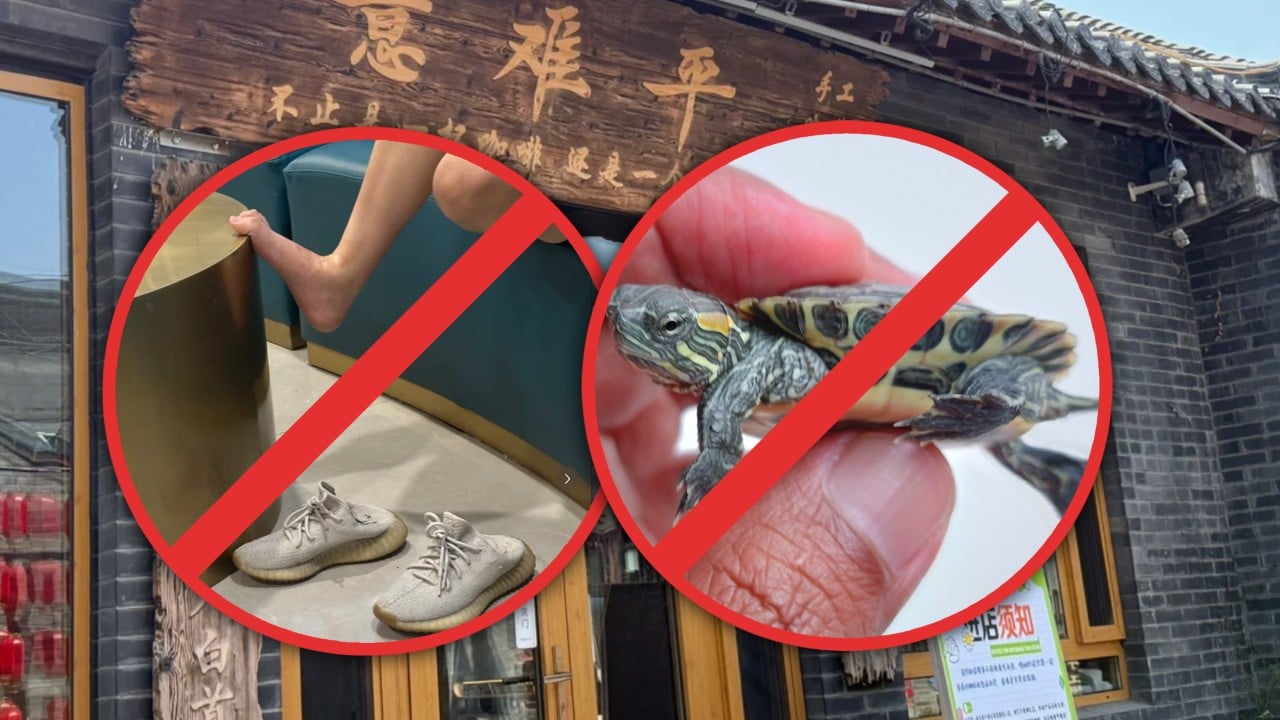
A small café in Guangdong, China, recently went viral for a set of "entry rules" that read more like a police blotter than a hospitality manifesto. The list of prohibitions included the usual suspects—littering and loud behavior—but veered sharply into the bizarre by specifically banning the abandonment of black stockings and the theft of "tiny turtles." While the internet laughed at the eccentricity of the sign, the reality behind these rules exposes a fracturing relationship between China's small business owners and a new generation of "check-in" tourists who value social media clout over basic human decency. This isn't just about weird rules. It is a desperate defense mechanism against a culture of performative consumption that is making small-scale entrepreneurship nearly impossible.
The Breaking Point of the Instagrammable Economy
The owner of the establishment, known as "The Wild Café," didn't wake up one morning with a vendetta against hosiery. The rules emerged from a series of escalating incidents that highlight the dark side of the "Wanghong" (internet celebrity) economy. In China, a café is rarely just a place to drink coffee. It is a set. It is a backdrop for elaborate photo shoots where customers often spend four hours and five dollars, occupying prime real estate while creating a mess that requires a professional cleaning crew to resolve. Building on this topic, you can find more in: The Armor We Choose When Words Run Out.
The ban on discarding black stockings, while seemingly fetishistic or random, stems from a specific trend of "cosplay" and "JK" (Japanese schoolgirl style) photography. Aspiring influencers frequently bring multiple outfits to a single location, changing in cramped bathrooms and, in several documented instances, leaving behind ripped or discarded garments in corners or under tables. For a business owner, this is not a quirky anecdote. It is a biohazard and a labor sink. When customers treat a private business like a public dressing room, the "hospitality" model collapses.
When Tiny Turtles Become Collateral Damage
The theft of turtles is perhaps the most heartbreaking entry on the list. Many traditional Chinese cafés incorporate "Feng Shui" elements or small indoor ponds to create a tranquil atmosphere. These ponds are often stocked with small Brazilian red-eared sliders or local turtles. The café owner reported a recurring problem where patrons would simply scoop these animals into their bags as "souvenirs" of their visit. Experts at Glamour have provided expertise on this trend.
This behavior points to a fundamental shift in the psyche of the modern consumer. There is a growing sense of entitlement where the price of a latte is viewed as a temporary deed to the entire property and everything within it. If it fits in a purse and looks good on camera, it is seen as fair game. By codifying these bans, the café is not trying to be "edgy." It is trying to stop the physical liquidation of its assets by people who view the world through a five-inch screen.
The Failure of Professional Civility
We often assume that social norms are self-regulating. In a high-trust society, you don't need a sign telling people not to steal a reptile. However, the sheer volume of domestic tourism in China, fueled by platforms like Xiaohongshu (the Chinese equivalent of Instagram), has created a "locust effect" on small businesses. A quiet, aesthetic spot gets "discovered," and within weeks, it is overrun by thousands of people who have no intention of becoming regulars. They are there for the "content," and once the photo is taken, the location has zero value to them.
This leads to a "tragedy of the commons" within the private sector. The owner provides a beautiful space; the "content creators" extract the aesthetic value and leave behind a husk of litter and missing pets. The café’s response—the sign—is a blunt instrument. It breaks the "fourth wall" of service. Usually, a business pretends that every customer is a guest. By posting these rules, the owner is admitting that they now view the customer as a potential vandal or thief.
The High Cost of Aesthetic Maintenance
Small business margins in China’s Tier 1 and Tier 2 cities are razor-thin. Rent is astronomical, and competition is fierce. To stand out, owners invest heavily in "atmosphere"—expensive lighting, curated plants, and delicate decor.
The Hidden Labor of the Wanghong Spot
- Cleaning Fees: Standard janitorial work doesn't cover the removal of discarded clothing or the cleaning of bathroom mirrors covered in hairspray and makeup.
- Security: Many owners now have to spend their time "patrolling" their own seating areas to ensure people aren't standing on chairs or moving furniture for "the perfect angle."
- Asset Replacement: From "tiny turtles" to designer spoons, the shrinkage rate in aesthetic-focused cafés is significantly higher than in traditional diners.
When you add these costs up, a customer who stays for three hours and buys one Americano is actually a net loss for the business. The "entry rules" are a way of saying: "If you are going to be a low-value, high-impact customer, please go somewhere else."
The Counter Argument and the Risk of Alienation
There is, of course, the risk that such aggressive signage backfires. Some critics on Weibo have argued that the rules are "insulting" and "discriminatory." They claim that by focusing on "black stockings," the owner is unfairly targeting a specific subculture. There is a grain of truth here. When a business starts profiling its customers based on their attire or their likelihood to steal a turtle, it loses the "welcoming" vibe that makes a café successful in the first place.
However, this critique ignores the exhaustion of the entrepreneur. The owner isn't a social scientist; they are someone trying to pay rent while people are literally walking out the door with the decorations. The "insult" is a secondary concern to the survival of the business.
A Symptom of a Larger Cultural Friction
The Guangdong café is a microcosm of a global tension between physical spaces and digital personas. We see this in the Louvre, where crowds jostle to take a selfie with the Mona Lisa without ever actually looking at the painting. We see it in "no-photo" policies in high-end Tokyo restaurants.
The difference in China is the speed and scale. The transition from "quiet neighborhood spot" to "viral sensation" happens overnight. Small businesses are not equipped for the sudden influx of people who view their life’s work as a disposable movie set. The "rules" are an attempt to re-establish the boundaries of the physical world. They are a reminder that a café is a place of business, not a public park, and certainly not a prop closet.
The Economic Necessity of the "Rude" Sign
In the past, a "customer is king" philosophy was the gold standard. But that philosophy assumes a reciprocal relationship where the "king" pays a fair price and respects the "kingdom." When the customer base shifts to people who are essentially "mining" the location for social media engagement, the old rules of hospitality no longer apply.
Owners are finding that they have to "filter" their clientele. Some do this by raising prices to prohibitive levels. Others do it by implementing "minimum spends." This Guangdong café chose a more direct, albeit abrasive, path: public shaming via the rule board. It is an attempt to scare off the "clout-chasers" and appeal to a more traditional, respectful customer.
The Future of the Third Space
If this trend of performative consumption continues, the "Third Space"—the place between home and work where people gather—will undergo a radical transformation. We may see the end of the "open" aesthetic café. Instead, we could move toward a "studio model" where customers pay an hourly fee just to exist in the space, regardless of whether they buy a coffee.
The era of the "unrestricted" beautiful space is dying because a small percentage of the population cannot be trusted not to steal the turtles. It is a harsh lesson in human behavior and a warning to anyone who thinks that "going viral" is the ultimate goal for a small business. For this café owner, fame didn't bring fortune; it brought a pile of discarded stockings and an empty turtle pond.
Stop treating every storefront as a background for your digital life. The person behind the counter isn't a director; they are a person trying to keep a dream alive against the tide of a thousand disrespectful "check-ins." Respect the space, or eventually, there won't be any spaces left to respect.