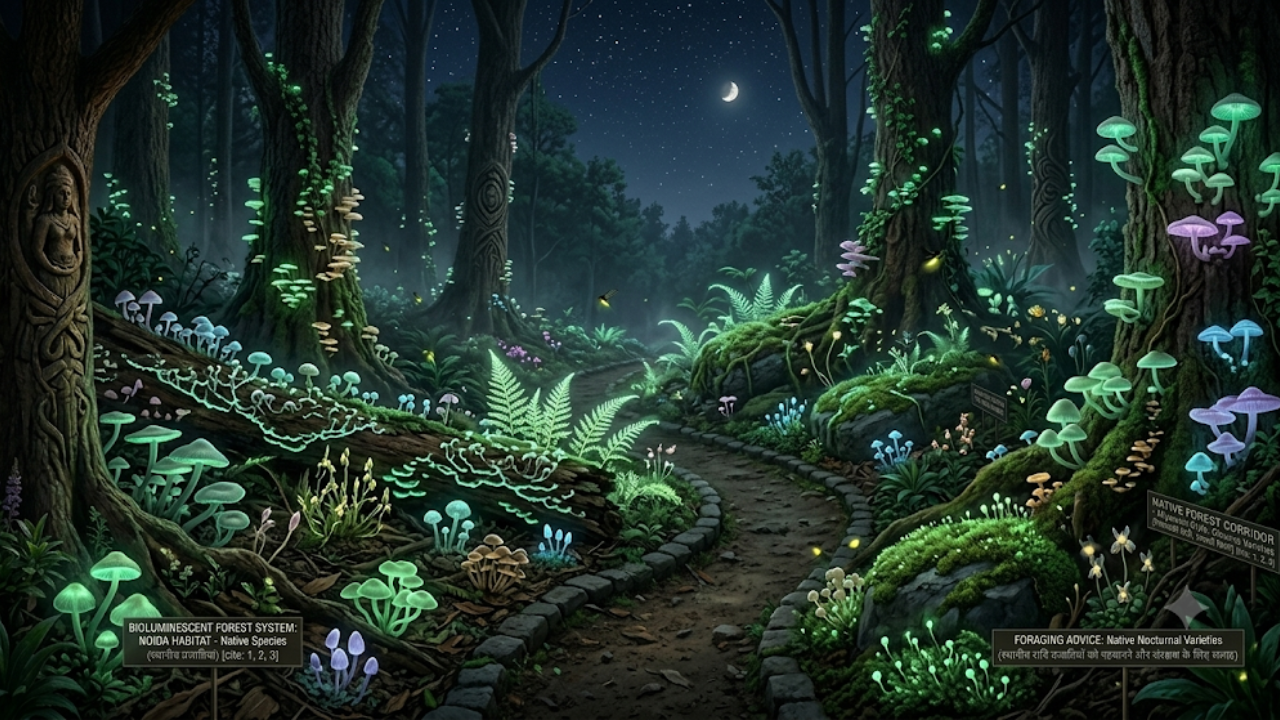
The promise of replacing streetlights with self-illuminating greenery is a captivating vision of urban sustainability. Scientists have successfully engineered plants that glow continuously by modifying their genetics to express bioluminescent pathways. But beneath the optimistic headlines lies a stark biological reality. These engineered plants produce a faint, ethereal glow that is vastly insufficient for public safety, and scaling their light output introduces severe evolutionary penalties. The dream of bioluminescent infrastructure is hitting a wall made of basic metabolic limits.
The Chemistry of the Cold Light
To understand why this technology faces such a steep uphill battle, we have to look at how these plants actually produce light. The recent breakthroughs rely on inserting the bioluminescent cycle of certain mushrooms into the genetic code of tobacco, petunias, or other common flora.
This process centers on an organic molecule called luciferin, which undergoes an oxidation reaction catalyzed by an enzyme called luciferase. In the mushroom-derived system, the plant converts an organic compound it already produces naturally—caffeic acid—into luciferin. This means the plant can glow continuously without requiring the external application of expensive chemical triggers. It is a closed-loop system inside the plant's own cellular machinery.
The visual result is undeniable. In a pitch-black room, you can see a soft, greenish-blue light emanating from the leaves and petals. It is a remarkable achievement of synthetic biology. However, a major disconnect occurs when translating this laboratory success into an infrastructure solution.
The Energy Crisis Inside the Leaf
Plants are not factories with infinite resources. They operate on a strict energy budget determined by photosynthesis. Every photon of light a plant emits requires a specific amount of adenosine triphosphate (ATP), the fundamental energy currency of all living cells.
Here is the problem. When a plant diverts its metabolic resources toward generating light, it is stealing those resources away from its own growth, defense mechanisms, and reproduction.
Imagine a hypothetical scenario where an engineer tries to boost a plant's light output to match a standard 15-watt LED bulb. To achieve this, the plant would need to consume its entire daily intake of sugars just to fuel the luminescence reaction. It would essentially starve itself to death in a matter of days.
Because of this metabolic tax, existing glowing plants are incredibly dim. Their light output is measured in micro-candela, a unit so small that you need night-adjusted vision just to read a few words of text held directly against a leaf. They are decorative novelties, not functional replacements for municipal infrastructure.
The Overlooked Urban Challenges
Even if synthetic biologists find a way to break through these metabolic limits, placing these organisms into actual city environments introduces a host of logistical nightmares that urban planners completely ignore.
- Light Pollution and Ecocide: Cities require light that shines down onto sidewalks and roads. Plants emit light in all directions, creating a dome of ambient illumination. Pervasive, unregulatable green light throughout the night disrupts the circadian rhythms of local wildlife, particularly nocturnal insects and migrating birds.
- Seasonal Failure: Streetlights must work in January just as well as they do in July. Deciduous trees shed their leaves in the winter, which would completely eliminate a city's light source precisely when the nights are longest. Even evergreen varieties slow down their metabolism drastically in freezing temperatures, causing their glow to fade when it is needed most.
- Vandals and Pathogens: Physical infrastructure is easily repaired or replaced. A living, glowing hedge along a city street is highly vulnerable to graffiti, physical trampling, and plant diseases. A single outbreak of a blight could plunge an entire neighborhood into total darkness.
The True Path Forward
If the goal is truly to reduce the carbon footprint of our cities, we need to stop looking for magical solutions in synthetic forests and look at the engineering options already available to us.
We do not need living trees to replace streetlamps when we can integrate highly efficient solar-powered LEDs into existing hardscapes. Modern solid-state lighting requires a fraction of the energy used decades ago, and smart grids can dim these lights when streets are empty, saving massive amounts of power without risking a biological collapse.
Synthetic biology holds incredible potential for pharmaceuticals, agriculture, and material science. Forcing it to solve an urban lighting problem that has already been solved by electrical engineering is a misallocation of scientific talent. The glowing plant remains a beautiful, fascinating proof of concept, but the physical laws of energy conservation guarantee it will stay confined to the greenhouse.