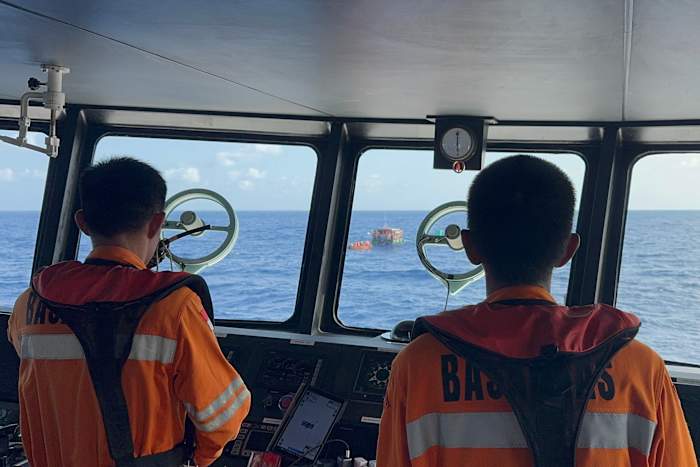
Twenty-seven people are currently missing at sea, adrift on a makeshift raft in the volatile waters of the Indonesian archipelago. While initial reports frame this as a tragic maritime accident, the reality is far more systemic. This is not a localized search and rescue mission. It is a symptom of a crumbling regional safety infrastructure and a desperate migration surge that the world is choosing to ignore.
The search, centered near the Makassar Strait, involves a combination of naval assets and local fishing vessels. However, time is the enemy. In these waters, dehydration and sun exposure can turn a survival situation into a recovery operation within forty-eight hours. The primary challenge isn't just the vastness of the ocean; it is the lack of real-time tracking on the "invisible" fleet of wooden vessels that ferry thousands across these straits every month.
The Failure of the Archipelago Safety Net
Indonesia is the world’s largest archipelagic state. It relies on water the way other nations rely on asphalt. Yet, the regulatory oversight of small-scale transport remains trapped in the nineteenth century. Most of the vessels involved in these disappearances are unregistered, overcrowded, and lack even basic GPS or radio equipment.
We see the same pattern repeating. A vessel departs under the cover of darkness to avoid port authorities or because there are no authorities present at the departure point. When the engine fails—which it often does due to poor maintenance and "black market" fuel—the passengers are left at the mercy of the currents. The Indonesian National Search and Rescue Agency (Basarnas) is frequently forced to start searches based on vague reports from family members rather than distress signals.
This creates a massive gap in response time. By the time a formal search begins, the target has drifted miles from its last known position. In the current case of the twenty-seven missing, the search area expands exponentially every hour.
The Human Cost of Economic Desperation
Why would twenty-seven people board a raft that offers no protection from the elements? The answer lies in the shifting economic reality of the region. This isn't always about refugees fleeing war. Often, it is about labor migration—thousands of people moving between islands or toward neighboring countries in search of work in the palm oil or construction industries.
The Rise of Unofficial Transits
Official ferry routes are often too expensive or too infrequent for those living on the edge of poverty. This has birthed a lucrative, dangerous industry of unofficial transits.
- Overloading: It is common practice to double the passenger capacity to maximize profit per trip.
- Minimal Gear: Life jackets are viewed as an unnecessary expense that takes up space for more passengers.
- Engine Fragility: Many boats use modified automotive engines that are not designed for the corrosive effects of salt water.
When we talk about "27 people on a raft," we are talking about a failure of the formal transport economy. These individuals are forced into the shadows, where safety is a luxury they cannot afford.
A Geography Designed for Disappearance
The Indonesian maritime environment is uniquely hostile to rescue efforts. The intersection of the Indian and Pacific Oceans creates complex current patterns that can pull a disabled craft in three different directions in a single day.
The Makassar Strait Trap
The current search area is notorious for its "internal waves" and unpredictable swells. For a raft with a low profile, visibility from a rescue plane is nearly zero. Searchers are effectively looking for a needle in a haystack while the haystack is moving and changing shape.
Basarnas frequently lacks the high-end thermal imaging necessary to spot heat signatures against the warm tropical water. They rely on the naked eye and binoculars. It is a grueling, low-tech process that fails more often than it succeeds. If the twenty-seven are found, it will likely be because a passing merchant vessel spotted them by chance, not because of a calculated search grid.
The Myth of Modern Maritime Security
There is a persistent belief that the ocean is "watched." Between satellites and AIS (Automatic Identification System) tracking, we assume every vessel is a blip on a screen somewhere. This is a dangerous fallacy.
Small wooden boats do not show up on commercial radar. They do not carry AIS transponders. In the eyes of the global maritime monitoring system, they do not exist. When one sinks or drifts away, it leaves no digital footprint. This "ghost fleet" operates in a total data vacuum.
The Cost of Inaction
Improving safety in these waters requires more than just more rescue boats. It requires a fundamental shift in how the Indonesian government manages its maritime borders.
- Subsidized Safety: Providing low-cost, solar-powered emergency beacons to small-scale operators.
- Community Spotters: Utilizing the thousands of local fishing boats as a formal "first responder" network, incentivized by government fuel credits.
- Strict Pier Enforcement: Moving beyond the major ports to regulate the small jetties where these dangerous journeys begin.
The Reality of the Search
As the sun sets on another day of the operation, the window of viability closes. Survival on an open raft in the tropics is a brutal endurance test. Without fresh water, the human body begins to shut down within three days. The psychological toll of watching the horizon for ships that never appear is equally devastating.
The rescuers are brave, and their commitment is undeniable. But they are fighting a fire with a squirt gun. Until the structural issues of maritime transport in Indonesia are addressed, the Makassar Strait will continue to swallow the desperate. We are not just looking for twenty-seven people; we are looking at the wreckage of a broken system.
Demand that maritime authorities move beyond reactive searching and toward proactive vessel tracking. Every hour spent debating the cost of safety equipment is an hour stolen from those drifting in the dark.