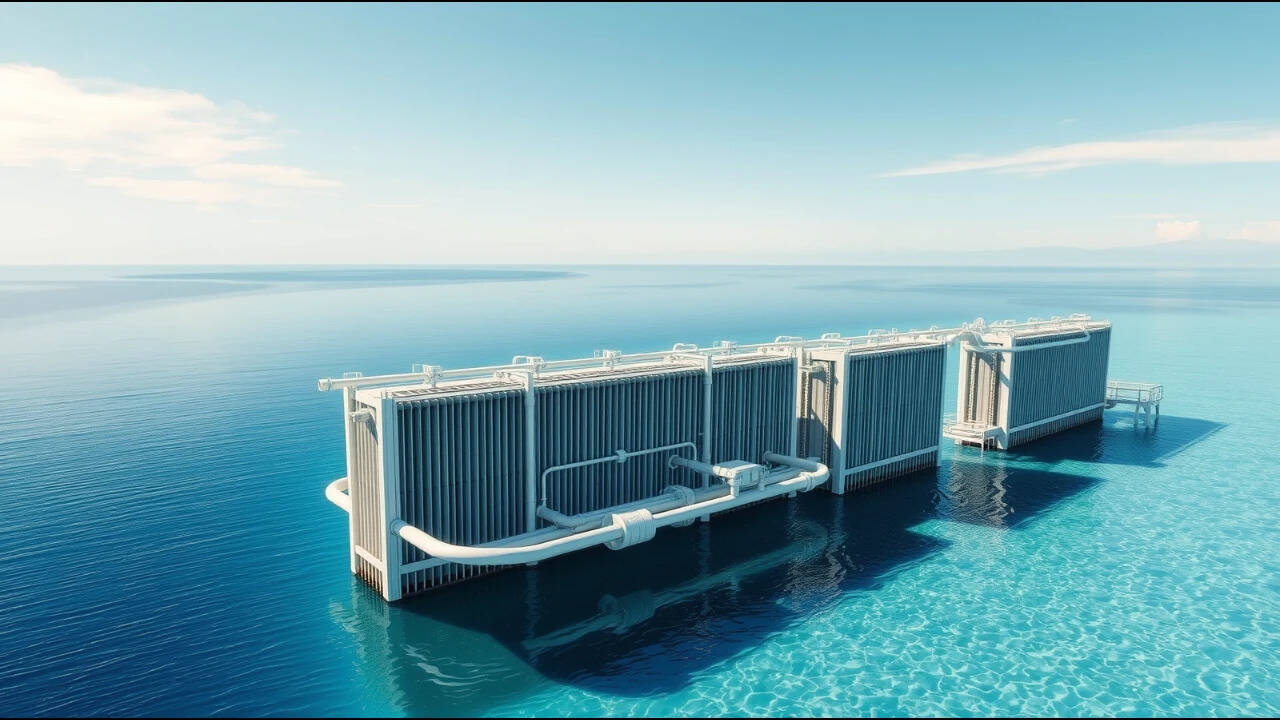
Energy generation by mixing salt water and fresh water is the ultimate scientific tease. The physics are undeniable. When you introduce a concentrated saline solution to a freshwater source across a semi-permeable membrane, entropy demands a reaction. Water molecules migrate toward the salt. Pressure builds. That raw, invisible hydraulic gradient represents an estimated global energy potential of nearly two terawatts. It is clean, it is relentless, and it runs whether the sun shines or the wind blows.
It is also an engineering nightmare that has quietly broken companies for decades.
Anyone tracking alternative energy read the headlines about the world's first salinity gradient power facilities with unbridled optimism. Pilot projects in Norway and the Netherlands proved the concept. Ions moved. Turbines spun. Electricity flowed from the marriage of river mouths and the sea. But moving from a controlled laboratory prototype to a commercial asset exposed an ugly operational reality. The membrane material costs too much, fouls too quickly, and degrades under real-world estuarine conditions faster than accountants can write off the depreciation.
Understanding why these plants struggle requires looking past the glossy corporate press releases and examining the physics of the membrane interface.
The Chemistry of Stagnation
To comprehend the failure modes of osmotic power, you must look closely at pressure-retarded osmosis, known universally in the field as PRO.
In a standard PRO setup, fresh water and sea water are separated by a specialized membrane. Because the osmotic pressure of seawater is roughly twenty-seven bar—equivalent to a column of water two hundred and seventy meters high—the fresh water naturally wants to cross the barrier to dilute the salt. If you pressurize the seawater side to, say, fifteen bar, you block some of the natural flow, but you allow a net volume of fresh water to cross into the pressurized chamber. That excess volume creates a high-pressure flow that can be routed through a hydro turbine.
Simple, elegant, and entirely merciless on materials.
The primary culprit behind stalled commercialization is concentration polarization. As fresh water floods across the membrane, it dilutes the salt concentration immediately adjacent to the surface on the saltwater side. Simultaneously, salts accumulate on the freshwater side due to minor membrane leakage. This localized equalization destroys the osmotic driving force. The theoretical twenty-seven bar drops to a fraction of its potential value, and power output plummets.
Engineers tried to combat this by thinning the membrane support layers and increasing fluid velocity. Thinner supports increase hydrodynamic resistance in other ways, creating internal pressure drops that devour the net energy gains. It is an endless game of thermodynamic whack-a-mole. Every time you fix one variable, another efficiency metric collapses.
The Fouling Factor
If chemistry does not kill the project, biology will.
Estuaries are not pristine swimming pools. They are chaotic, murky soup bowls packed with organic matter, humic acids, bacteria, algae, and suspended silt. When you pull millions of liters of river water and seawater through a filtration module featuring micro-channels and microscopic membrane pores, you have built an industrial filter that acts like a biological sponge.
Within weeks of operation, bio-fouling takes over. Microorganisms lay down sticky extracellular polymeric substances. Silt particles wedge themselves into the membrane matrix. Salt crystals precipitate out of solution in stagnant boundary layers. The membrane surface becomes coated in a resilient slime layer that chokes off water permeability entirely.
Cleaning these systems requires aggressive chemical flushes using acids, bases, and biocides. These harsh washes degrade the delicate polymer structure of the membranes, shortening their operational lifespan from years to months. When replacement costs represent the single largest operational expenditure of the facility, a high replacement frequency destroys the financial model.
Energy generation cannot survive a business case where the core asset consumes itself to produce a few megawatts of power.
The Economics of Scale Versus Location
Geographical realities present another immense hurdle. You cannot build a salinity gradient plant just anywhere the river meets the sea.
You need massive real estate right at the coastal interface, where land values are notoriously high and environmental regulations are fiercely protective. Estuaries are delicate nurseries for marine life, fish migration routes, and complex ecosystems. Pumping billions of liters of brackish water introduces thermal, saline, and biological disruptions that local environmental agencies scrutinize heavily.
Furthermore, the logistical footprint is staggering. To generate a meaningful amount of baseload electricity—say, one hundred megawatts—you need thousands of square meters of membrane modules, colossal intake and outfall piping infrastructure, pre-treatment filtration arrays, and high-pressure energy recovery devices.
Compare this to utility-scale solar or wind. Solar farms require open land and basic mounting hardware. Wind turbines require foundations and grid ties. Neither requires managing the continuous fouling of delicate, multi-million-dollar polymer films operating under intense hydraulic pressure. The capital expenditure required to build a utility-scale osmotic plant makes traditional nuclear projects look nimble by comparison.
The Path Forward Through Niche Application
Despite these structural hurdles, writing off salinity gradient energy entirely is a mistake. The technology is simply trapped in the wrong deployment paradigm.
Instead of chasing gigawatt-scale grid dominance, innovative firms are pivoting toward decentralized, symbiotic industrial integration. Consider large-scale desalination plants. A reverse osmosis facility takes in seawater and spits out clean water, leaving behind a concentrated brine byproduct that is typically pumped back into the ocean, disrupting local marine salinity.
By pairing a desalination plant with an osmotic power unit, you solve two problems simultaneously. The high-salinity brine from the desalination process provides a much stronger osmotic gradient when mixed with local fresh water or treated wastewater than standard seawater ever could. The pressure generated by the mixing process can then be fed back into the desalination plant’s high-pressure pumps, cutting total energy consumption for fresh water production by double-digit percentages.
This is not about powering cities with river mouths. It is about closing the loop on industrial water treatment.
The Brutal Reality Check
The world's first power plant utilizing this technology proved that physics works. It did not prove that the market cares about physics when the balance sheet bleeds red.
Until material science produces a breakthrough membrane that costs pennies, repels biological fouling automatically, and maintains structural integrity under sustained pressure for a decade, osmotic power will remain an expensive academic curiosity.
The resource is infinite. The mathematics are sound. But until the engineering catches up with the ambition, the river will keep flowing past the empty generating stations, wasting power that we know how to harvest, but cannot afford to keep.