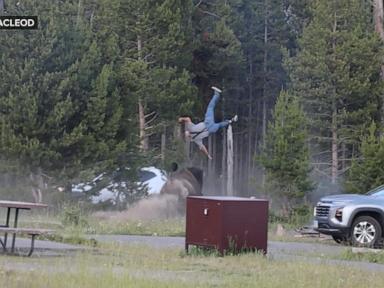
Carl Isom-McDaniel did everything by the book when he and his grandson encountered a bull bison on July 10, 2026, at Yellowstone’s Bridge Bay Campground. They maintained a respectful distance, monitored the animal's behavior, and moved behind a stand of trees when the beast grew restless. Yet, moments later, the 2,000-pound animal charged, hooked the 65-year-old Washington resident with its left horn, and flung him eight feet into the air. This incident, captured in terrifying detail by an onlooker, represents the second major bison-on-human encounter in the park this year. It exposes a harsh reality that wildlife officials rarely voice publicly. Following the rules is no longer a guarantee of safety.
Historically, mainstream coverage of park incidents follows a predictable narrative of tourist stupidity. We laugh at "tourons" getting too close for selfies. This time, the narrative collapsed. Eyewitnesses, including professional photographer Mike MacLeod, confirmed that the grandfather and grandson behaved responsibly. They did not crowd the animal. They ran when it charged. They sought cover.
The animal simply did not care.
The Bridge Bay Assault
The encounter occurred around 8:30 p.m. near the shores of Yellowstone Lake. The bull bison, already highly agitated, had been roaming through the campground, kicking up dust and charging at campers. It even lunged at a passing pickup truck, which managed to accelerate out of harm's way.
Then, the animal turned its attention toward the trees where Isom-McDaniel and his grandson were hiding.
The young boy managed to outrun the beast. His grandfather was not as fortunate. The massive animal pursued the older man around a cluster of pine trees before closing the gap. With a swift flick of its massive neck, the bull drove its horn into the man's hip and launched him skyward.
He flipped completely upside down before crashing hard onto his side.
MacLeod, a former military photographer, stopped filming to run toward the beast. He and several nearby campers screamed, waved their arms, and made themselves look as large as possible. The distraction worked. The bull backed off, allowing emergency medical services to retrieve the victim. Isom-McDaniel survived the ordeal but suffered multiple broken bones and significant internal trauma.
Anatomy of a Rutting Bull
To understand why this attack happened, one must understand the biological calendar of Bison bison. Mid-summer marks the beginning of the rut. This is the annual mating season where male bison compete fiercely for dominance and breeding rights.
During the rut, which runs from late June through September, bull bison are essentially walking chemical reactions. Their bodies are flooded with testosterone. They lose their typical lethargic demeanor, becoming highly territorial, unpredictable, and prone to violent outbursts. They wallow in the dirt to scent-mark territory, bellow constantly, and view any moving object as a rival or an active threat.
The pickup truck that drove past the bull just before the attack likely triggered its defense mechanisms. The vehicle's motion and noise pushed an already-stressed animal over the edge. By the time Isom-McDaniel and his grandson attempted to retreat, the bison was in full fight-or-flight mode. It did not distinguish between a retreating grandfather and a rival bull.
Why the Safety Guidelines are Failing
The National Park Service officially mandates that visitors maintain a distance of at least 25 yards from bison. This rule is designed for average encounters. It assumes the animal is calm and grazing.
During the peak of summer tourism, these numbers break down. Yellowstone hosts millions of visitors annually, squeezing massive crowds into the same tight corridors used by wildlife. Campgrounds like Bridge Bay are built directly on historical bison migration routes. When a hormonal, 2,000-pound wild animal decides to walk through a crowded campsite, maintaining a 25-yard buffer becomes physically impossible.
The safety instructions tell visitors to "back away slowly." If an animal charges, people are told to seek cover. Isom-McDaniel followed this logic, putting trees between himself and the charging bull. In reality, a mature bison can run up to 35 miles per hour. They can pivot on their hind legs with the agility of a cutting horse. A human trying to outmaneuver a bison in a small grove of trees is playing a game of physics they are mathematically guaranteed to lose.
The Hard Realities of Coexistence
This event highlights the systemic pressure on our national parks. We want wild spaces, but we also demand manicured campgrounds, paved roads, and close-up views. When these two desires collide, the wild animals pay the price through habituation, and humans pay in broken bones.
Park rangers cannot police every animal or every visitor. The responsibility ultimately falls on the public to recognize when the baseline rules are no longer sufficient. If you see a bull bison during the summer months, 25 yards is not a safe distance. It is a hazard zone.
If an animal is wallowing, vocalizing, or pacing, the only safe option is to retreat entirely. Do not wait to see if it calms down. Do not pause to take a quick video. Move indoors or enter a hard-sided vehicle immediately. Nature does not grade on a curve, and a testosterone-fueled bull will not ask to see your compliance record before it charges.