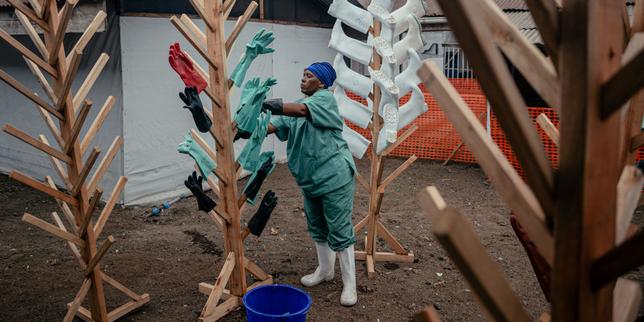
The global health establishment loves a narrative of tragic incompetence. When an Ebola outbreak tears through the eastern Democratic Republic of Congo, the Western press and Geneva-based technocrats immediately trot out the same tired script: the response is "laborious," the local infrastructure is failing, and if we just poured more money into top-down coordination, the virus would vanish.
This diagnosis is completely wrong.
The sluggishness of the Ebola response in the DRC is not a bug; it is a feature of how international aid is structured. We are told that a centralized, heavily militarized medical intervention is the only way to contain a Level 4 biohazard. But decades of field data prove that the heavy-handed, top-down approach of the World Health Organization (WHO) and its massive NGO entourage actually drives the resistance that keeps these outbreaks alive.
We do not have a deployment problem. We have a trust problem engineered by the very organizations claiming to fix it.
The Illusion of the Centralized Command
When an outbreak hits North Kivu or Ituri, the immediate reaction of international agencies is to establish a massive "riposte"—a centralized command structure that treats a complex social ecosystem like a conventional battlefield.
This strategy assumes that public health is a top-down logistical exercise. It ignores the reality that eastern DRC has been a conflict zone for a quarter of a century. When white SUVs roll into a village filled with workers in positive-pressure biohazard suits, backed by government soldiers, the local population does not see salvation. They see another invading army.
I have spent years watching institutions torch millions of dollars trying to force compliance from communities they do not understand. During the 2018–2020 Kivu outbreak—the second-largest in history—attacks on Ebola treatment centers did not happen because villagers were "ignorant" or "superstitious." They happened because the international community weaponized the medical response.
Consider the mechanics of isolation. When a centralized response team forcibly removes a suspected Ebola patient from their family, they break a fundamental social contract. In a region where the state has done nothing but exploit the population for decades, sudden, intense state interest in a specific disease breeds immediate, logical suspicion.
Why is there suddenly infinite funding to isolate an Ebola patient, but zero funding for the malaria, measles, or cholera killing their children next door?
The Economics of the Epidemic Industry
Let us look at the financial mechanics that the standard news coverage refuses to touch. An Ebola outbreak is a massive economic engine.
When the WHO declares a Public Health Emergency of International Concern (PHEIC), it opens a financial floodgate. Millions of dollars pour into regional hubs like Goma and Beni. But where does that capital actually land?
- Hazard Pay Distortions: Local healthcare workers are paid a pittance by the DRC ministry of health. Suddenly, international NGOs arrive offering massive daily stipends for Ebola response work. This creates an immediate economic incentive to keep the outbreak going, or at least to misclassify standard hemorrhagic fevers as Ebola to maintain funding.
- The Rental Economy: The sudden influx of foreign experts drives up the cost of real estate, vehicle rentals, and basic goods in the conflict zone. The local elite thrives on the logistics of the response, while the average citizen faces inflation.
- Resource Siphoning: Routine vaccination campaigns for polio and measles are routinely suspended because every capable local nurse is poached by the Ebola response teams. More children died of measles during the 2019 Ebola outbreak in the DRC than died of Ebola itself.
This is the hidden trade-off of the centralized model. By hyper-focusing on a single headline-grabbing pathogen to satisfy Western donors, the international apparatus hollows out the remaining shards of the local healthcare system.
Dismantling the "People Also Ask" Mythos
If you look at public queries surrounding African health crises, the premise of the questions is fundamentally broken.
"Why is it so hard to deploy vaccines in the DRC?"
The premise here is that geography and infrastructure are the primary barriers. They are not. Merck’s Ervebo vaccine and Janssen’s two-dose regimen are technological marvels, but a vaccine is entirely useless if people refuse to take it.
The barrier is political. When the government uses the threat of Ebola to cancel elections in opposition strongholds—as happened in Beni and Butembo in 2018—the vaccine ceases to be a medical tool. It becomes a political instrument. You cannot separate the syringe from the state that wields it.
"Can the WHO handle these outbreaks alone?"
The honest answer is that the WHO shouldn't be handling them at all. The agency is a diplomatic body, not an operational strike force. Its structures are designed to interface with sovereign ministries of health, not to navigate the shifting alliances of dozens of armed groups in a dense equatorial forest.
When the WHO tries to run ground logistics in an active conflict zone, it inevitably relies on local political actors who use the aid distribution to reward allies and starve enemies.
The Decentralized Alternative: Flipping the Model
To actually stop a viral outbreak in a high-conflict zone, you must completely dismantle the centralized command structure. You must stop trying to build a fortress around the virus and instead distribute the tools of containment to the people living on the front lines.
CENTRALIZED MODEL (Failure)
[WHO/NGO Command] -> [Government Military Protection] -> [Forced Isolation Centers] -> [Community Resistance]

DECENTRALIZED MODEL (Success)
[Local Clinics + Traditional Leaders] -> [Rapid Home-Based Diagnostics] -> [Community-Led Triage] -> [Containment]
This is not theoretical. Look at the data from the late stages of the 2014–2016 West Africa outbreak and the smaller, localized outbreaks in Ecuador and Equateur province. When control, diagnostics, and burial protocols were handed entirely to village elders and local youth groups, transmission rates collapsed within weeks.
Shift to Home-Based and Localized Triage
Instead of transporting patients miles away to a massive, terrifying plastic tent complex run by strangers, the response must fund and equip existing community health posts (aires de santé). If a patient must be isolated, it should happen in a facility where their family can see them, cook for them, and participate in their care through clear protective barriers.
Demilitarize the Medicine
The use of state security forces to escort medical teams must stop completely. If a medical team cannot enter a neighborhood without armed guards, they have already lost the epidemiological battle. The presence of soldiers guarantees that contact tracing data will be falsified by a population terrified of state surveillance.
Total Transparency in Funding
If an international NGO enters a territory, their budget sheets, salaries, and local procurement contracts should be pinned to the door of the local town hall. The population must see that the resources are not being hoarded by expats living in air-conditioned compounds in Goma.
The Cost of Autonomy
Admitting that the decentralized, community-led approach is superior comes with an uncomfortable truth that international agencies refuse to face: it means relinquishing control.
If you empower local committees to manage the response, they will prioritize their immediate needs over the geopolitical fears of the West. They might demand that money first be spent on clean drinking water, maternity wards, or protection from armed militias before they track down every single contact of an Ebola patient.
The Western aid apparatus cannot tolerate that deviation. They require predictable, measurable metrics to justify their budgets to parliaments and boardrooms. A line item for "community goodwill" cannot be audited by a European accounting firm.
So instead, we stick to the broken play-book. We send more trucks, more international experts, and more soldiers. We write articles lamenting the "laborious setup" of the response, blaming the terrain and the victims, while ignoring the fact that the architecture of the intervention itself is what keeps the virus alive.
Stop trying to fix the international response machinery. Fire the consultants, park the white SUVs, and hand the diagnostic kits and the payroll directly to the local nurses who were there before the cameras arrived and will remain long after they leave.